Spider Bite Symptoms: Which Ones Need a Doctor

You found a mark on your arm this morning. Two small punctures, maybe, or just a red bump that itches. Nobody saw a spider. Now you are on your phone at the kitchen table trying to work out whether this is nothing or whether you should be in a car.
Here is the part almost no article tells you up front. You are probably not going to identify the spider, and you do not need to. What decides whether you need a doctor is not which species bit you. It is what the wound does over the next 48 hours, and whether your body starts complaining somewhere other than the bite.
What Most Spider Bite Symptoms Actually Look Like
Start with the baseline, because odds are strong this is what you have.
A typical spider bite leaves a small bump, sometimes a blister, sometimes a pair of tiny fang marks where the skin broke. Around it you get mild swelling, some redness or discoloration depending on your skin tone, and itching or a dull ache. It is annoying. It is not an emergency. Cleveland Clinic notes there are at least 60 different spider species in America and only a few pose any danger to people. Most spiders have fangs too small to even break human skin.
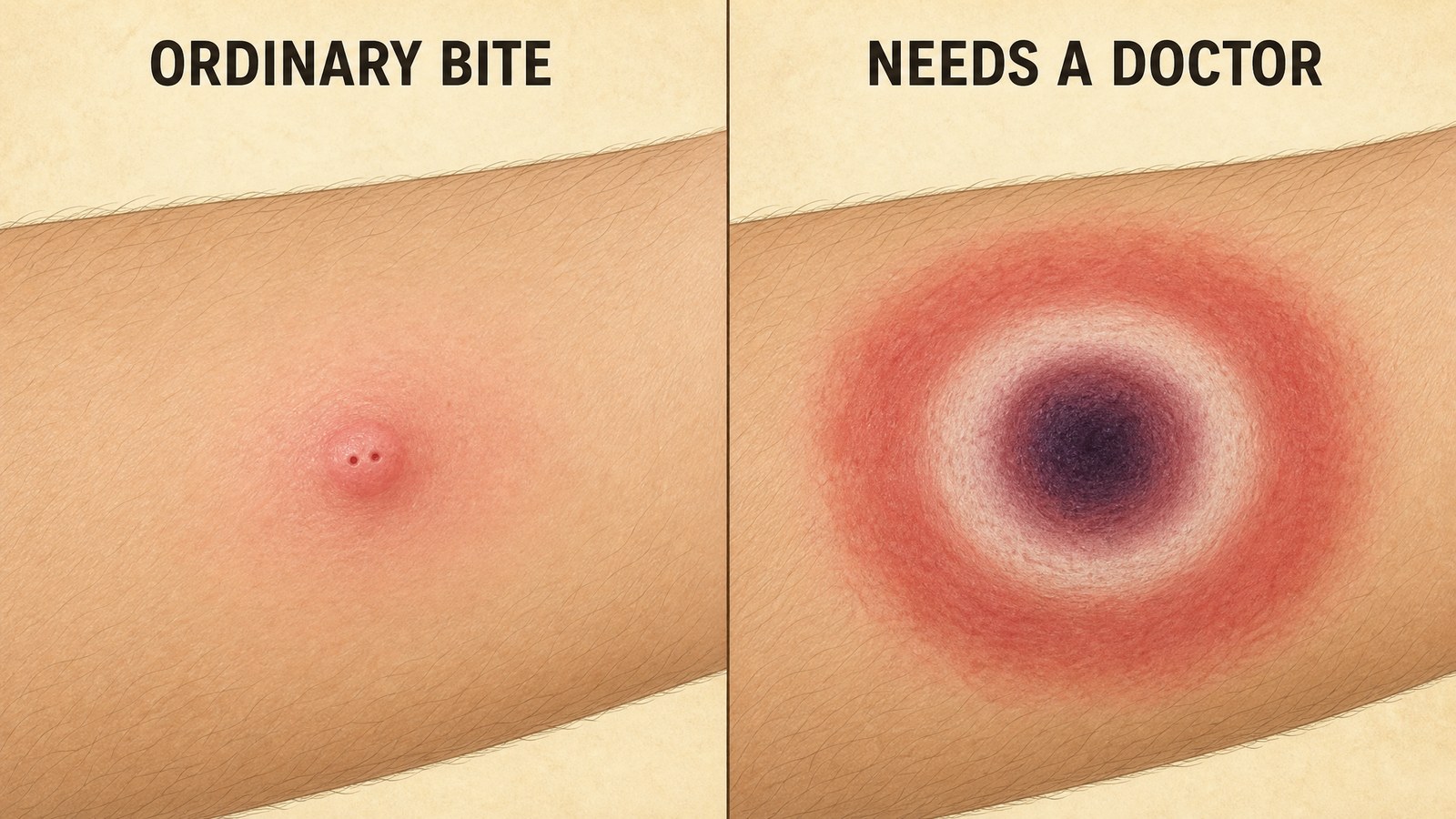
The word that matters here is stays. A harmless bite stays roughly the size it started at. It gets a little puffy for a day or two, then quietly gets better. Nothing else in your body joins in.
What you do about it is unglamorous and it works. Wash the area with soap and warm water. Put a cold pack or a cold wet cloth against it to bring the swelling down. Prop the limb up if the bite is on an arm or a leg. Then leave it alone. Do not try to suck or cut the venom out. Cleveland Clinic says that plainly, and it is worth repeating, because the folk cures do more damage than the bite.
Black Widow Spider Bite Symptoms Show Up Away From the Bite
Black widow spider bite symptoms break the pattern in a way that is hard to miss once you know what to listen for.
The bite itself often announces itself immediately: a sharp, pinprick pain, and then the area goes numb. You may be able to see two fang marks. But the reason a widow bite is a hospital problem has nothing to do with the skin. The venom acts on the nervous system, which is why Johns Hopkins Medicine calls emergency care the expected response rather than an optional one.
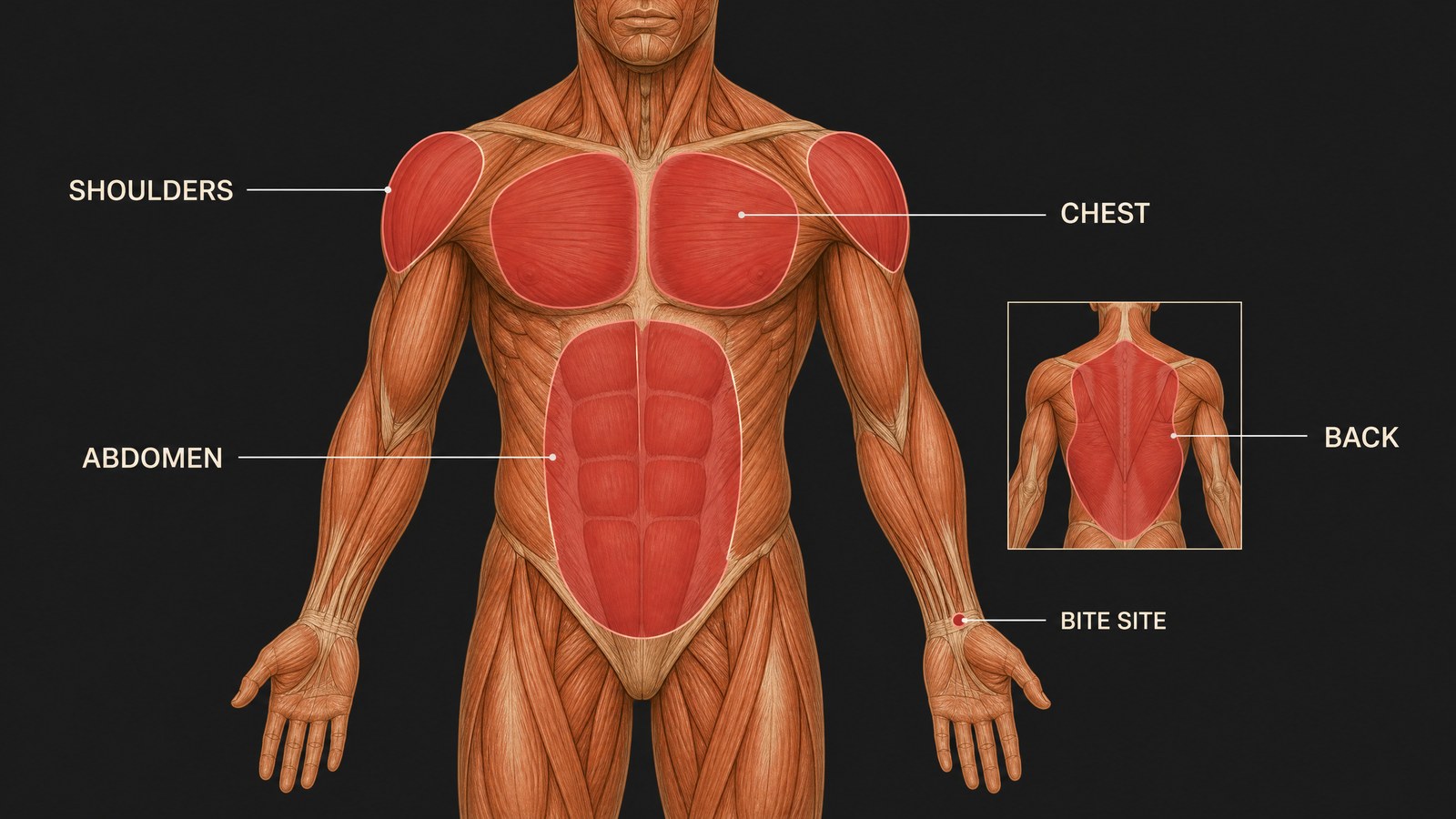
What people actually feel is cramping and muscle rigidity that shows up somewhere else entirely. Stomach. Chest. Shoulders. Back. Your abdomen can go hard and board-like, which is why widow bites get mistaken for appendicitis or a gallbladder attack in emergency rooms. Alongside it you might get heavy sweating, a bad headache, nausea, swollen or droopy eyelids, tearing eyes, a racing pulse, and in the worse cases weakness or tremors in the legs. Trouble breathing is a 911 call, full stop.
The tell is simple. If your body is in trouble in places the spider never touched, that is systemic, and systemic does not wait until morning.
Brown Recluse Spider Bite Symptoms and the 48-Hour Wound
Brown recluse spider bite symptoms are the opposite problem. They are quiet at the start, which is exactly what makes people wait too long.
You usually feel nothing when it happens. Cleveland Clinic describes the site turning sensitive and red about three to eight hours later, often with a burning feeling. Then the color changes. Johns Hopkins describes the classic look as a deep blue or purple area around the bite, ringed by a whitish band, ringed again by a large red outer ring. People call it a bullseye. If it progresses, a blister forms over the center, and it can rupture into an open sore that darkens.
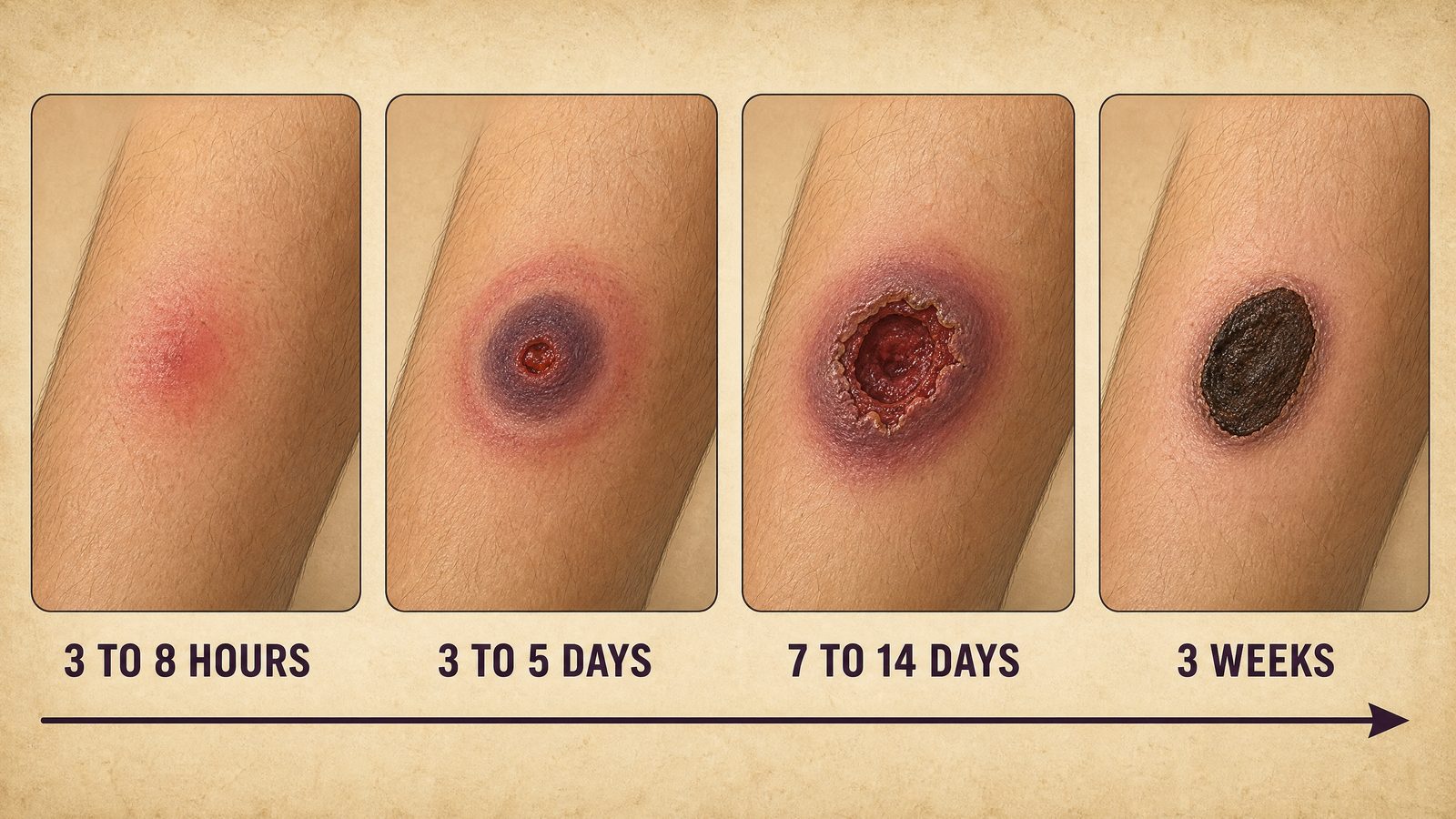
Here is the rough arc, per Cleveland Clinic. In the first hours, redness and burning. By day three to five, either the discomfort fades because very little venom went in, or it keeps going and an ulcer forms. Between day seven and 14, a severe bite can break down the skin around the ulcer into a wound that takes months to close. Most bites are healed by around three weeks, often under a thick dark scab.
Recluse venom mostly does its damage locally, but it can make you feel sick too: fever, chills, body aches, nausea, a rash somewhere other than the bite. Any of that turns a wound you were watching into a wound you get looked at.
Why the Spider Matters Less Than the Wound
This is the part worth pinning up somewhere.
There is no test for a spider bite. Cleveland Clinic is direct about it: short of seeing the spider bite you, there is no lab work that confirms one or identifies the species. A provider may swab fluid from a blister, but that is to check for a skin infection like MRSA, not to prove a spider was involved.
So stop hunting the spider. Track the wound instead, and track four things:
Size. Is the red area the same as yesterday, or is it reaching outward? A margin that keeps advancing is the single most useful bad sign you can watch for.
Center. Is the middle staying pink, or turning blue, purple, gray or black? A darkening center is what pushes a bite toward a recluse or an ulcer.
Pain trend. Bites hurt most in the first day and then ease. Pain that climbs on day two and three is going the wrong direction.
Local or body-wide. Fever, chills, cramping, vomiting, breathing trouble. None of that is a skin problem, and it changes the answer immediately.
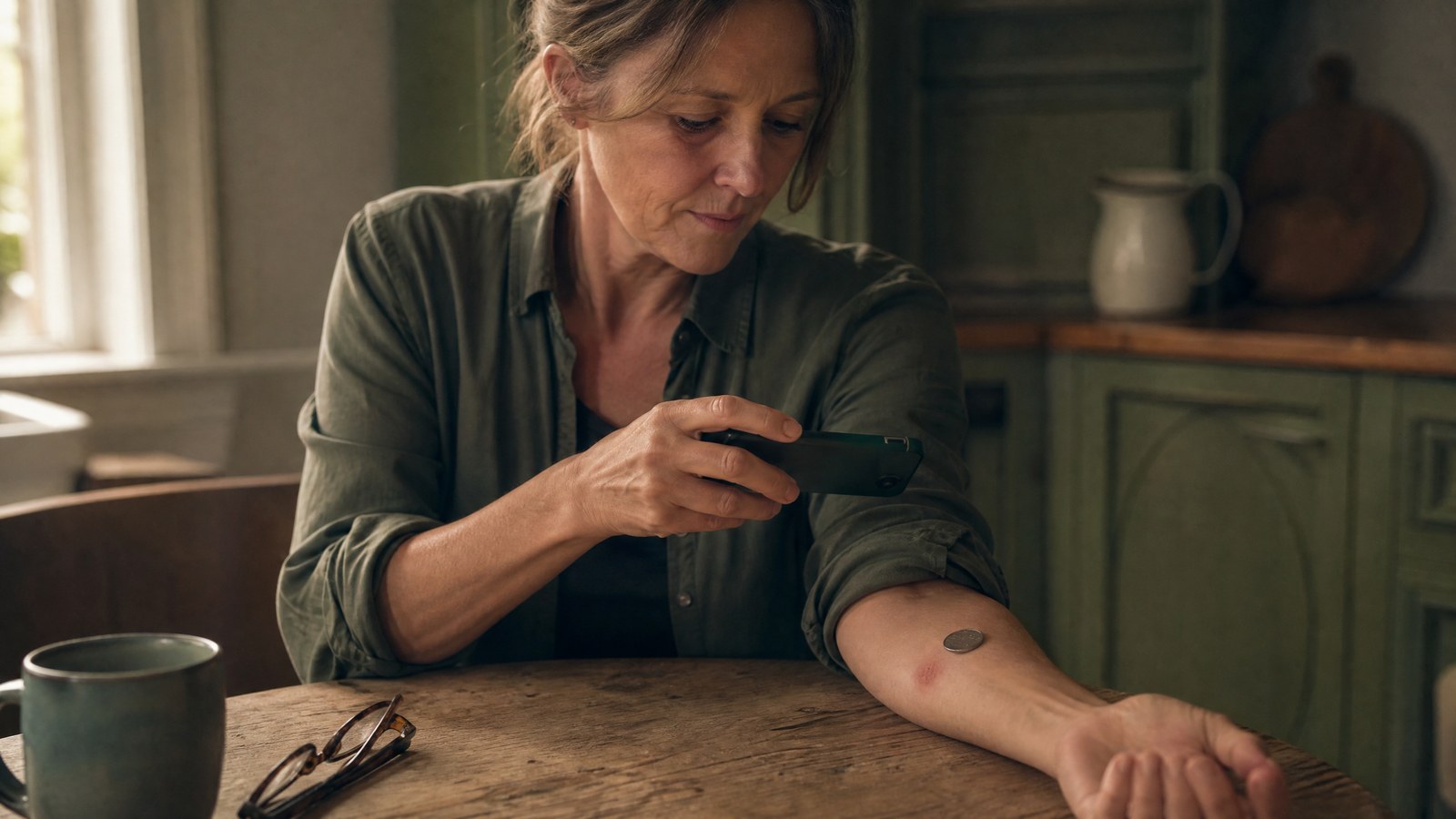
Take a photo with something for scale next to it, a coin or a pen cap, once in the morning and once at night. Memory is a terrible measuring tape. A photo settles the argument about whether it is spreading.
The Look-Alike Nobody Expects: An Infected Bite
Here is what we have found gets missed most. "Spider bite" is one of the most confidently wrong self-diagnoses in medicine, and the thing it usually turns out to be is a bacterial skin infection.
An abscess or cellulitis, including the MRSA kind, looks a great deal like the scary spider bite people picture. Angry red skin. Real pain. A firm swollen lump. Sometimes a center that opens and drains. It is common, it is treatable, and it needs the same response as a bad bite would: get it looked at. That is why providers culture blister fluid rather than guessing.
The practical version: signs of infection are reason enough to go in whether or not a spider was ever there. Fever. Redness spreading past where it started. Warmth. Pus or cloudy drainage. Increasing pain, or a red streak running from the wound toward your body. If you have gone through this with an ordinary cut before, the logic is the same as deciding whether that cut needs stitches rather than something you can manage at the sink.
When to Worry About a Spider Bite and Go In
Cut through the species question with a plain list.
Call 911 now if:
- Breathing is difficult, or the throat or tongue feels tight
- Severe cramping or rigidity in the abdomen, chest, shoulders or back
- Chest pain, a racing or irregular pulse, fainting or near-fainting
- Weakness, tremors, or an inability to move a limb properly
- Confusion, a severe sudden headache, or vision changes
Get seen the same day if:
- You are fairly sure it was a black widow, brown recluse or hobo spider
- The wound has a bullseye ring or a center turning blue, purple or black
- A blister has opened into a sore
- You have a fever, chills, vomiting or body aches along with the bite
- Redness is spreading outward more than 24 hours in
- The bite is on your face, near an eye, on your genitals, or over a joint
Call your provider within a day or two if:
- Pain, swelling or itching is getting worse instead of better after two days
- There is cloudy drainage, or the area feels hot and firm
- The area goes numb or tingly
- You are pregnant, immunocompromised, or managing a condition like diabetes that slows healing
- You are not sure. That is a legitimate reason to call.
Two more notes. Bites are hardest on the youngest and the oldest. Cleveland Clinic points out that widow and recluse bites hit children and adults over 60 hardest, and that fewer than three people a year die from spider bites in the US, most of them children. So the odds are strongly in your favor, and also: lower your threshold for going in if the person bitten is a kid or an older parent.
And if the reaction is not local at all but full-body, hives, swelling, faintness, throat tightness within minutes, you are no longer managing a bite. You are managing an allergic reaction, and the response for that is the one we cover in anaphylaxis first aid. Same goes for stings, which follow their own rules for when swelling stops being normal.
The Part You Can Do Before Anything Bites You
Spiders bite defensively. They bite when a hand goes somewhere a hand was not expected. That makes most bites preventable in a boring, mechanical way.
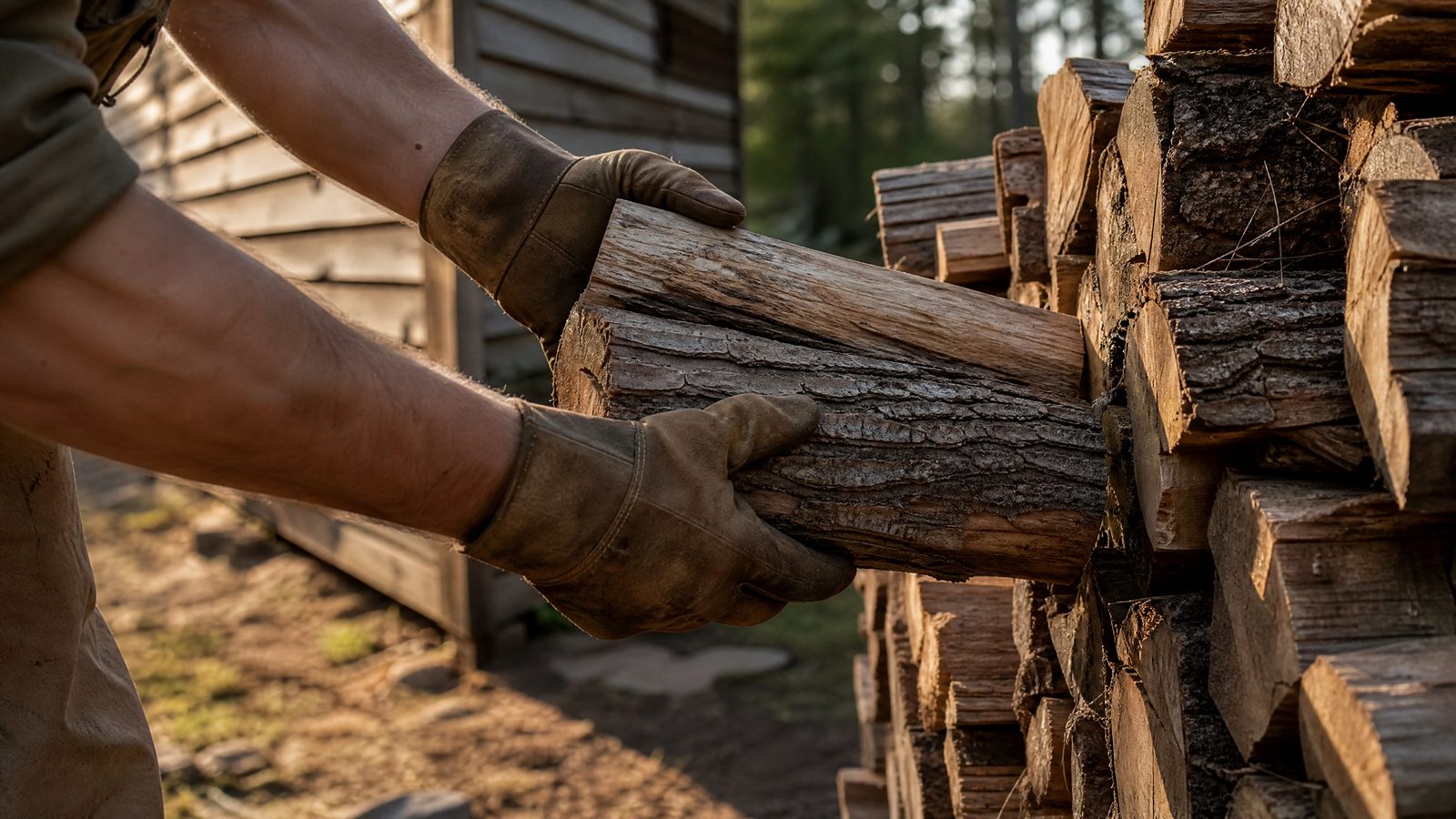
Wear gloves for firewood, rock piles, garden beds and anything that has been sitting undisturbed in a garage. Shake out boots, gloves and work clothes that have been in a shed or a basement, especially in recluse country across the Midwest and the South. Keep firewood away from the house rather than stacked against it. Seal the gaps around basement windows and door frames. Long sleeves for crawlspace and attic work.
The same habit that catches a spider early catches a tick early too: look at your skin after the work is done, while you can still act on what you find.
Most of what a bite needs in the first hour is unremarkable. Clean water, soap, gauze, something cold, and the ability to see clearly what you are looking at. That last part is where people get stuck, because the moment you need supplies is never the moment you feel like going to find them. Our home first aid kit checklist covers what actually earns a place in the box.
A bite you are watching for 48 hours is a wound-care problem, and wound care goes badly when the supplies are scattered across three rooms. The 1stHour Trauma Kit puts that side of it in one place: 82 pieces of real medical equipment, organized so you are not assembling a kit at 11pm with a flashlight in your teeth.
This content is for informational purposes only and does not constitute medical advice. If you think you have been bitten by a black widow, brown recluse or hobo spider, or you have symptoms beyond the bite site, seek medical care.


