Signs of Dehydration Adults Miss Until It's Serious

Nobody collapses out of nowhere from this. Dehydration arrives on a schedule, and the signs of dehydration show up in a fairly predictable order, which means there are three or four chances to catch it before it turns into a problem you cannot fix at the kitchen sink. The trouble is that the early ones look like a long day. Tired, mild headache, a bit foggy. That describes most of us by four in the afternoon. Here is the actual progression, what each stage means, and the specific point where drinking water stops being the answer.
The Signs of Dehydration, in the Order They Show Up
Fluid loss is a sliding scale, not a switch. Clinicians describe it in rough bands of body weight lost: about 3 to 5 percent is mild, 6 to 9 percent is moderate, and 10 percent or more is severe and treated as an emergency. For a 180-pound man, 5 percent is nine pounds of water. You can get there in an afternoon of roofing.

What that feels like, in sequence:
- First: thirst, dry mouth, dry or sticky lips. Urine turns darker and there is less of it.
- Then: a dull headache, usually across the front. Energy drops off. You get irritable, and you get worse at anything that needs focus. This is the stage where people say they just need to push through.
- Then: dizziness or a grey-out when you stand up fast. Muscle cramps, often calves or hands. Resting heart rate climbs. Sweating tapers off even though you are still hot.
- Then: confusion, slurred or wandering speech, sunken-looking eyes, no urine for hours. Fainting.
By that last stage the body has started protecting blood pressure at the expense of everything else, and Cleveland Clinic is direct about what comes next if it is left alone: electrolyte disturbance, organ injury, and in serious cases death. The gap between stage two and stage three is where most people lose a whole afternoon.
Why Thirst Stops Being a Reliable Warning After 60
"Drink when you're thirsty" is fine advice for a 30-year-old. It fails the exact group most likely to end up in an ER with this.
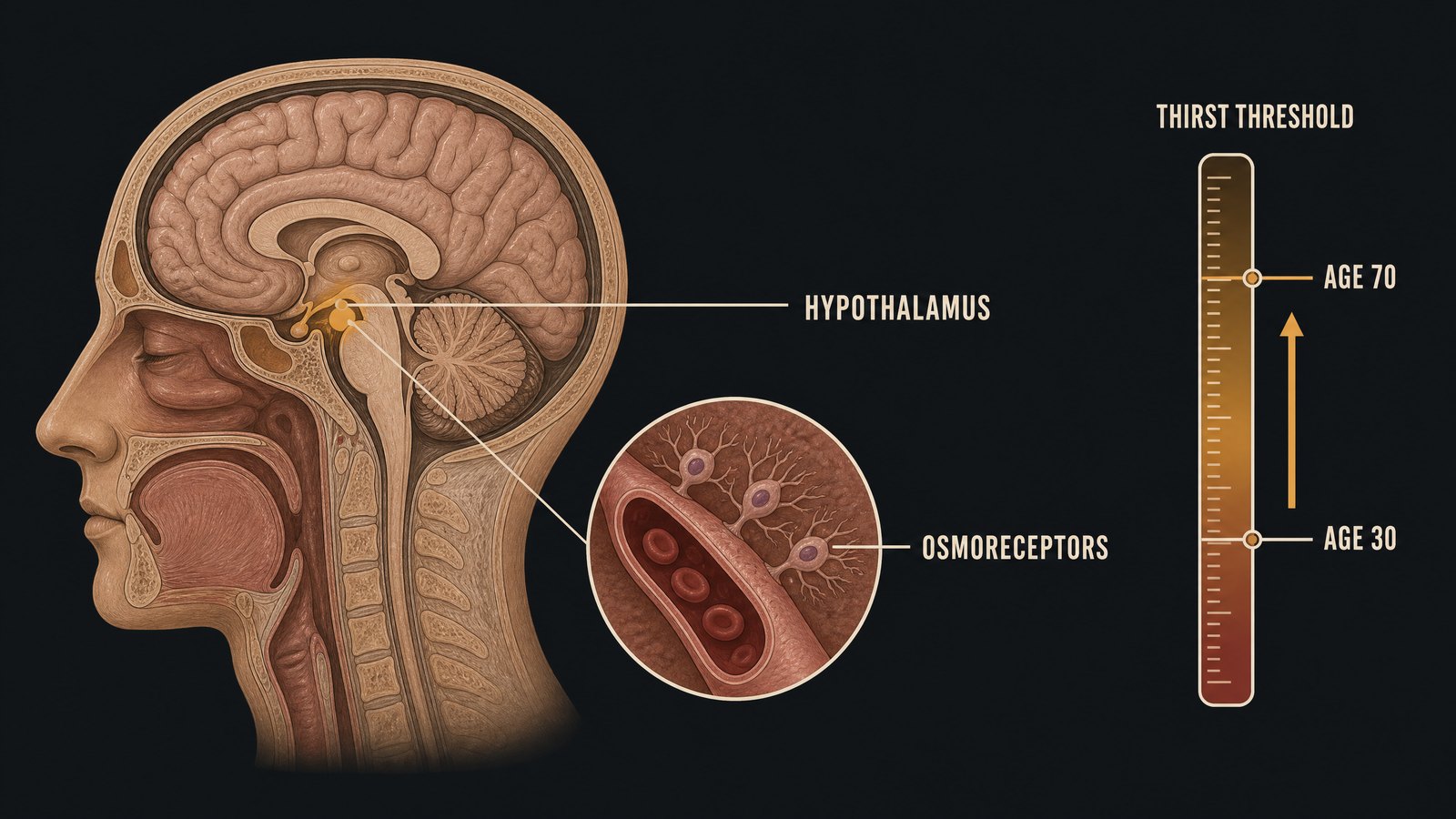
Thirst starts in the hypothalamus, where osmoreceptors read how concentrated the blood is and trigger the urge to drink once it crosses a threshold. With age that system gets less sensitive and the threshold moves upward, so the same degree of fluid loss produces a weaker signal, or none. There is a name for it, hypodipsia, and researchers treat reduced thirst as a normal part of aging rather than a symptom of something else. As Cleveland Clinic puts it in its piece on hydration risk in older adults, by the time an older adult feels thirsty, early dehydration is already underway.
Two other things stack on top. People over 65 carry less total body water to begin with, so the same pint lost matters more. And several very common medications, diuretics and some blood pressure drugs in particular, increase output all day without any thirst to match.
Practical version: if you are checking on a parent, do not ask whether they are thirsty. The answer will be no, and it will not mean anything. Ask when they last used the bathroom.
What Urine Color Actually Tells You (and What It Doesn't)
Urine color is the most useful home signal you have, and it is also the one people over-read.
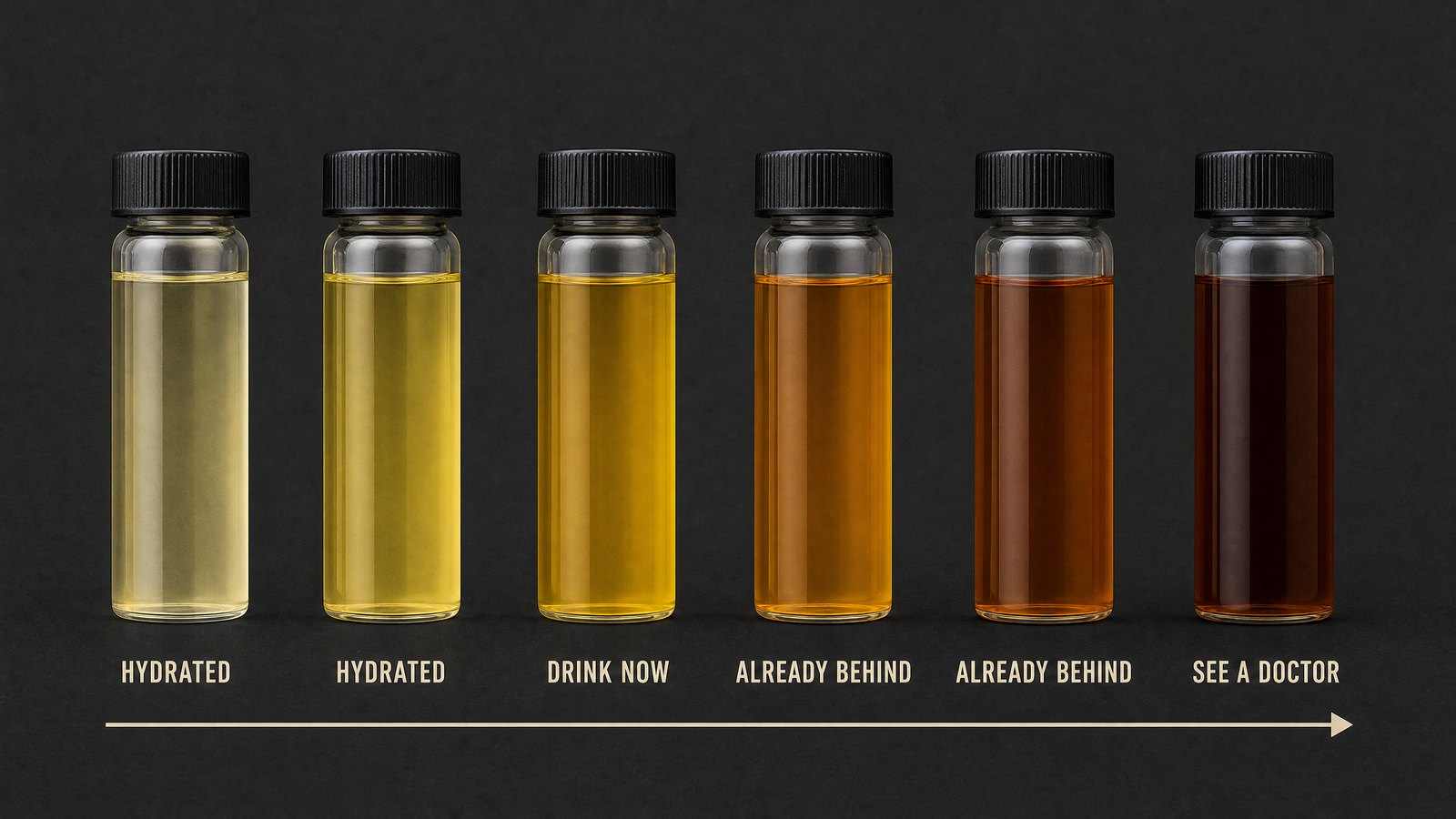
The scale that matters is short. Pale straw to light yellow is fine. Deep yellow means start drinking. Amber or the color of apple juice means you are already behind. Brown or cola-colored, especially after hard exertion, is not a hydration problem anymore and needs a doctor same-day.
Volume is the better number, though, and almost nobody tracks it. A hydrated adult urinates roughly every three to four hours during the day. Going six or eight hours without needing to, while awake, tells you more than any single color reading. MedlinePlus lists reduced urine output among the signs that dehydration has become significant.
Two caveats, because they cause a lot of false alarms. B vitamins turn urine bright yellow whatever your hydration status, and beets, blackberries and rhubarb can tint it pink or red. Some antibiotics and laxatives change it too. If the color changed and nothing else did, look at what went in your mouth before you panic.
Severe Signs of Dehydration: When Water Is No Longer Enough
This is the line. Below it, fluids and shade fix the problem. Above it, someone needs an IV and an actual assessment. Treat these as severe dehydration symptoms and get medical help:
- Confusion, disorientation, or speech that has gone off in a person who was fine this morning
- No urine for eight hours or more, or urine so dark it looks brown
- Fainting, or dizziness so bad the person cannot stand or walk normally
- Resting pulse well above normal with low blood pressure, particularly with cold or mottled hands and feet
- Sweating has stopped in the heat, skin hot and dry
- Vomiting or diarrhea that has run more than 24 hours, or any inability to keep fluids down at all
- Fever above 101°F, seizures, chest pain or abdominal pain alongside any of the above

Confusion is the one worth sitting with. In an older adult it is often the very first sign anyone notices, and it is also a symptom of several other emergencies, so it does not get to be filed under "probably dehydrated." Sudden confusion, weakness on one side or garbled speech needs a stroke ruled out first. Confusion in someone with an infection can mean sepsis. If someone passes out, that is emergency care regardless of what you think caused it.
The Home Tests That Work Worse Than You Think
Two tests get repeated everywhere, and both of them fall apart on the people you are most likely to be testing.
The skin pinch
Pinch the back of the hand, let go, see if it springs back. In aged skin, collagen and elasticity are already gone, and skin can take 20 seconds or more to flatten out in someone perfectly hydrated. Studies of hydration assessment in older patients found skin turgor, dry mucous membranes and sunken eyes all performed poorly as standalone indicators.
Capillary refill
Press a fingernail until it blanches, release, count until color returns. Under two seconds is the textbook normal. Except older adults routinely run past three seconds with no dehydration at all, which makes the test nearly useless for telling those two situations apart.
What to use instead
- Take a baseline before you need one. Note the person's normal refill time and skin recoil on an ordinary day. A change from their baseline means something. A single reading does not.
- Count bathroom trips. Boring, concrete, and it does not degrade with age.
- Sit-to-stand. Have them sit, then stand, and ask about dizziness or a grey-out. New orthostatic dizziness is a real signal.
- Weigh them. Same scale, same time of day. Two or three pounds lost in 24 hours with no diet change is fluid, not fat.
Where Dehydration and Heat Illness Overlap
On a hot jobsite these stop being separate problems. Sweat is the fluid loss, so heat exposure and dehydration feed each other, and dehydration makes it harder to shed heat, which drives core temperature up faster.
Sweating that stops in the heat is the sign to react to. Hot, dry, red skin with confusion is heat stroke, which is a 911 call, not a water-bottle situation. Our guide to heat exhaustion versus heat stroke covers where that line sits and what to do at each side of it.
One more overlap worth naming. Cramping calves and hands after hours of sweating are usually about sodium, not just water, and drinking plain water hard at that point can dilute things further and make cramping worse.
How to Rehydrate Without Making It Worse
For anything mild to moderate, where the person is awake, alert and can swallow:
Small amounts, often. Four to eight ounces every 15 minutes beats chugging a liter. A gut that is behind on fluid will hand a large volume straight back.
Use an oral rehydration solution if losses involved sweat, vomiting or diarrhea. ORS is not marketing. It is a specific ratio of glucose to sodium that exploits sodium-glucose cotransport in the small intestine, so fluid crosses the gut wall faster than plain water does. The StatPearls chapter on adult dehydration treats oral rehydration as first-line for mild and moderate cases. A packet weighs nothing and belongs in your home first aid kit and your truck.
Get out of the heat and stop the work. Fluid alone does not fix an ongoing loss.
Skip these: alcohol, heavily sugared soda and energy drinks, and salt tablets on their own. High sugar can pull water into the gut and worsen diarrhea. Salt without water and glucose does not help absorption.
If you are dealing with a parent who is not drinking, stop offering water. Offer something cold they actually like, at a set time, in a small glass, on a schedule rather than on demand. Broth, diluted juice, popsicles and watermelon all count. Waiting for them to want it will not work, because the wanting is the part that broke.
When to Call 911
- Unconscious, or too confused to answer simple questions
- Fainted and has not come fully back
- Hot, dry skin with a high temperature and no sweating
- Seizure
- Chest pain, severe abdominal pain, or trouble breathing
- Cannot keep any fluid down and is getting worse by the hour
- Blood in vomit or stool
Most of what fixes this early costs nothing. Water, shade, and someone paying attention. What is worth having on hand is the small stuff you never think about until the afternoon it matters: oral rehydration packets, an instant cold pack, a thermometer, something to shade a person with. The 1stHour Trauma Kit packs 82 pieces into one bag so that the answer to "what do we have" is already settled before you are standing in a hot parking lot deciding.
This content is for informational purposes only and does not constitute medical advice. Dehydration can be a medical emergency, and confusion, fainting or absent urine output need professional assessment. Do not use this article to rule out stroke, sepsis, heat stroke or any other cause of altered mental status. Seek emergency care when in doubt.


