Heart Palpitations: When to Worry and When to Wait
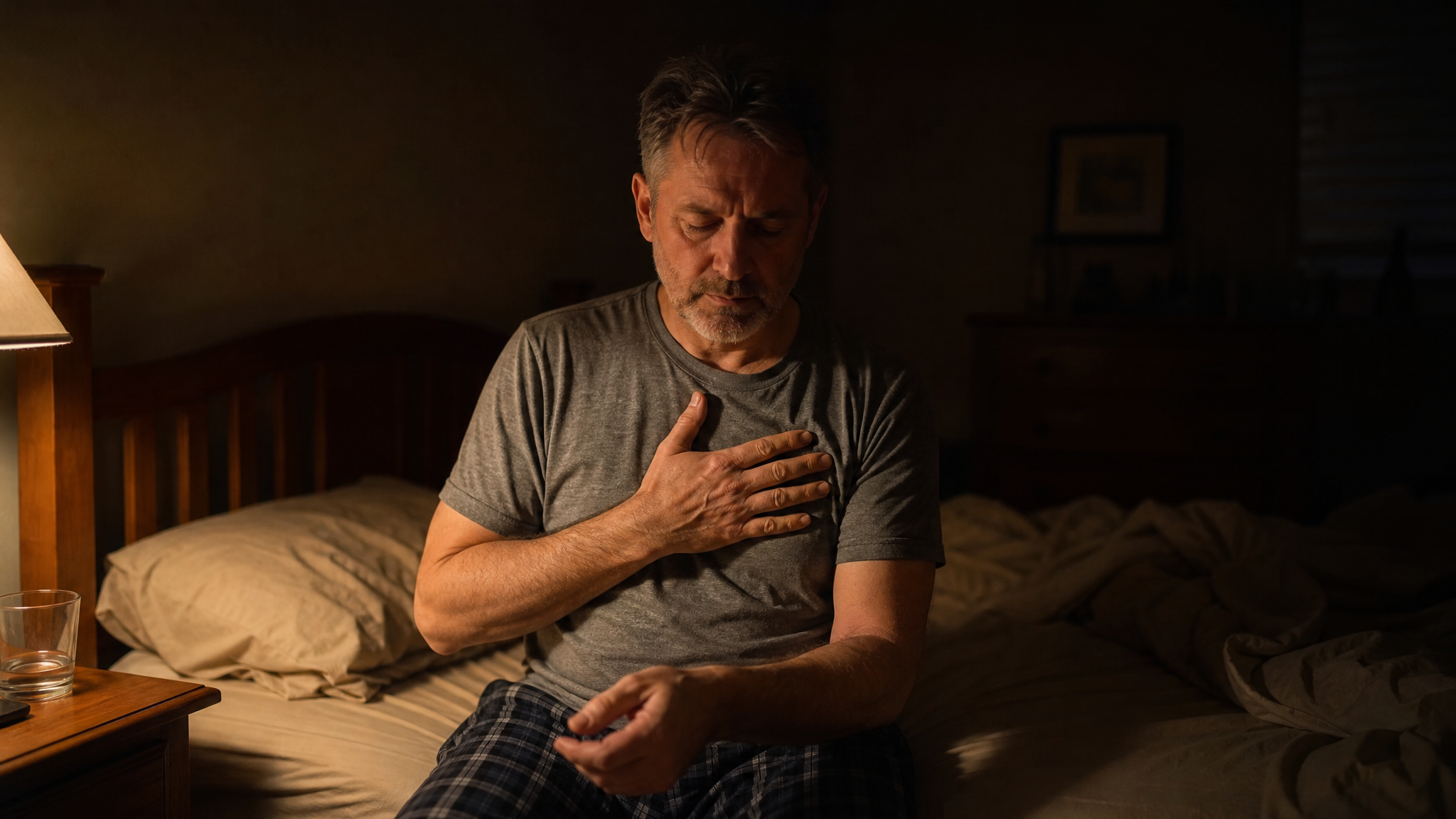
You are sitting still, maybe about to fall asleep, and your heart does something you notice. A thud. A flutter. A beat that feels like it got skipped and then made up for it with an extra hard one. And then you are wide awake, hand on your chest, counting.
Almost everyone has had this happen. Most of the time it means nothing at all. But "most of the time" is not a useful answer when it is happening to you at 1 a.m., so here is the version with actual lines in it: what a palpitation is, which ones are boring, which ones are not, and what to do when the test comes back normal and you still feel it.
What a Heart Palpitation Actually Is
A palpitation is just awareness of your own heartbeat. That is the whole definition. It is a symptom, not a diagnosis, and it covers everything from a single odd beat to a run of fast ones.
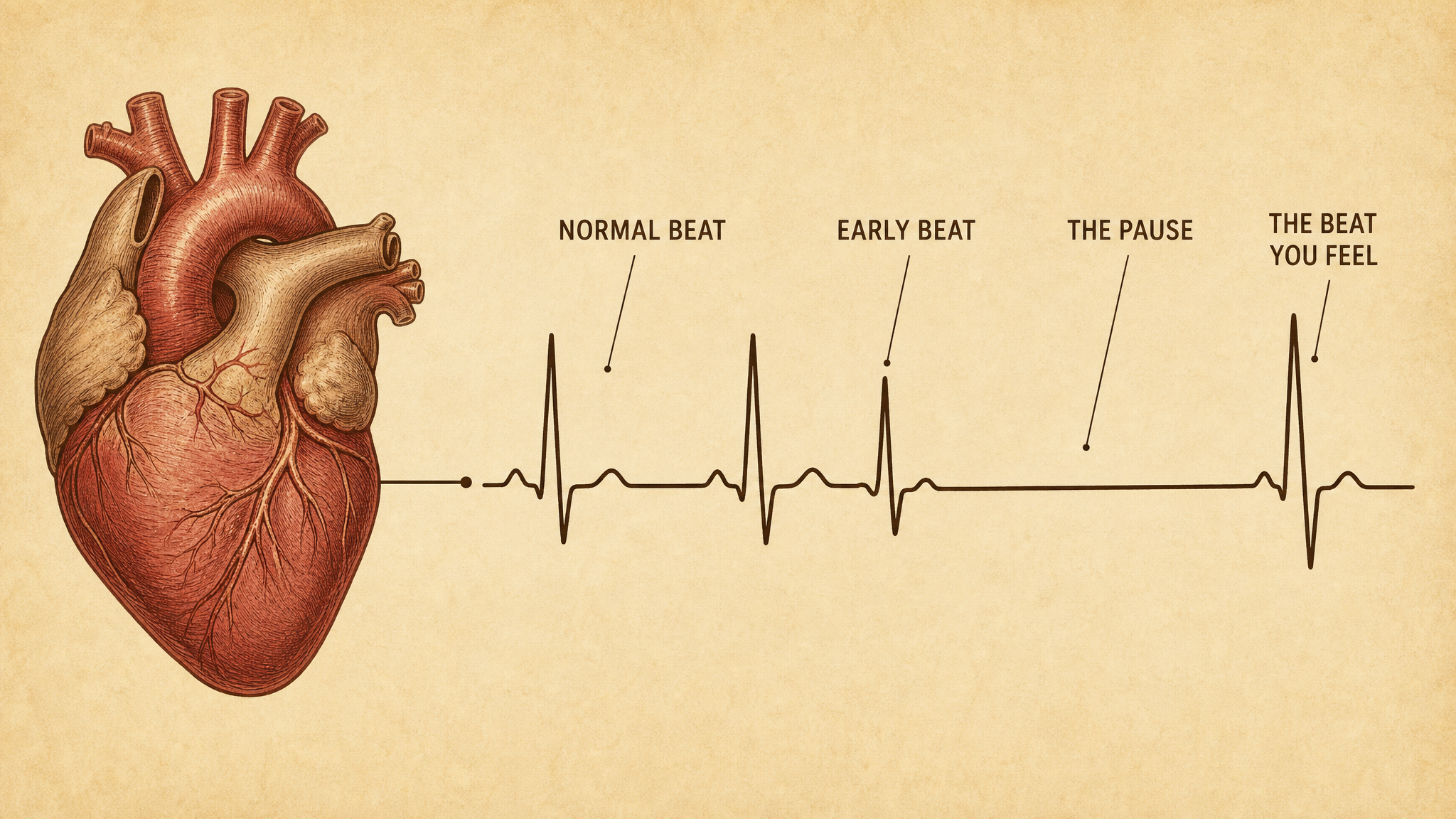
The most common cause of the classic skipped-beat feeling is an early beat, either a premature atrial contraction (PAC) from the upper chambers or a premature ventricular contraction (PVC) from the lower ones. Here is the part that surprises people: you do not feel the extra beat. You feel the pause after it.
The early beat fires before the heart has finished filling, so it moves almost no blood and you sense nothing. Then the heart waits slightly longer than usual before the next beat, and that next one lands with a full chamber behind it. That is the thud. One small early beat, one brief pause, one hard beat, and your night is ruined.
Healthy hearts do this. A lot. Most people have some PVCs on any given day and never notice a single one.
The Palpitations That Are Almost Always Harmless
There is a recognizable profile for the benign kind:
- They last seconds, not minutes
- They come as a single beat or a short cluster, then stop on their own
- They happen at rest, often when you are lying down or sitting quietly
- Nothing else comes with them. No dizziness, no pain, no shortness of breath
- You can trace them to something. A third coffee, a bad night, a hard workout, a stressful call
They can also show up during a stretch of poor sleep and vanish when you catch up. That is not you talking yourself out of a problem, that is a real and well-documented pattern.
If your episodes fit that description and you feel completely normal between them, the odds are heavily in your favor. That does not mean never mention it to a doctor. It means you do not need to mention it tonight.
The Companion Symptoms That Change the Answer
Here is the single most useful thing we can tell you about heart palpitations, and when to worry about them: the palpitation is rarely the important part. What comes with it is.

An irregular beat that arrives alone is usually a nuisance. The same irregular beat arriving with any of the following is a different situation:
- Fainting or nearly fainting. Graying vision, a room that tilts, having to sit down fast. This suggests the rhythm is briefly failing to move enough blood to your brain.
- Chest pain or pressure. Especially anything heavy, squeezing, or spreading into the jaw, neck, or arm. If that is what you are feeling, stop reading and get help, and know the warning signs of a heart attack cold.
- Shortness of breath that is out of proportion to what you are doing, or that starts with the palpitations rather than before them.
- Sudden weakness, facial droop, or trouble speaking. Some rhythm problems throw clots. Learn to recognize a stroke fast.
- Cold sweat or nausea alongside any of the above.
If someone actually loses consciousness, that is its own emergency with its own response, and what you do in the first minute matters.
Worth knowing the difference here too: a rhythm problem that stops the heart entirely is cardiac arrest, which is not the same thing as a heart attack, and the two need different responses.
What Causes Heart Palpitations: Caffeine, Thyroid and Anemia
Before anyone goes looking for a structural heart problem, there is a shorter list worth clearing.
Stimulants. Caffeine is the obvious one, and the threshold is personal. Some people run four cups with no trouble and get flutters off two on an empty stomach. Nicotine counts. So does alcohol, especially the night after. Energy drinks stack caffeine with other stimulants and are a common trigger in people who swear they do not drink coffee.
Over-the-counter medicine. Decongestants with pseudoephedrine and some antihistamines are stimulants in everything but name. People take a cold tablet, notice their heart racing that evening, and never connect the two.
Thyroid. An overactive thyroid speeds everything up. It also brings weight loss, heat intolerance, tremor, and trouble sleeping. It is a blood test.
Anemia. Low iron means less oxygen carried per beat, so the heart compensates by beating faster and harder. Add fatigue and breathlessness on stairs and it looks a lot like a cardiac problem. Also a blood test.
Dehydration and electrolytes. Heavy sweating, a long day outdoors, or a stomach bug will do it. Endurance athletes hit this one regularly. The signs of dehydration adults miss overlap more than you would expect.
Adrenaline. Anxiety genuinely causes palpitations. It also gets blamed for palpitations that are not anxiety, which is why "it's just stress" should be a conclusion after a workup, not a substitute for one.
Why Heart Palpitations Feel Worse at Night
Almost everyone who has this describes it getting louder in bed. There are unremarkable reasons for that.
Lying on your left side puts the heart closer to the chest wall, so beats transmit better. The room is quiet, you are not moving, and there is nothing competing for your attention. Your heart rate is also at its lowest, and a slower baseline makes any pause more noticeable. Add the alcohol or the big late meal and you have the whole picture.
The night pattern by itself is not a warning sign. Waking from sleep because your heart is pounding, repeatedly, is worth reporting.
When to Worry About Heart Palpitations: The Three Timeframes
Sort it into one of three buckets.
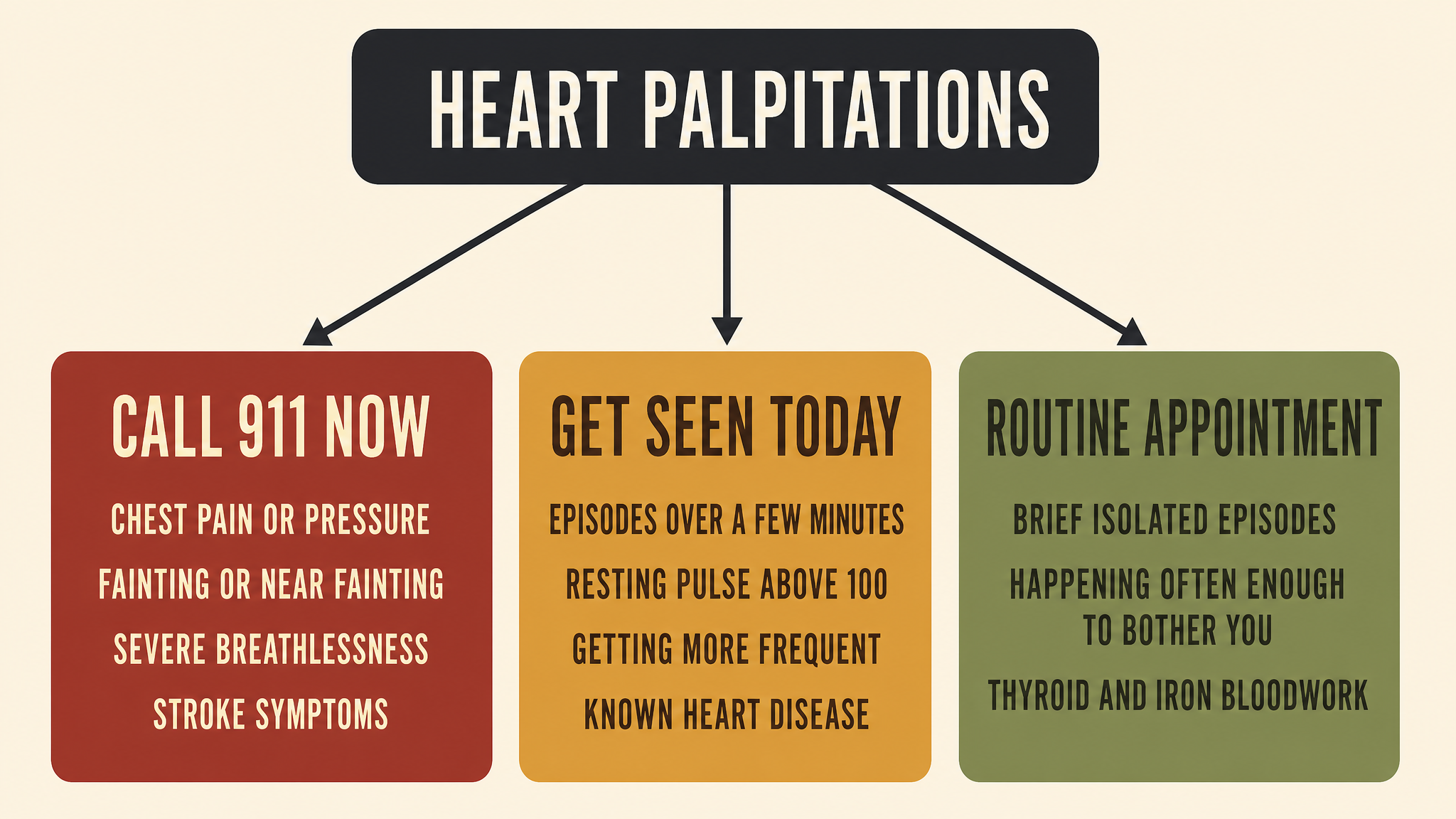
Call 911 now if: palpitations come with chest pain or pressure, fainting or near-fainting, severe breathlessness, confusion, or stroke symptoms. Also if a fast, pounding rhythm simply will not stop.
Same day or urgent care if: episodes last more than a few minutes at a stretch, your resting pulse stays above 100 after you have been sitting quietly, they are clearly getting more frequent or more intense, you have known heart disease or a family history of sudden cardiac death, or you are pregnant and this is new.
Routine appointment if: the episodes are brief and isolated but happening often enough to bother you, or you want the thyroid and iron studies done to rule the simple things out. That is a reasonable ask and a good doctor will not push back on it.
One number is worth memorizing because it is the one you can check yourself: put two fingers on your wrist, sit still, and count for a full minute. Resting and persistently over 100 is a number to act on.
Why One Normal ECG Doesn't Close the Question
This is where people get stuck, and it is the most common frustration we hear on this topic.

You go in, you get an ECG, it is clean, and you get sent home. Then it happens again that night and you are back where you started, now also wondering whether you imagined it.
You did not. A resting ECG records roughly ten to fifteen seconds of your heart's activity. If your palpitations show up twice a week for thirty seconds at a time, the odds of that ten-second window catching one are close to nothing. A normal ECG rules out a handful of things that are always visible, and it tells you almost nothing about an intermittent event. That is a known limitation, not a loophole, and it is exactly why longer monitoring exists.
If the episodes keep going, the next step is usually ambulatory monitoring: a Holter monitor for 24 to 48 hours if things happen most days, or an event or loop recorder worn for two weeks or more if they are less frequent. Bloodwork for thyroid and iron usually goes along with it. The NHLBI has a plain-language overview of the rhythm disorders these tests are looking for.
Three things make that appointment go better:
- Keep a log. Date, time, how long, what you were doing, what you had eaten or drunk. A month of entries is worth more than any single description.
- Take your own pulse during an episode. Fast or slow? Regular or chaotic? "Irregularly irregular" is a specific finding and doctors take it seriously.
- Record it if you can. A smartwatch ECG strip captured mid-episode is real data. It is not a diagnosis, but it is far better than a memory of a feeling.
Go in with those three and you have moved from "sometimes my heart feels weird" to something a cardiologist can actually work with.
Ready before you need it. Knowing what a symptom means is half of it. Being able to act when something goes wrong in front of you is the other half, and that half needs supplies within arm's reach, not in a store across town. The 1stHour Trauma Kit is built for the window before help arrives, with 82 pieces chosen for the injuries that cannot wait. Because the first hour is the one you have to cover yourself.
This content is for informational purposes only and does not constitute medical advice. If you are having chest pain, fainting, or severe shortness of breath, call 911 or your local emergency number. Do not use this article to rule out a heart rhythm problem, and do not start, stop, or change any medication based on it.


