Do I Need a Tetanus Shot for This Cut?

You are standing at the sink with a paper towel pressed against your hand, and the question showing up is not really about the cut. The cut will probably be fine. Do I need a tetanus shot for this, or am I overreacting? That is the actual question, and most people answer it badly, because most people are working from a piece of folk wisdom about rusty nails that was never true in the first place. Here is the real decision. It comes down to two questions and about two minutes.
Rust Has Nothing to Do With It
Tetanus is caused by a bacterium called Clostridium tetani. It is not caused by iron oxide. A shiny new nail and a rusty one carry the same risk, and that risk depends entirely on what has been on the nail, not what color it is.
C. tetani lives in soil, dust, and animal manure. It forms spores that survive for years in conditions that would kill almost anything else. Those spores only turn dangerous when they get pushed into tissue with no oxygen reaching it, which is why deep punctures matter so much more than long shallow slices. A wound that bleeds freely and stays open is a bad home for this bacteria. A narrow hole that seals over the top while the bottom stays dirty is a good one.
So why the rust story? Rusty metal is usually old metal, and old metal has usually been sitting outside in the dirt. The rust is a marker for where the object has been, not the hazard itself. One study that swabbed rusted metal and concrete surfaces found C. tetani DNA on about three quarters of them, while soil samples came back positive far less often. The bacteria is where the grime is.
Do I Need a Tetanus Shot? Look at the Wound First
This is the split that drives everything else, and the CDC draws it fairly bluntly.
Clean and minor means a superficial cut or scrape with nothing ground into it. A kitchen knife slip. A scratch from a box cutter. A shaving nick. The edges are visible, it bled, you rinsed it, and there is nothing left inside.
Dirty or major covers a lot more ground than people expect:
- Puncture wounds of any depth, including splinters and nails through a shoe
- Anything contaminated with soil, manure, or saliva
- Crush injuries
- Burns
- Frostbite
- Wounds with dead or missing tissue
- Anything left untreated for more than six hours
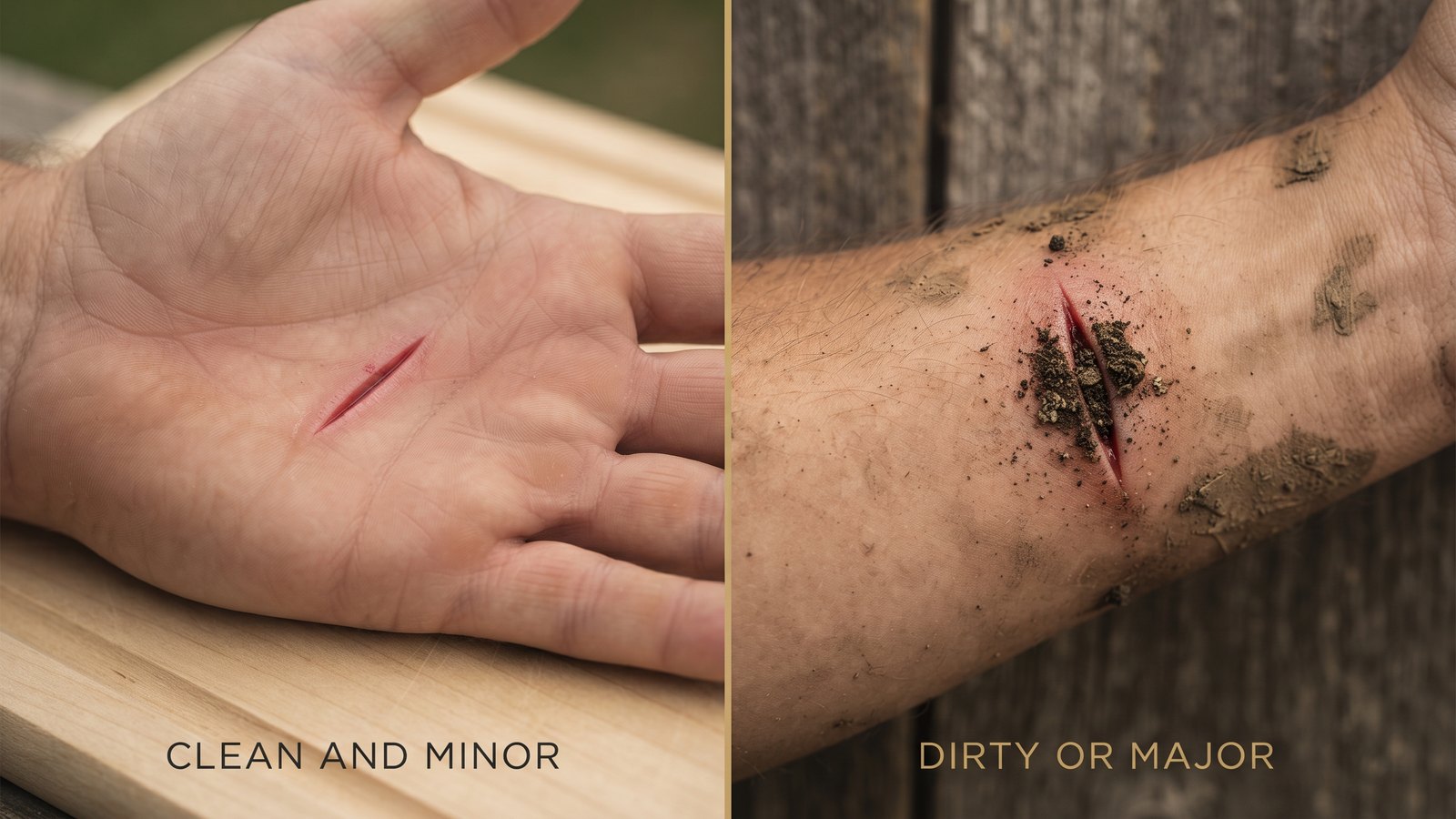
Puncture wounds are the classic tetanus scenario precisely because they combine depth with contamination and then close over the top. A garden fork through a boot ticks every box. So does a cat bite, which is why animal bites get treated as dirty by default.
If you are honestly unsure which category you are in, treat it as dirty. The cost of being wrong in that direction is one shot.
Do I Need a Tetanus Shot Based on My Last Booster?
Now put the two answers together.
| Your last tetanus shot | Clean, minor wound | Dirty or major wound |
|---|---|---|
| Less than 5 years ago | No shot needed | No shot needed |
| 5 to 10 years ago | No shot needed | Get a booster |
| More than 10 years ago | Get a booster | Get a booster |
| Unknown or incomplete series | Get a shot | Get a shot, ask about immune globulin |
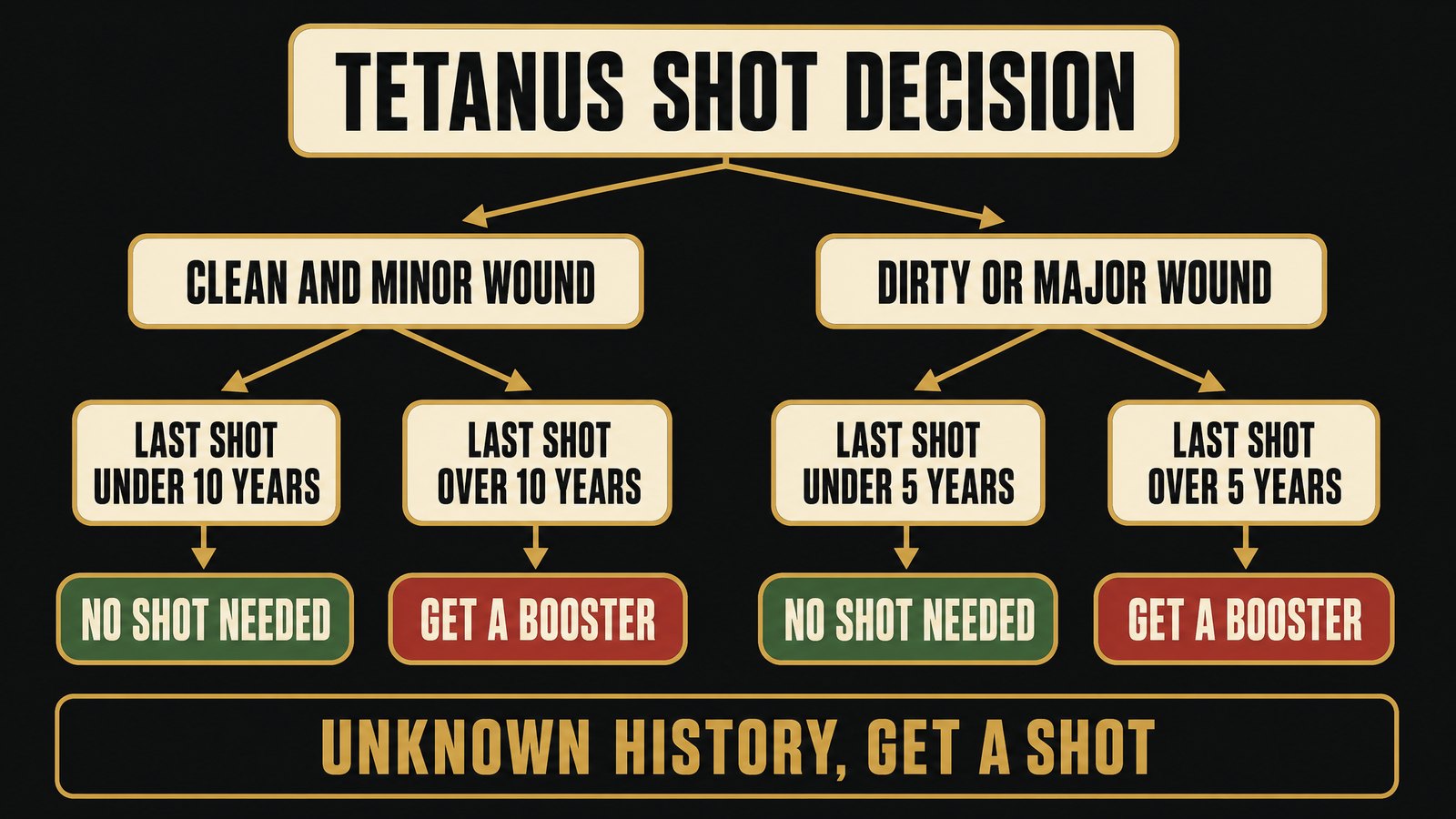
That middle row is the one almost nobody knows about. The famous 10-year rule is real, but it only applies to clean minor wounds. Once the wound is dirty, the clock runs at half speed and you are due at five years.
The unknown row deserves its own note. Plenty of adults genuinely cannot remember, and "I think I got one when I sprained my wrist a while back" is not a record. If you cannot name a year, assume you are out of date. Clinics deal with this constantly and nobody will make you feel stupid about it.
What Happens at the Clinic
The visit is short and dull, which is the point.
You will get either Td (tetanus and diphtheria) or Tdap (tetanus, diphtheria, and pertussis). If you have never had a Tdap as an adult, most providers will give you that one so you pick up whooping cough protection at the same time. Either counts as your booster, and either resets the clock for another ten years.
If you have never completed a primary tetanus series, or you have no idea whether you did, you may also be offered tetanus immune globulin. That is a separate injection, usually in a different arm. The vaccine teaches your immune system to make antibodies, which takes a couple of weeks. Immune globulin hands you borrowed antibodies right now, covering the gap. Only people with unknown or incomplete vaccine history need it.
On timing: sooner is better, but this is not a same-hour emergency. Getting the booster within 24 to 48 hours of a dirty wound is standard. If it has already been three days, still go. Do not talk yourself out of it because you missed some imaginary window.
Tetanus Symptoms and How Long They Take to Show Up
Symptoms usually start between 3 and 21 days after the injury, most often around day 8. It runs shorter with a badly contaminated wound and longer with a small one far from the trunk.
The first sign is almost always the jaw. Stiffness, trouble opening your mouth, a feeling like the muscles have locked. That is where "lockjaw" comes from. From there it moves down: neck stiffness, difficulty swallowing, rigid abdominal muscles, then full-body spasms severe enough in some cases to fracture bone.
If any of that shows up after a wound, go to an emergency room and say the word tetanus out loud. Do not wait to see if it passes.
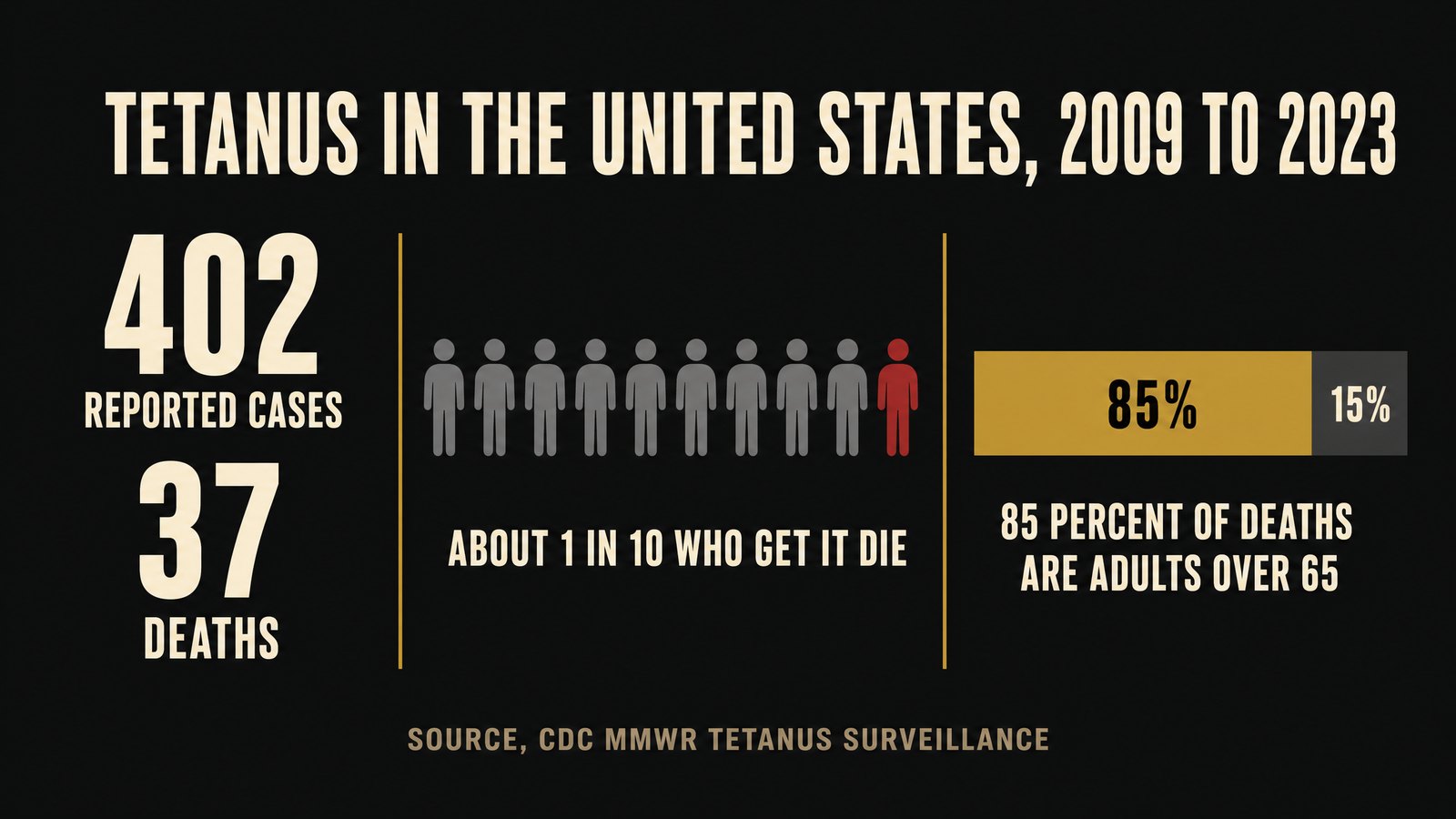
The odds are strongly in your favor. The CDC logged 402 tetanus cases and 37 deaths in the United States across the fifteen years from 2009 to 2023, in a country of 330 million people. But of the people who do get it, roughly one in ten dies, and 85 percent of those deaths are in adults over 65. It is a rare disease with a bad ceiling, which is exactly the profile that makes a cheap booster worth the trip.
Clean the Wound Right, Whatever You Decide
The vaccine is only half the job. Wound care is the other half, and it does more for you in the first ten minutes than anything that happens later.
Rinse it under running water, and be more aggressive than feels polite. Volume and pressure matter more than soap or antiseptic. Thirty seconds of real irrigation clears out more contamination than a careful dab with a cotton ball. If there is visible grit you cannot flush out, that is a reason to have someone look at it.
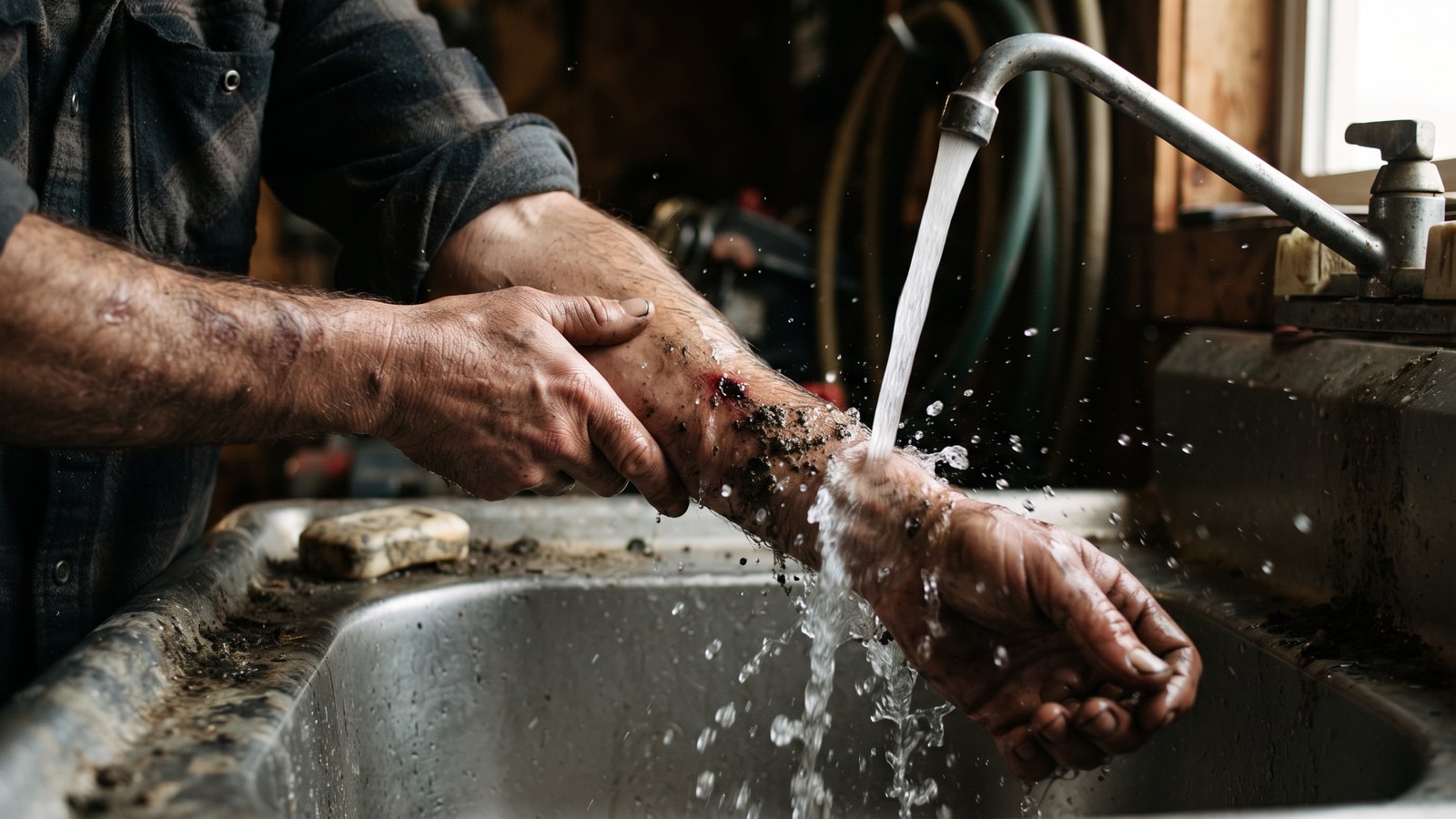
Do not seal a dirty puncture wound shut. Cover it loosely so it can drain. The instinct to close everything up is exactly wrong for the wounds that carry the most tetanus risk.
Then watch it for a few days. Spreading redness, heat, swelling that gets worse instead of better, red streaks running up the limb, or fever all mean go in. Those are infection signs generally rather than tetanus specifically, and the early signs of sepsis are worth knowing for the same reason. Separately, if the edges gape open or you can see fat or muscle, check whether it needs stitches within the first several hours, because that window does close.
When to Skip the Debate and Just Go In
Some situations do not need a decision tree:
- You cannot remember your last tetanus shot, at all
- The wound is a deep puncture from anything that had been outdoors
- Manure, soil, or standing water got into it
- It is an animal or human bite
- There is embedded material you cannot flush out
- The injury is a crush, a burn, or has dead tissue around it
- You are over 65 and the wound is anything but trivial
None of these are dramatic. They are just the cases where the booster is the cheap answer and guessing is the expensive one.
This decision feels harder than it is mostly because of what happens before it. When you have already cleaned a wound properly, you have the time and the clear head to work out whether a clinic visit is worth it. When you are improvising with a dish towel, everything feels urgent. A properly stocked first aid kit buys you that clear head, and The 1stHour Trauma Kit carries the irrigation supplies, sterile dressings, and wound closures to handle the first ten minutes properly. Then the only question left is the one about your vaccine record.
This content is for informational purposes only and does not constitute medical advice. If you are unsure about a wound or your vaccination status, contact a healthcare provider. Call 911 or your local emergency number for any wound with uncontrolled bleeding or signs of a serious infection.


