How to Treat a Puncture Wound Before Help Arrives

Puncture wounds are deceptive. A small entry point doesn't mean a minor injury. A nail through the foot, a bite that breaks skin, a fishhook that sets deep — these carry real risk and they don't look like much from the outside.
They also don't bleed the way most people expect. A deep puncture wound may bleed very little. That's not a good sign — it's a warning. The blood that should be washing the wound clean is staying inside, along with whatever drove the puncture in.
This guide will walk you through how to assess a puncture wound, treat it correctly, and recognize the signs that mean you need to escalate — fast. Because with puncture wounds, the danger isn't always what you can see.

What Makes a Puncture Wound Different
A puncture wound is a narrow, deep wound made by a pointed object — a nail, screw, knife tip, thorn, tooth, fishhook, or bullet. The wound channel is deeper than it is wide.
That's the problem. When a surface cut bleeds, it cleans itself to some degree. The blood coming out carries bacteria and debris with it. A puncture wound doesn't work that way. The entry point is small — sometimes so small the skin closes back over it almost immediately — while the wound track runs deep into tissue. Bacteria, rust, plant matter, animal saliva, whatever came in on that object, go deep and stay there.
This is why puncture wounds have a disproportionately high rate of infection compared to other wound types. And it's why some infections that start in a puncture wound become serious before the person realizes anything is wrong.
A severe laceration bleeds aggressively and demands immediate attention. A puncture wound can feel almost minor and still set up a deep tissue infection, compartment syndrome, or systemic sepsis if handled wrong. Know which you're dealing with.
Assess the Wound First — Before You Do Anything
Before you clean or cover anything, take 30 seconds to assess what you're actually dealing with. The treatment approach depends on what you find.
How Deep Does It Go?
If the object that made the wound was longer than the tissue it went through, you have a deep wound. A one-inch nail through a thin web of skin between fingers is a different problem than a one-inch nail through a thick boot and into the sole of the foot. Depth matters.
Is Anything Still Embedded?
Do not remove embedded objects. A nail, a piece of glass, a fishhook with a barb — if it's in the wound, leave it. Removing it can cause sudden, significant bleeding as the object that was tamponading the wound comes out. It can also drive fragments deeper. EMS and ER personnel have the right tools for this. Your job is to stabilize the object (not let it move), protect the wound, and get to care.
Where Is the Wound?
Location changes the risk profile immediately:
- Hands and feet: High infection risk. Deep structures (tendons, joint spaces) are close to the surface. A nail through the bottom of the foot that reaches the bones or joints needs urgent evaluation even if it doesn't bleed much.
- Face: High cosmetic consequence, good blood supply (heals well), but proximity to eyes, sinuses, and airways matters.
- Chest or abdomen: Any penetrating wound to the torso is a potential life threat. Go to the ER. Don't wait to see how it feels.
- Joint spaces (knee, elbow, shoulder): Infection inside a joint is a medical emergency. It requires aggressive treatment and can cause permanent damage.
- Near or over a major vessel: Any pulsatile bleeding or rapid blood accumulation — see our guide on stopping severe bleeding and act accordingly.
What Caused the Wound?
Object type affects what came in with the wound. Rusty metal carries higher tetanus risk. Animal bites and human bites carry a different spectrum of bacteria — Pasteurella from cats and dogs, Eikenella from humans — that respond to different antibiotics. Soil-contaminated wounds, fish-related wounds (especially freshwater), and barnyard injuries all carry elevated infection risk. Know what you're working with before you decide how aggressively to treat.

How to Treat a Puncture Wound: Step-by-Step
These steps apply to a puncture wound where there's no embedded object, no arterial bleeding, and no penetration into the torso. If any of those are present, skip to the emergency section below.
- Control the bleeding first. Apply direct pressure with a clean cloth or sterile gauze. Hold firm pressure for 5–10 minutes without peeking. Puncture wounds often don't bleed much, but if bleeding is brisk, get it under control before anything else.
- Wash your hands. Before you touch the wound, wash your hands with soap and water, or put on nitrile gloves if you have them.
- Rinse the wound thoroughly. Flush with clean running water — the more the better. Use a syringe or squeeze bottle if you have one to push water into the wound channel. You're trying to flush bacteria and debris out. Minimum 5 full minutes of active rinsing. If you don't have running water, use the cleanest available water.
- Clean around the wound. Use mild soap and a soft cloth to clean the skin around the wound opening. Don't scrub inside the wound — that damages tissue. Outside edges only.
- Don't use hydrogen peroxide or iodine directly in the wound. These kill bacteria but also kill the healthy tissue cells needed for healing. Clean water is better for the wound channel itself. Antiseptic is appropriate for the intact skin around the wound, not the wound interior.
- Check for debris. If you can see and easily remove a superficial foreign body — a splinter sitting at the surface — you can remove it with tweezers cleaned with alcohol. If you can't see it clearly, if it's deep, or if removal requires force, stop. Go to urgent care.
- Do not close the wound. Puncture wounds should not be closed with adhesive strips or butterfly closures. Closing a potentially contaminated wound traps bacteria inside. Leave it open to drain. Cover it — don't seal it.
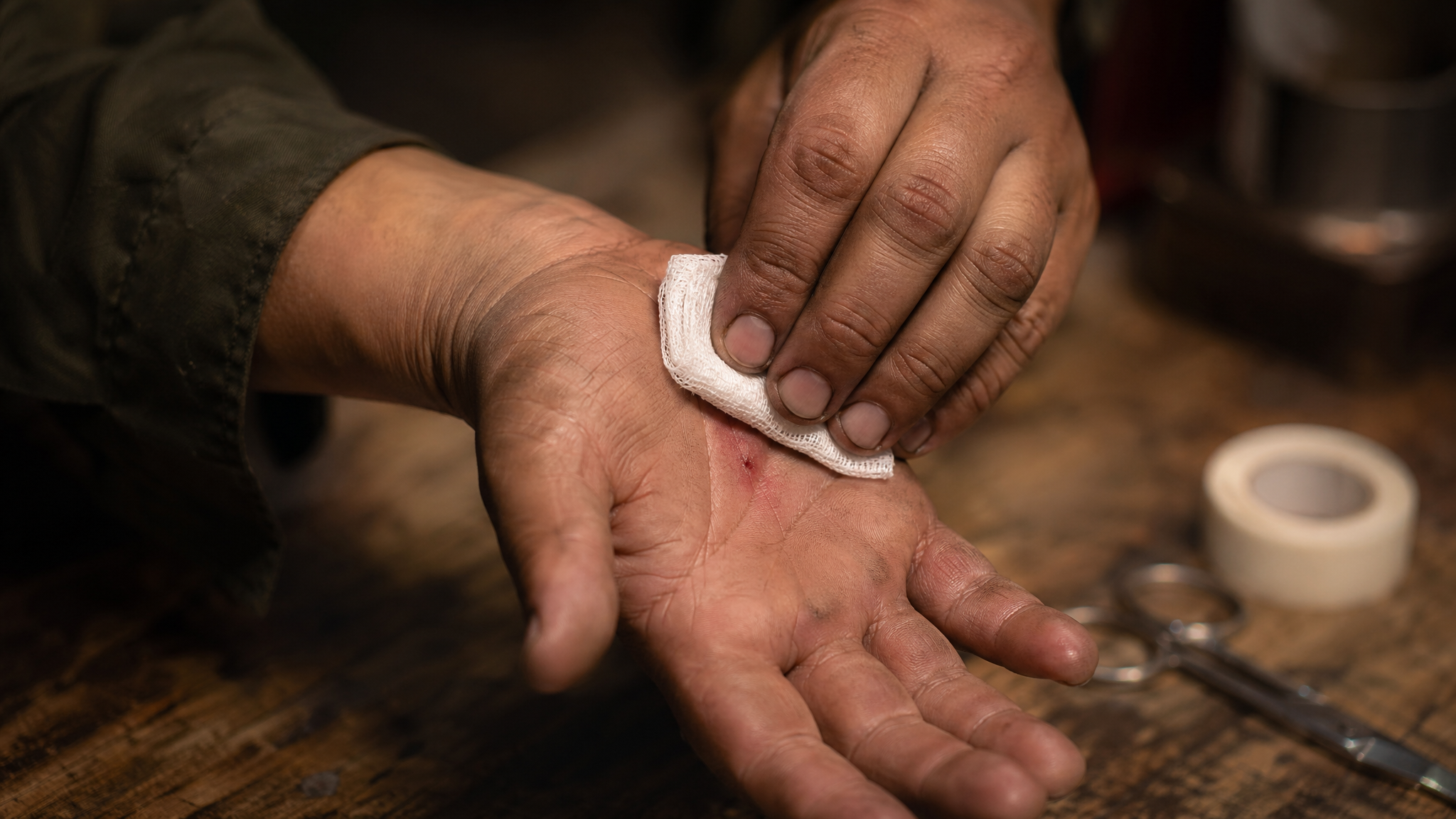
- Apply a sterile dressing. Use a sterile gauze pad and secure it with medical tape. The dressing keeps the wound clean and protected while allowing drainage. Change the dressing daily or whenever it gets wet or dirty.
- Elevate if possible. If the wound is on a hand, foot, or arm, keep it elevated above heart level to reduce swelling and minimize fluid accumulation in the wound.
- Check your tetanus status (see below). This is not optional. Puncture wounds are the primary vector for tetanus infection.

What NOT to Do
Getting puncture wound care right is partly about knowing what to avoid. These mistakes are common and some of them make the situation significantly worse.
Don't Probe or Dig Inside the Wound
Using a finger, a tool, or a swab to probe the wound depth or look for a foreign body pushes bacteria deeper into the tissue and can introduce new contamination. If something is in there, imaging (X-ray or ultrasound) at urgent care will find it without making it worse.
Don't Suck Out Venom or "Clean Out" a Bite
This is outdated and counterproductive for both animal bites and snake bites. Sucking introduces oral bacteria into the wound. For snake bites specifically, the goal is keeping the victim calm and getting to a hospital with antivenom — not extraction at the wound site.
Don't Apply a Tight Bandage Over a Puncture
A firmly wrapped bandage over a puncture wound can trap anaerobic conditions — no oxygen — in the wound, which is exactly what bacteria like Clostridium tetani (tetanus) and Clostridium perfringens (gas gangrene) need to thrive. Cover the wound, don't compress it.
Don't Soak the Wound in a Bathtub or Pool
Submerging an open puncture wound in non-sterile water introduces environmental bacteria into the wound channel. Rinse under running water — don't soak.
Don't Ignore It Because It Doesn't Hurt Much
Puncture wounds in thick areas — like the sole of the foot — sometimes hurt very little initially. The nerve endings may be in the tissue at the margins, not along the wound track itself. Low pain is not a proxy for low risk. Assess and treat regardless of how it feels.
Tetanus: The Risk Most People Don't Think About
Tetanus is caused by Clostridium tetani, a bacterium found in soil, dust, and animal feces that produces a toxin attacking the nervous system. Once the toxin sets in, it causes painful, involuntary muscle spasms — starting in the jaw (lockjaw) and spreading throughout the body. It's fatal in a meaningful percentage of cases even with treatment.
Puncture wounds are the highest-risk wound type for tetanus. The narrow, deep wound channel creates an anaerobic environment (low oxygen) where C. tetani spores can germinate. A rusty nail in a barnyard is the classic scenario, but tetanus doesn't require rust — it requires a wound deep enough to create the right conditions and a bacterium that's already in the environment.
When to Get a Tetanus Shot After a Puncture Wound
- If your last booster was more than 5 years ago and the wound is deep, contaminated (soil, feces, rust), or caused by an animal bite — get a booster now.
- If your last booster was more than 10 years ago — get a booster regardless of wound type.
- If you've never been vaccinated or your history is uncertain — get the full tetanus immune globulin (TIG) treatment plus the vaccine series. Don't guess.
- If you're not sure — when in doubt, get the booster. The risk of a booster is negligible. The risk of tetanus is not.
Tetanus symptoms don't appear immediately. They can take 3–21 days to develop after the wound. By the time you see symptoms — stiffness in the neck or jaw, difficulty swallowing, muscle rigidity — you're dealing with a serious illness that requires ICU-level care. Prevention is the strategy. There is no good treatment once symptoms appear.

Signs of Infection — Watch for These in the Days After
A wound that looks manageable at the time of injury can start going wrong within 24–48 hours. Monitor closely for the following, and go to urgent care or the ER if any appear:
Local Signs (At the Wound)
- Increasing redness — especially if it's spreading outward from the wound edges
- Warmth — the tissue around the wound feels hotter than the surrounding skin
- Swelling — some swelling is normal in the first 24 hours; increasing swelling after 24 hours is not
- Pus or discharge — any yellow, green, or cloudy fluid draining from the wound
- Foul odor — a significant sign, especially with deeper wounds
- Red streaks — red lines radiating outward from the wound along the skin are a sign of lymphangitis, a spreading bacterial infection. This is an emergency. Go immediately.
Systemic Signs (Your Whole Body)
- Fever over 100.4°F — your immune system is responding to something significant
- Chills, sweating, or feeling generally unwell
- Swollen lymph nodes — near the wound site (in the armpit for a hand wound, groin for a foot wound)
- Increasing pain — pain that gets worse after the first 24 hours instead of better
Infections in hands and feet deserve extra urgency. Tendons, joint capsules, and bone are close to the surface in both locations, and an infection that spreads to those structures requires surgical intervention. Don't wait on a hand or foot infection to see if it resolves on its own.
When to Go to the ER — No Waiting, No Watching
Most minor puncture wounds can be managed at home with proper care and monitoring. These cannot:
- Any penetrating wound to the chest, abdomen, or back — even if it looks minor. Internal damage is possible with no external indication of severity.
- Embedded objects you cannot safely remove — nails, hooks, glass, anything that went in and didn't come out clean
- Bleeding you cannot control — see our full guide to stopping severe bleeding
- Animal or human bites — especially to the hand or face. The infection risk is high and prophylactic antibiotics are often indicated
- Any wound with red streaks radiating outward — this is spreading infection, and it moves fast
- Wounds that enter a joint space — a nail through the knee or a bite near a knuckle needs imaging and evaluation
- Punctures to the foot with deep penetration — especially through a shoe (rubber-soled shoes harbor a specific bacteria, Pseudomonas aeruginosa, that causes a characteristic infection requiring specific antibiotics)
- Signs of tetanus — jaw stiffness, difficulty swallowing, muscle rigidity — call 911
- Signs of sepsis — fever, rapid heart rate, confusion, or extreme fatigue combined with a recent wound — go immediately
When in doubt, go. Urgent care and ERs see puncture wounds regularly. It is always better to be told it's fine than to wait and find out it wasn't.
A puncture wound in the field, at a job site, or on a trail doesn't care how prepared you thought you were. 1st Hour builds compact trauma kits for people who move through real environments — with sterile dressings, proper irrigation gear, and the essentials you actually need when something sharp finds a way in. Because first aid should be in your hands, not on a shelf somewhere.
What to Keep in Your Kit for Puncture Wounds
The right supplies change what you can do in the field or at home. These are the essentials:
- Sterile gauze pads (multiple sizes) — for wound coverage and pressure
- Medical tape — to secure dressings without compression
- Irrigation syringe — a 20–35cc syringe creates enough pressure to properly flush a wound channel. Better than running tap water for field use.
- Saline solution or a means to produce sterile water
- Nitrile gloves — always carry two pairs
- Tweezers — for superficial splinters only. Clean with alcohol wipes before use.
- Alcohol wipes — for cleaning around the wound and sterilizing tools. Not for inside the wound.
- Trauma shears — to clear clothing away from the wound quickly
- Antibiotic ointment — a thin layer over a covered, superficial puncture can help, but it's not a substitute for proper cleaning
Know your tetanus status before you need it. Check your records, ask your doctor, and get current if you're overdue. It takes five minutes and removes one of the worst complications from the table entirely.
And go through these motions before you're standing over a wound trying to remember what you read once. The technique should be familiar before you need it. Wounds don't wait for you to refresh your memory.
Medical Disclaimer: The information in this article is for educational purposes only and is not a substitute for professional medical training or advice. Puncture wound care carries risks if performed incorrectly. Some wounds require immediate professional medical evaluation and cannot be safely managed at home. In any medical emergency, call 911 immediately. Always consult a healthcare professional for wound assessment, tetanus vaccination status, and any signs of infection or systemic illness. 1st Hour does not assume liability for outcomes resulting from the application of information presented here.


