Bell's Palsy vs. Stroke: How to Tell Why One Side of the Face Is Drooping

You look in the mirror and one corner of your mouth hangs lower than the other. Or your spouse smiles at the table and the smile comes out lopsided. Your mind goes two places at once: stroke, or something milder like Bell's palsy. The plain answer on bell's palsy vs stroke is that the two can look alike in the first minutes, and guessing wrong costs time you do not get back. Here is how they differ, what the ER checks, and what to do first.
Bell's Palsy vs Stroke: Why Any Sudden Facial Droop Is Treated as a Stroke First
Both conditions can pull one side of the face down. Both can make it hard to smile, close an eye, or keep drool in. That overlap is the whole problem.
Stroke is the one that cannot wait. The American Stroke Association lists face drooping as the "F" in BE FAST and says to call 911 right away, even if the symptoms go away. A symptom that fades can be a transient ischemic attack, a warning stroke, and the next one can be worse. The group also asks you to note the time symptoms began, because treatment choices depend on it.
Mayo Clinic gives the same rule from the other direction. It says to seek help right away for any type of paralysis, because you may be having a stroke. Bell's palsy is not caused by a stroke, but the symptoms are close enough that doctors want to rule the stroke out first.
So the first step is never to decide which one you have. It is to make the call. Our guide to recognizing a stroke fast walks through the full BE FAST check.
Bell's Palsy vs Stroke: The Signs That Differ
Bell's palsy is sudden weakness of the facial nerve on one side. The cause is not fully known. Doctors suspect the nerve swells after a viral infection, including the viruses behind cold sores, chickenpox, and flu. Per the National Institute of Neurological Disorders and Stroke, symptoms come on over about 48 to 72 hours. Mayo Clinic notes it can develop over hours to days.
A stroke is a problem in the brain, and it usually arrives in seconds or minutes. A few patterns help the people in the room, though none of them is a guarantee.
| Sign | Bell's palsy | Stroke |
|---|---|---|
| Forehead and eyebrow | Droop on the affected side | Often still moves |
| Arm or leg weakness | Not part of it | Common |
| Speech | Mumbled from the droop, but language is normal | Slurred, or trouble finding words |
| Ear or jaw pain | Common | Uncommon |
| Taste change, sound sensitivity | Common | Uncommon |
| How fast it starts | Hours to a couple of days | Seconds to minutes |
| Typical age | Often 30 to 50 | More common after 60 |
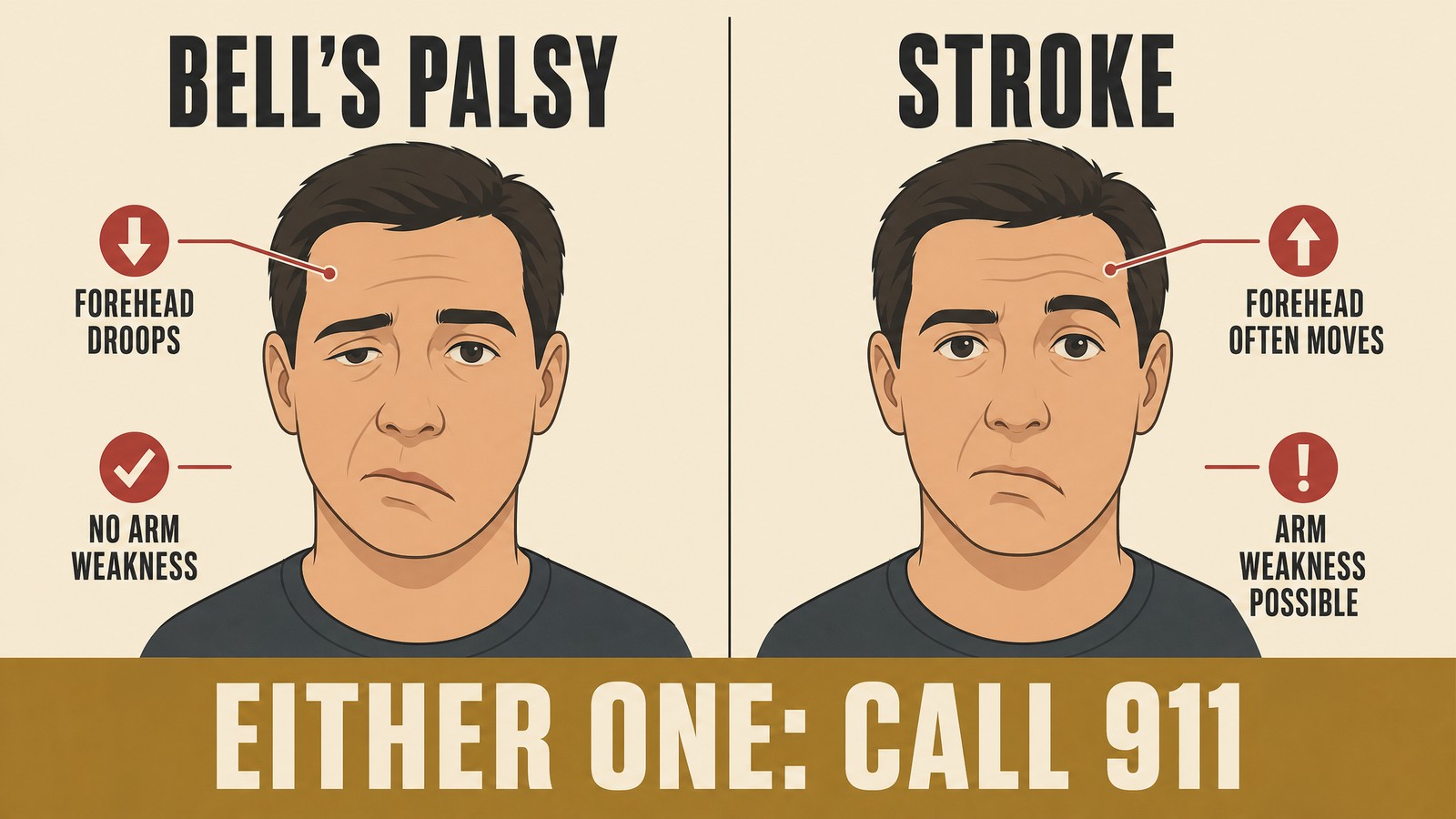
Treat the table as background, not a home test. Plenty of people over 60 get Bell's palsy, and strokes happen to younger adults.
The Forehead Clue (and Why You Cannot Rely on It)
Here is the most useful bedside trick, and also the one people trust too much.
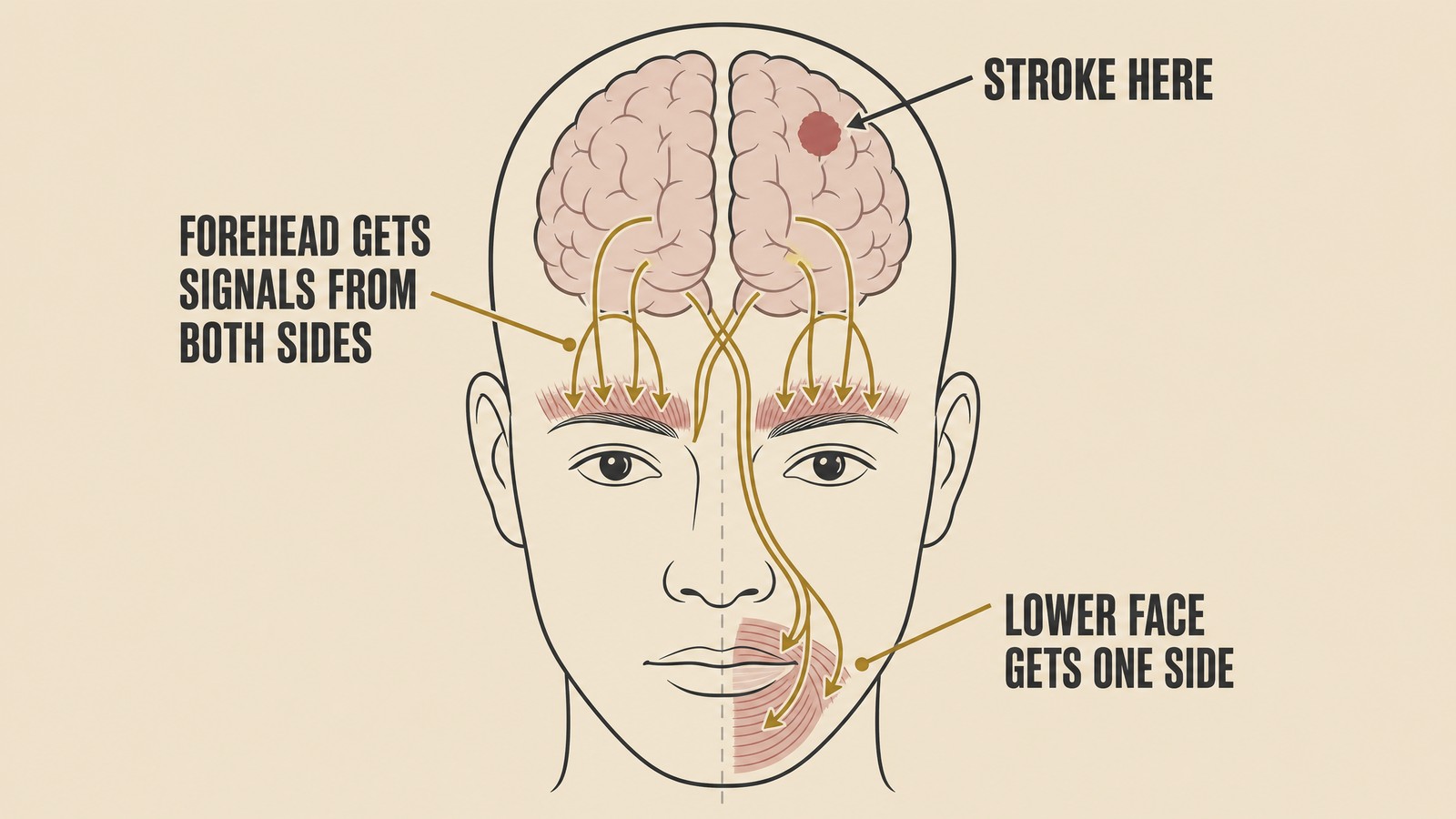
The muscles of your forehead get nerve signals from both sides of the brain. When a stroke damages one side of the brain, the other side usually keeps the forehead working. The result is a drooping mouth and cheek but an eyebrow that still lifts and a forehead that still wrinkles. Bell's palsy damages the nerve itself, past that junction, so the whole side goes down, forehead included. Medical News Today describes it the same way: Bell's palsy always involves the upper face, while a stroke does not typically affect the forehead.
Ask the person to raise both eyebrows. If one side will not lift, that points toward Bell's palsy. If both lift, that points toward a stroke.
Now the catch. Some strokes do affect the forehead, and a person under stress may not follow the instructions well. The clue can tilt your suspicion, but it cannot lower your alarm. If you ever catch yourself thinking "the forehead moves, so it's a stroke," the plan is to call. If you think "the forehead is frozen, so it's probably Bell's palsy," the plan is the same.
Other signs that push hard toward a stroke: weakness or numbness in an arm or leg, slurred speech, sudden confusion, vision loss in one or both eyes, a sudden severe headache, or trouble walking. Our posts on sudden vision loss and headache red flags cover two of those in more detail.
How the ER Tells Bell's Palsy vs Stroke Apart
The ER team starts with a quick neurological exam. They watch you smile, raise your eyebrows, close your eyes tight, lift both arms, and speak. They check strength, sensation, vision, and coordination. A doctor looking at upper and lower facial muscles on one side is one of the main tools for Bell's palsy, according to NINDS.
If a stroke is possible, you will usually get a brain scan, either a CT or an MRI, along with blood tests and a heart check. The point is speed. Clot-busting treatment for the most common type of stroke only works within a limited window, and the clock starts when symptoms began, not when you arrived. That is why the time you noticed matters.
There is no single lab test for Bell's palsy. It is diagnosed by the pattern of weakness and by ruling out other causes. Sometimes that includes a look for shingles near the ear, which can paralyze the face nerve as well, or an ear infection.
What to Do in the First Hour
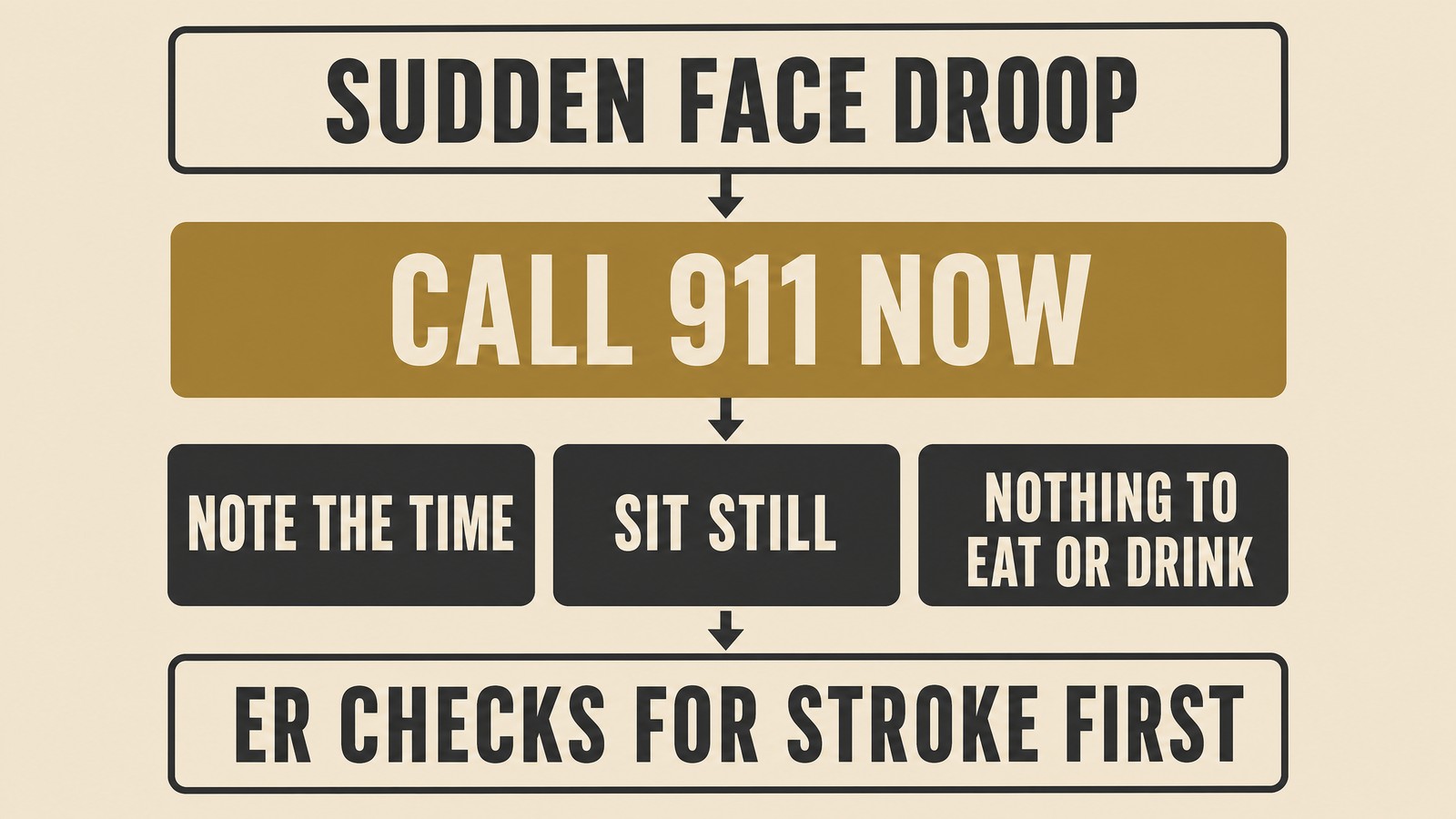
Call 911 for any sudden facial droop. Do not drive yourself, and do not wait to see if it passes.
While you wait for the ambulance:
- Write down or remember the time you first noticed the droop, or the last time the person looked normal.
- Sit the person down, and keep them calm and still.
- Give nothing to eat or drink, because swallowing may be affected.
- Do not give aspirin unless a 911 dispatcher tells you to.
- Unlock the door and gather a medication list for the crew.
If the person is alone, they should unlock the door, sit near it, and keep the phone in hand.
A few people feel embarrassed to call for what turns out to be Bell's palsy. Do not. Paramedics and ER staff would rather see a hundred false alarms than miss one stroke. And the treatment for Bell's palsy also has a clock.
Bell's Palsy Care After a Stroke Is Ruled Out
If the ER finds Bell's palsy, the news is mostly good. NINDS says most people recover some or all facial function within a few weeks to six months, though in some cases weakness lasts longer or becomes permanent. Mayo Clinic notes that it rarely comes back.
Treatment works best when started early. NINDS says oral steroids should begin within three days of the first symptoms, and a doctor may add an antiviral in some cases. So the fast call helps here too.
The eye needs attention. If you cannot close it, it dries out, and Mayo Clinic warns that dryness can damage the surface of the eye. Doctors usually recommend lubricating drops during the day, ointment at night, and sometimes taping the eyelid shut for sleep. Follow your doctor's instructions on this, and report eye pain or blurry vision right away.
Expect an odd few weeks. Eating can be messy, a drink may dribble, and smiling in photos will feel strange. It improves. If there is no improvement by a few weeks, or the weakness gets worse, follow up with your doctor or a neurologist.
Knowing the signs is one thing. Having gear and a plan ready when seconds matter is another. See what's inside The 1stHour Trauma Kit, built for the first hour of whatever happens next.
This content is for informational purposes only and does not constitute medical advice. Sudden facial drooping, weakness, speech trouble, or vision changes are emergencies. Call 911 right away.


