Sudden Vision Loss: What It Means and How Fast to Move

You're reading this because something just happened to your vision, or to someone else's, and you're trying to figure out how worried to be. Maybe it's a shadow creeping in from one side. Maybe it's a curtain that dropped over half your view. Maybe your vision just went dark in one eye for thirty seconds and then came back, and now you're wondering if that even counts as a real problem.
It does. Sudden vision loss is one of the few symptoms in medicine where "wait and see" is almost never the right answer. This post walks through why, what the different patterns actually mean, and what to do in the next hour.
The Curtain, the Flashes, and Why They're Not the Same Thing
Two different warning signs get lumped together a lot, and they're not equally urgent, though both deserve fast attention.
Flashes alone, brief streaks of light at the edge of your vision, especially when you move your eyes or in a dark room, can be a symptom of a retinal tear starting. New floaters, a sudden scatter of spots, cobwebs, or dark specks drifting across your sight, are the other early sign. Either one by itself is worth a same-day call to an eye doctor.

A curtain or shadow is different. That's the sign of a retinal detachment already underway. It usually starts at the edge of your vision, top, bottom, or side, and spreads inward. Some people describe it as a gray veil, others as if someone pulled a shade partway down over one eye. It is painless, and that's exactly what makes it dangerous. People wait because nothing hurts.
If you're getting flashes and floaters together, or if any part of your vision has a shadow or curtain over it, that's not a "call the eye doctor Monday" situation. That's a same-day, often same-hour, situation.
Painless vs. Painful: The Question That Decides Your Next Move
Here's a question worth asking yourself immediately: does it hurt?
Painless sudden vision loss in one eye is the pattern behind retinal detachment, retinal artery occlusion, and something called amaurosis fugax, a temporary vision loss that clinicians describe as a retinal transient ischemic attack, or TIA. All three can look similar from the inside: vision goes dark, dim, or partially blocked, and there's no eye pain to go along with it. That absence of pain is not reassuring. It's often the opposite.
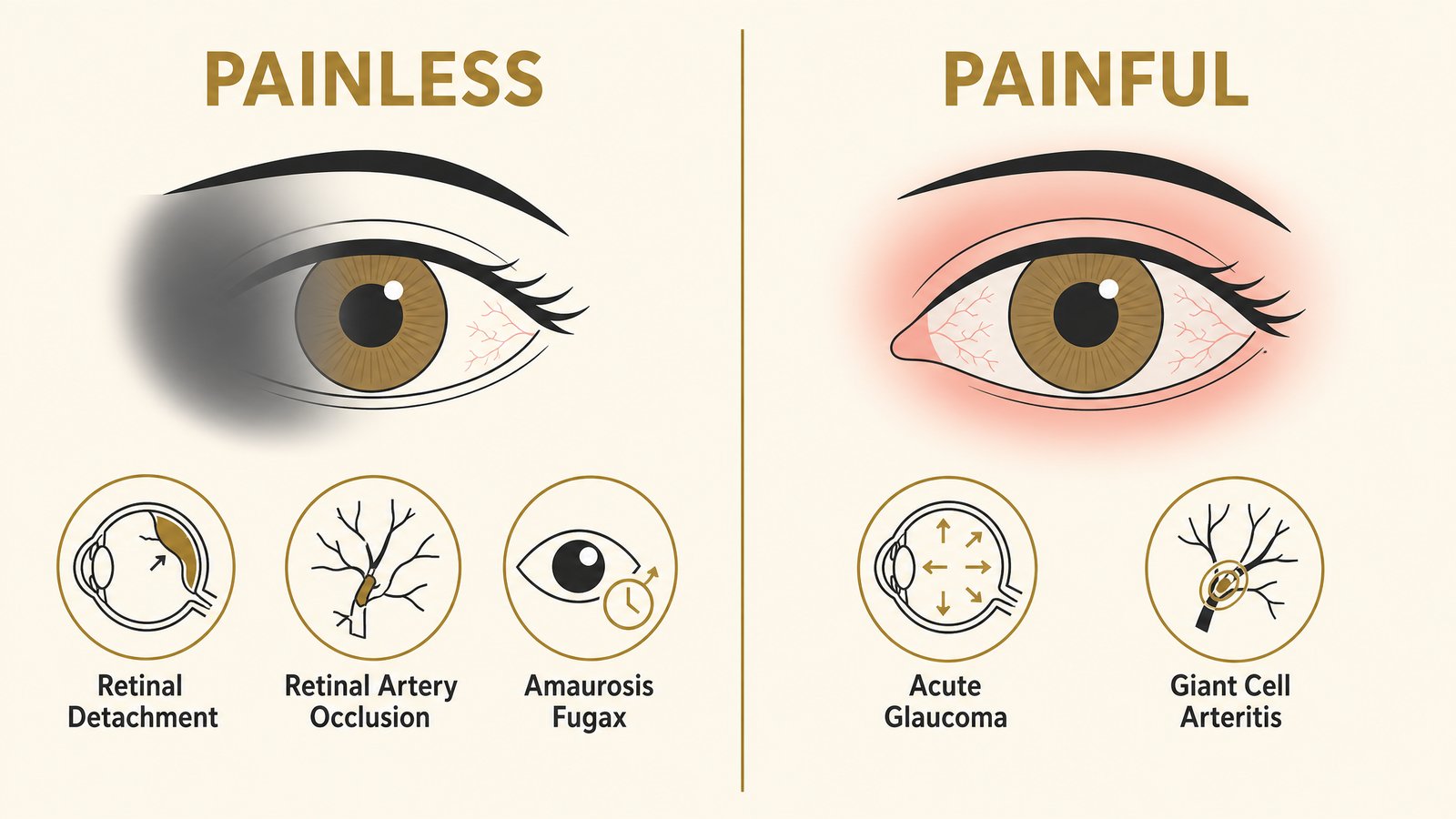
Painful vision loss points somewhere else. Acute angle-closure glaucoma causes sudden pain, redness, blurred vision, and sometimes nausea, often with halos around lights. Giant cell arteritis, a condition mostly seen in adults over 50, can cause sudden vision loss along with a new headache, tenderness at the temples, and pain when chewing, sometimes called jaw claudication. Both are still emergencies. Pain doesn't downgrade the urgency, it just points a doctor toward a different diagnosis once you're already on your way in.
Either way, painless or painful, the move is the same: this is not a symptom to sit with.
The Clock Is Real: How Fast Vision Loss Emergencies Actually Move
This is the part people underestimate the most. These aren't vague "get it checked out eventually" conditions. Several of them run on a clock measured in hours.
Central retinal artery occlusion, sometimes described by the American Academy of Ophthalmology as a stroke of the eye, happens when a clot blocks blood flow to the retina. Research summarized in the medical literature puts the best chance of visual recovery at treatment within roughly 90 minutes to 4 hours of the vision loss starting. Past that window, the odds of getting meaningful vision back drop sharply. There is genuinely no version of this where waiting overnight helps.
Retinal detachment moves on a slightly longer but still short clock. Ophthalmologists generally consider it a true emergency requiring treatment within 24 hours to prevent permanent vision loss. Caught early, while it's still just a tear, a fairly simple laser procedure can often seal it before it becomes a full detachment. Wait too long and that same tear can progress to a detachment that needs a much bigger surgery, with a real risk that some of the lost vision never comes back.
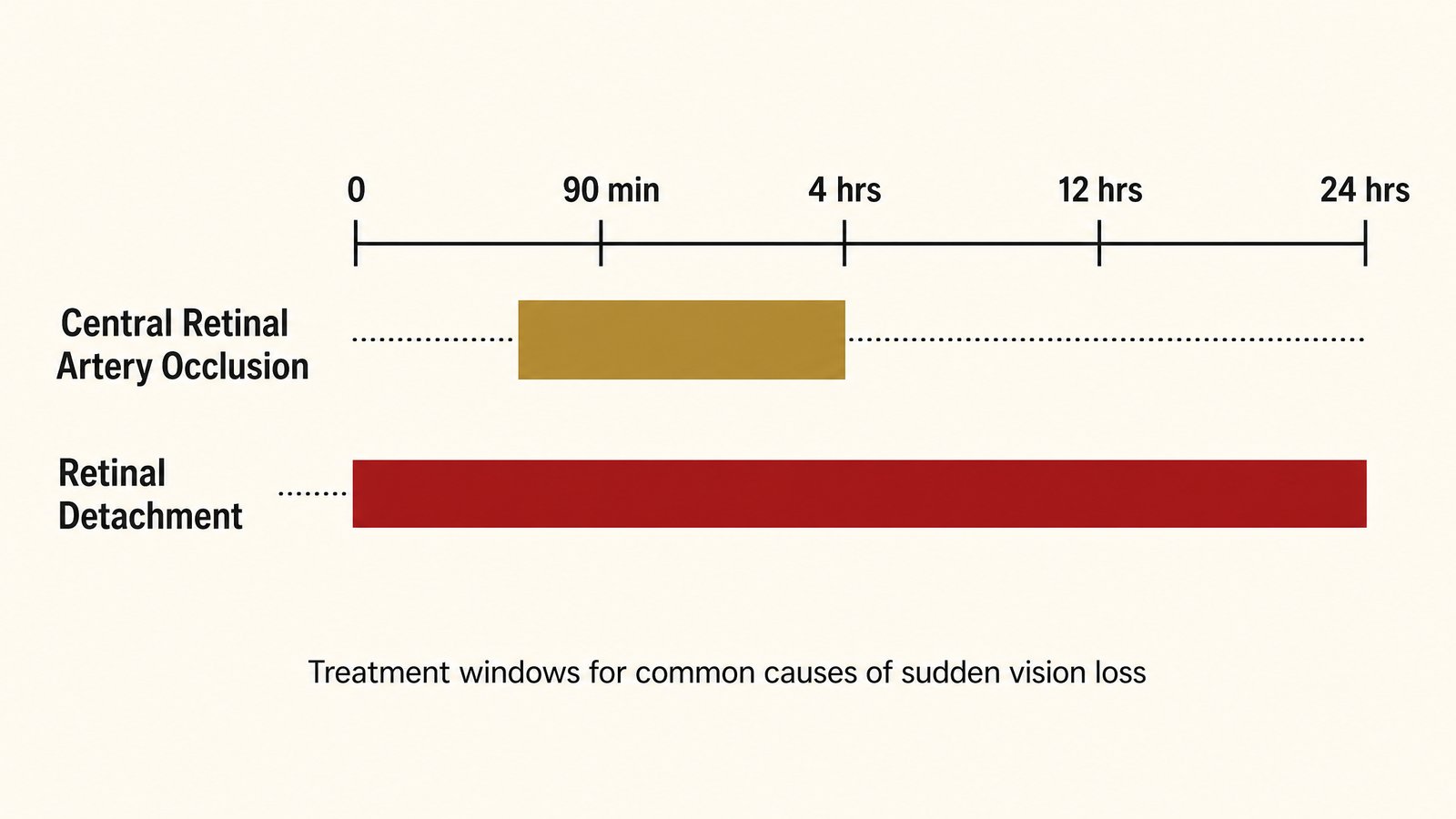
Neither of these conditions announces itself with pain. Both of them are treatable if you move fast and much harder to treat if you don't.
When Vision Loss Is Actually a Stroke Warning
Amaurosis fugax deserves its own section because people talk themselves out of taking it seriously more than almost any other symptom on this list.
It goes like this: vision in one eye goes dark, dim, or gets a shade pulled over it, sometimes described exactly like the retinal detachment curtain. Then it clears up on its own within a few minutes. Because it resolves, plenty of people decide it must not have been serious. That's backwards.
Amaurosis fugax is considered a transient ischemic attack of the eye, according to Cleveland Clinic. It's frequently a warning sign of the same vascular problems that cause strokes: carotid artery disease, clots, cardiac issues. Clinical data puts the one-year stroke risk after an episode somewhere in the range of 5 to 10 percent. That's not a number you get to ignore just because your vision came back.

This is also a good moment to know the broader signs of a stroke beyond the eyes; sudden vision changes are one entry on that list, and knowing how to recognize a stroke FAST covers the rest of what to watch for in the face, arms, and speech. If someone has a sudden vision episode along with any facial drooping, arm weakness, or slurred speech, treat it as a stroke and call 911 without hesitation.
What to Do in the First Hour
If you or someone with you experiences sudden vision loss, partial, total, or limited to one eye, here's the short version:
Call 911 or get to an emergency room immediately. Don't drive yourself if your vision is significantly affected; have someone else drive or call an ambulance. Don't wait to "see if it gets better," and don't wait until morning or until your regular eye doctor's office opens. Note what time it started and which eye, or if it was both. That detail matters for treatment decisions and it's easy to forget once you're already in a waiting room.
If there's any pain involved, say so right away. The same goes for a new headache, scalp tenderness, or jaw pain in someone over 50. It changes what the care team looks for first.
Mention diabetes too, if it applies. Diabetic eye complications, including sudden bleeding inside the eye, are a separate but related reason vision can go dark fast. Blood sugar crashes can affect vision and alertness together, so it's worth knowing the broader signs of a diabetic emergency as well. This is also different from a direct blow or chemical splash to the eye; that's covered separately in eye injury first aid.
None of this is a situation where a wait-and-see approach pays off. The eye conditions on this list have real treatment windows, some as short as 90 minutes, and the stroke-adjacent ones carry risk that doesn't go away just because your sight came back.
Being ready for the first hour of a medical emergency isn't just about knowing what to do, it's about having what you need close by when every minute counts. The 1stHour Trauma Kit was built around that same idea: the tools that matter most in an emergency, organized so you're not digging through a drawer while a clock is running somewhere you can't see.
This content is for informational purposes only and does not constitute medical advice. If you or someone near you is experiencing sudden vision loss, call 911 or seek emergency medical care immediately.


