Sprained Ankle vs Broken Ankle: How to Tell at Home

You rolled it. You are sitting on the floor or on the tailgate of somebody's truck, the ankle is already puffing up, and you are running the same calculation everyone runs. Is this a sprain I can ice tonight, or is this the kind of thing where I end up in a waiting room until midnight?
Most articles will hand you a comparison chart. We are going to do something more useful, because that chart is the reason people get this wrong. Here is what the ankle can actually tell you, and what it cannot.
Sprained Ankle vs Broken Ankle: What Is Actually Different
A sprain is a ligament injury. Ligaments are the tough bands that hold the ankle bones in position, and a sprain means one or more of them got stretched past their limit and tore, anywhere from a few fibers to the whole band.
A break is a bone injury. Three bones meet at your ankle: the tibia, the fibula, and the talus that sits between your heel and your lower leg. The knobs you can feel on either side of your ankle are the ends of the first two. Break any of them and you have an ankle fracture.
Around 90% of ankle sprains happen the same way, according to the American Academy of Orthopaedic Surgeons: the foot rolls inward and the ligaments on the outside of the ankle take the load. The thing is, that is also one of the most common ways to break an ankle. Same misstep, same twist, same curb. The mechanism does not sort the two injuries for you, which is why so many people are certain they know what happened and are wrong.
Pain, Swelling and Bruising Will Not Tell You Which One You Have
This is the part almost every article gets backwards, so read it twice.
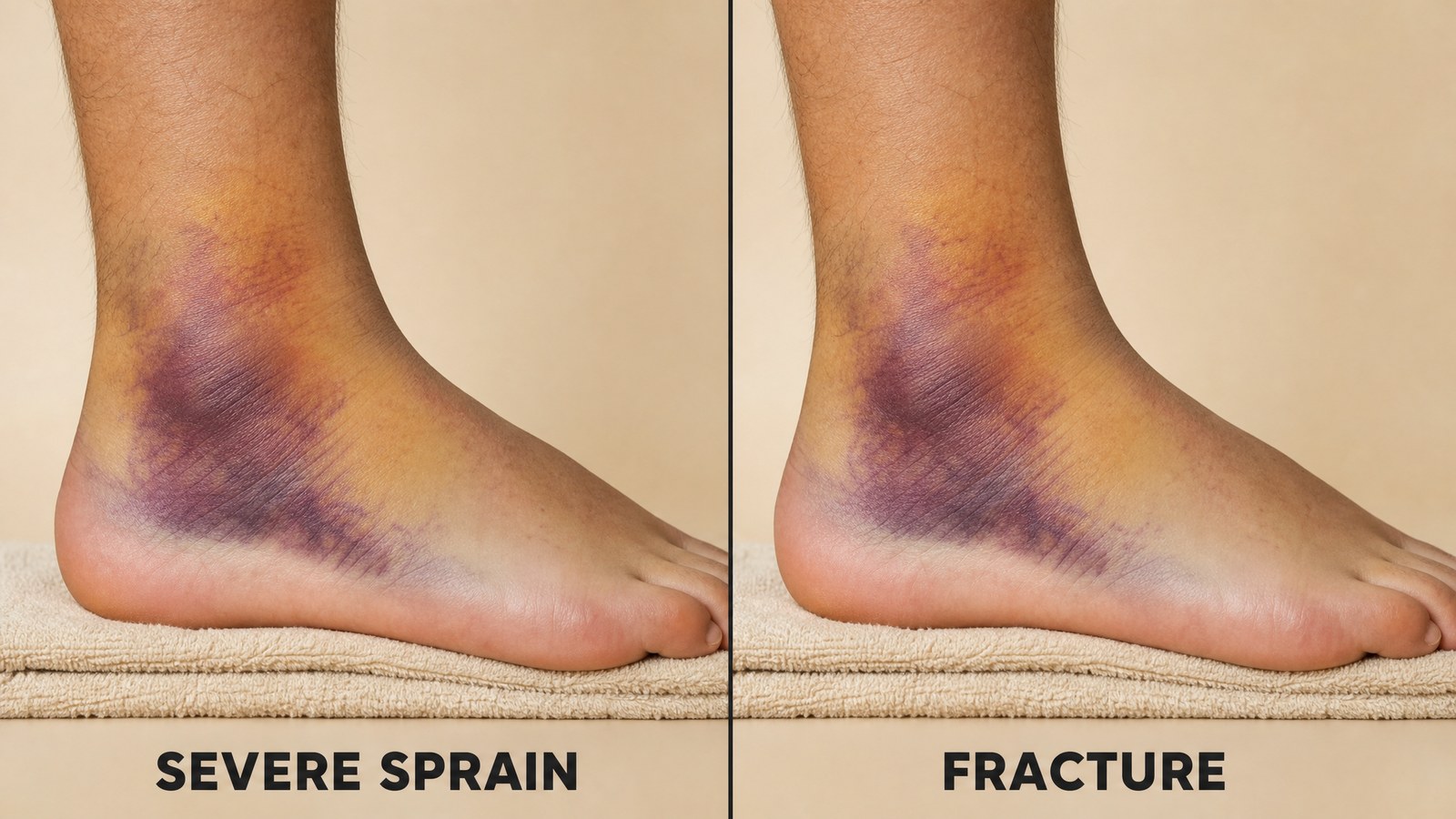
AAOS puts it about as plainly as a medical body ever does: severe ankle sprains can have a similar degree of pain, bruising and swelling as a fracture, which makes it hard to tell the difference between the two injuries. Cleveland Clinic says the same thing from the other direction. It is not always easy to know if your ankle is broken just by how it feels.
So all the folk rules you have heard need to go.
"If it were broken, I couldn't walk on it." A minor fracture will often let you walk. Cleveland Clinic says you might not even know you broke it. AAOS describes ankle fractures that range from a simple break in one bone, which may not stop you from walking, all the way up to injuries that need surgery.
"There's too much bruising for a sprain." A grade 3 sprain, where the ligament tears through completely, produces dramatic swelling and bruising. It can look worse than a clean fracture.
"I heard a pop, so it's a sprain." A pop can be a ligament tearing. It can also be bone. If you heard an actual crack, the NHS treats that as a reason to go to emergency care, not a reason to relax.
"The pain is spread out, not on the bone." Once an ankle swells, everything is tender. Trying to localise pain through a swollen joint an hour after the injury is not a reliable test, and it is not the one clinicians use.
None of this means you are helpless. It means the useful information is somewhere else.
Press These Six Spots Before You Decide Anything
Emergency departments do not X-ray every ankle that comes through the door. They use a decision rule, validated over decades, that comes down to bone tenderness at named spots plus a walking test. You can run the tenderness half of it on your own ankle right now.
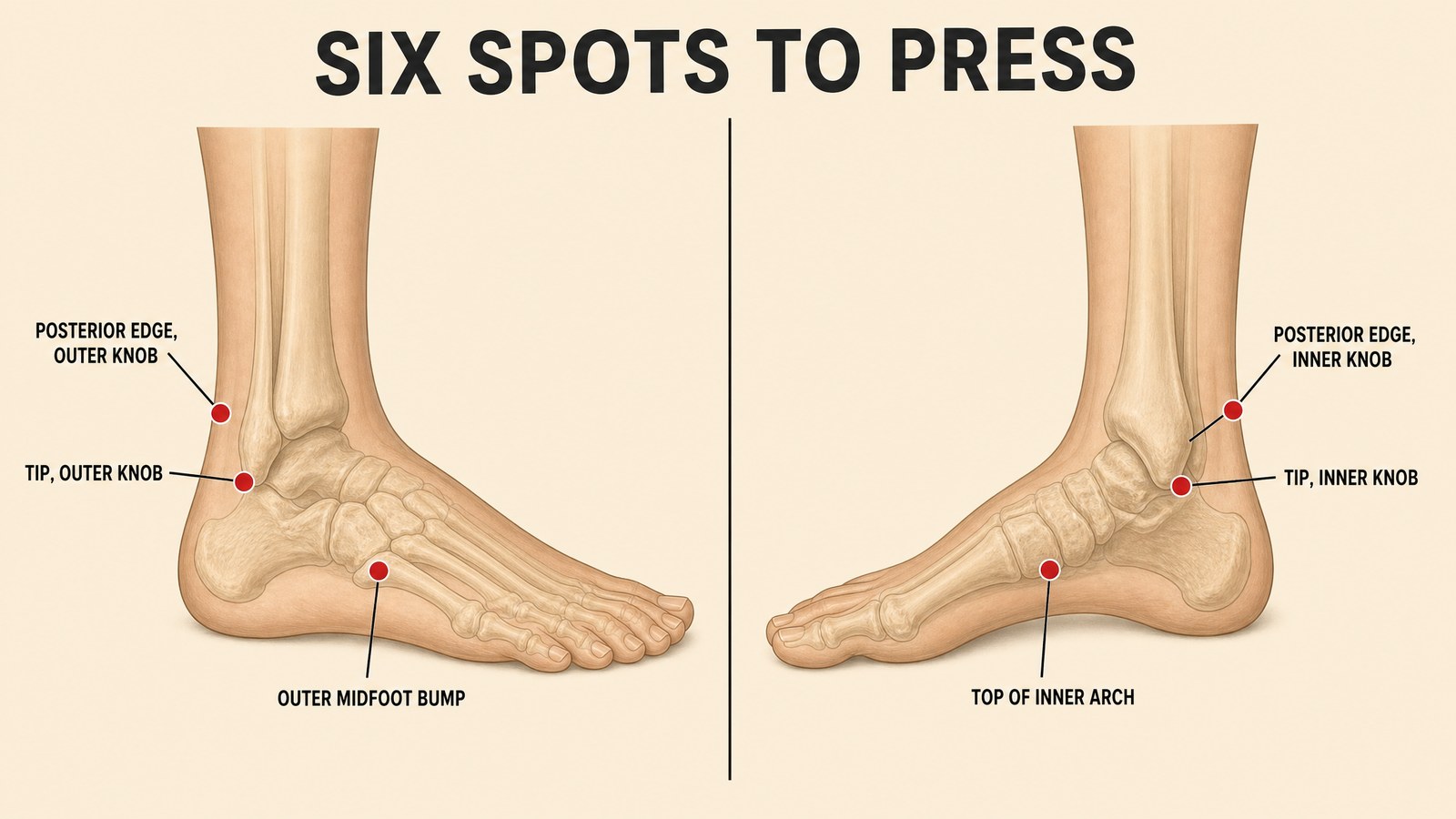
Use one fingertip. Press firmly, the way you would press a bruise to see how bad it is, and work through these six places one at a time on the injured side:
- The back edge of the bony knob on the outside of your ankle. Not the front, not the tip. Run your finger up the back of that knob for about two inches.
- The very tip of that outside knob.
- The back edge of the bony knob on the inside of your ankle, same two inches.
- The very tip of that inside knob.
- The outer edge of your midfoot, about halfway between your heel and your little toe. There is a bump there where a bone flares out. It is one of the most commonly missed fractures in a rolled ankle.
- The top inside arch of your foot, roughly in line with your big toe, an inch or two forward of the ankle.
What you are feeling for is sharp, specific, right-on-the-bone pain, clearly worse than the general ache around it. Sore soft tissue is expected. A hot point of pain on bone is different, and you will usually know it when you find it.
If any of those six spots lights up, get an X-ray. That is the finding, according to StatPearls' review of the Ottawa ankle rules, that separates the ankles worth imaging from the ones that are not. Used properly, the rule catches close to 100% of fractures that matter while cutting unnecessary X-rays by roughly 30%.
The Four-Step Test (and What It Does Not Prove)
The second half of the rule is weight-bearing, and it is more specific than "can you walk."

The question is whether you could take four steps right after it happened, and whether you can take four steps now. Not hobble a foot forward. Four actual steps, transferring weight onto the injured ankle each time. Limping counts. Hopping does not.
Two failures and no bone tenderness still gets you imaged. That combination is the whole rule.
Now the warning, because this test gets misused constantly. Do not run it at all if the ankle looks bent or pointed the wrong way, if your foot is numb or tingling, if the skin has gone pale, grey or blue, if it is cold to the touch, or if there is a wound over the joint. Any of those means stop and get emergency care. Never try to straighten an ankle that is sitting at an odd angle. You can do real damage to nerves and blood vessels, and it changes nothing about the treatment you are going to need.
And the honest caveat: passing both halves of this check does not mean your ankle is fine. It is a decision aid built for clinicians who are also looking at you, taking a history, and putting hands on the joint. A clean result lowers the odds of a fracture. It does not rule one out. If the ankle is still not right in a week, get it looked at regardless of what you found tonight. The same logic applies to any suspected break, which we walk through in how to tell if a bone is broken.
Feel Your Whole Lower Leg, Not Just the Ankle
Here is the one almost nobody checks, and it is worth ninety seconds.
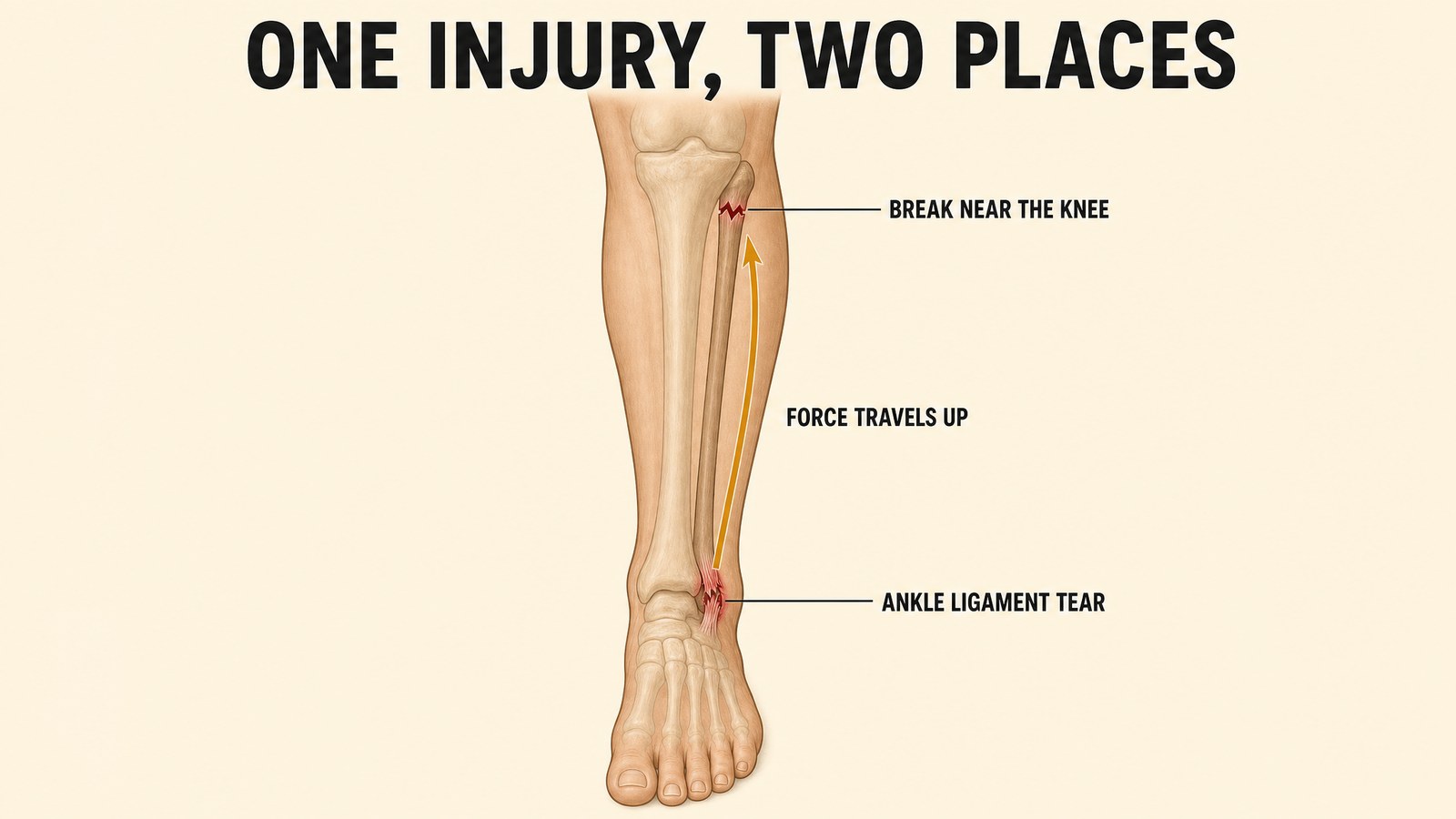
Run your hand up the outside of your shin, from the ankle knob all the way to just below the knee, pressing as you go. If there is a tender spot up near the top of that bone, you may be dealing with a Maisonneuve fracture. Cleveland Clinic describes it exactly this way: you sprain your ankle and break the upper part of your fibula, near your knee. The force travels up the leg and comes out somewhere you are not looking.
People miss this constantly, because the ankle is screaming and a bit of soreness below the knee seems irrelevant. It is not. StatPearls tells clinicians to palpate proximally along the fibula for this specific reason.
While you are there, press just above the ankle joint on the front, where the two lower leg bones sit side by side. Real tenderness a couple of inches above the joint line points toward a high ankle sprain, which involves the ligaments binding those two bones together. High ankle sprains heal slower than ordinary ones and often need proper assessment.
If either spot hurts, mention it by name when you are seen. It changes which X-rays get ordered.
Sprained Ankle vs Broken Ankle: What the First 72 Hours Tell You
Time sorts these injuries better than any test you can run in the first hour.
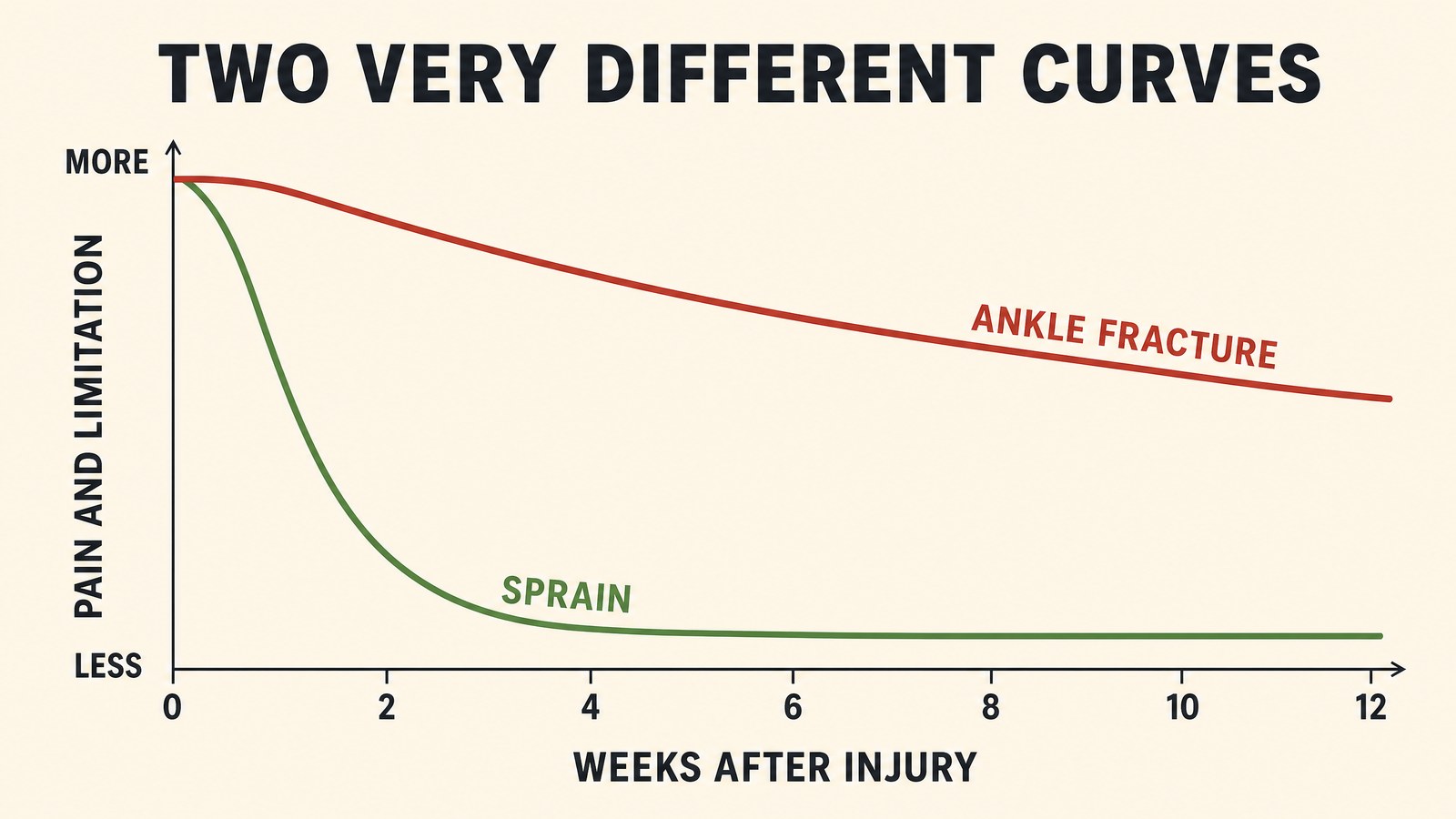
With most sprains, the worst of the swelling and pain lasts two to three days, then starts backing off. AAOS grades them by how much ligament gave way. Grade 1 is stretched fibers with mild swelling and usually no pain on weight-bearing. Grade 2 is a partial tear with moderate swelling and mild pain on weight-bearing. Grade 3 is a complete tear, severe pain standing on it, and an ankle that feels loose. Even a grade 3 usually heals without surgery if it is protected and rehabbed properly.
The NHS puts the ordinary sprain timeline at feeling better after about two weeks, with strenuous exercise off the table for up to eight.
Fractures do not follow that curve. Bone takes at least six weeks for early healing and ten to twelve for complete healing, and most people are three to four months out from normal activity. If your ankle is not clearly improving day over day, or you still cannot put weight through it after a week, that is your answer. Stop waiting and get imaged.
What to Do While You Wait to Be Seen
Whatever this turns out to be, the first two or three days look the same. The NHS calls it PRICE.
Protect the ankle with a supportive shoe, a brace, or a bandage. Rest it and keep weight off. Ice it for up to 20 minutes at a time, every two to three hours, with something between the ice and your skin. Compress it with a bandage during the day. Elevate it above heart level as much as you can for the first 48 hours.
Skip the heat, the hot bath, the alcohol and the deep massage for the first couple of days. All of them push more blood into a joint that is already swelling. A pharmacist can point you at the right over-the-counter option for pain and swelling if you need one.
Keep the ankle raised while you wait. A cold pack, an elastic bandage and something to elevate on are the useful items here, and this is the situation where you find out whether your home first aid kit is actually stocked. If you are somewhere without help nearby and the leg needs stabilising before anyone moves it, the same rules apply as with any suspected fracture. Our guide to splinting a broken bone covers that, including how to check circulation past the splint once it is tied.
When an Ankle Injury Is an Emergency
Stop reading and get emergency help now if any of these are true. The NHS lists them as reasons to call 999 or go straight to A&E, and they translate directly to calling 911 or heading to an emergency department here.
- You heard a crack when it happened
- The ankle or foot has changed shape or points at an odd angle
- The foot is numb, tingling, or has pins and needles
- The skin has turned blue, grey or unusually pale, or the foot is cold to touch
- Bone is visible, or there is an open wound over the joint
- The pain is severe and getting worse rather than settling
Do not drive yourself. If the foot is numb or discoloured, that can mean pressure on a nerve or a blood vessel, and time matters in the same way it does with any serious trauma. The same goes for an ankle injured in a fall from any real height, where the ankle is often the least of what got hurt.
Most ankle injuries are sprains, and most sprains do fine. The reason we keep coming back to this topic is that the gap between a bad sprain and a quiet fracture is invisible from the outside, and the cost of guessing wrong is an ankle that heals crooked. Cold, compression, and a way to stabilise a limb before it gets moved cover the part you can control. The 1stHour Trauma Kit puts all of that in one grab-and-go package of 82 pieces. The rest is a phone call and an X-ray.
This content is for informational purposes only and does not constitute medical advice. The checks described here are decision aids, not diagnoses, and a clean result does not rule out a fracture. Seek emergency care for any visible deformity, numbness, colour change or coldness in the foot, an open wound over the joint, or pain that keeps getting worse.


