Fishhook Removal: How to Get It Out Without Making It Worse

You were casting, baiting up, or netting someone else's catch, and now there's a hook where a hook shouldn't be. Knowing how to remove a fishhook safely, instead of just yanking on it, is the difference between a two-minute fix and a trip to urgent care. Maybe it's just a prick that didn't quite go through. Maybe the barb is buried in your palm and every attempt to move your hand reminds you it's there. Either way, the instinct to just yank it out is usually wrong, and the instinct to panic is unnecessary.
Fishhook injuries are one of the most common outdoor accidents there is, and most of them are minor enough to handle on the riverbank or in your kitchen. This guide covers how to tell which kind you've got, how to get it out if it's safe to try, and exactly when that decision isn't yours to make anymore.
Should You Try to Remove a Fishhook Yourself?
Three things decide this, not gut feeling. First, has the barb actually broken through the skin, or is the point just resting under the surface? If you can see it hasn't fully set, you can often back it straight out the way it entered without any special technique at all.
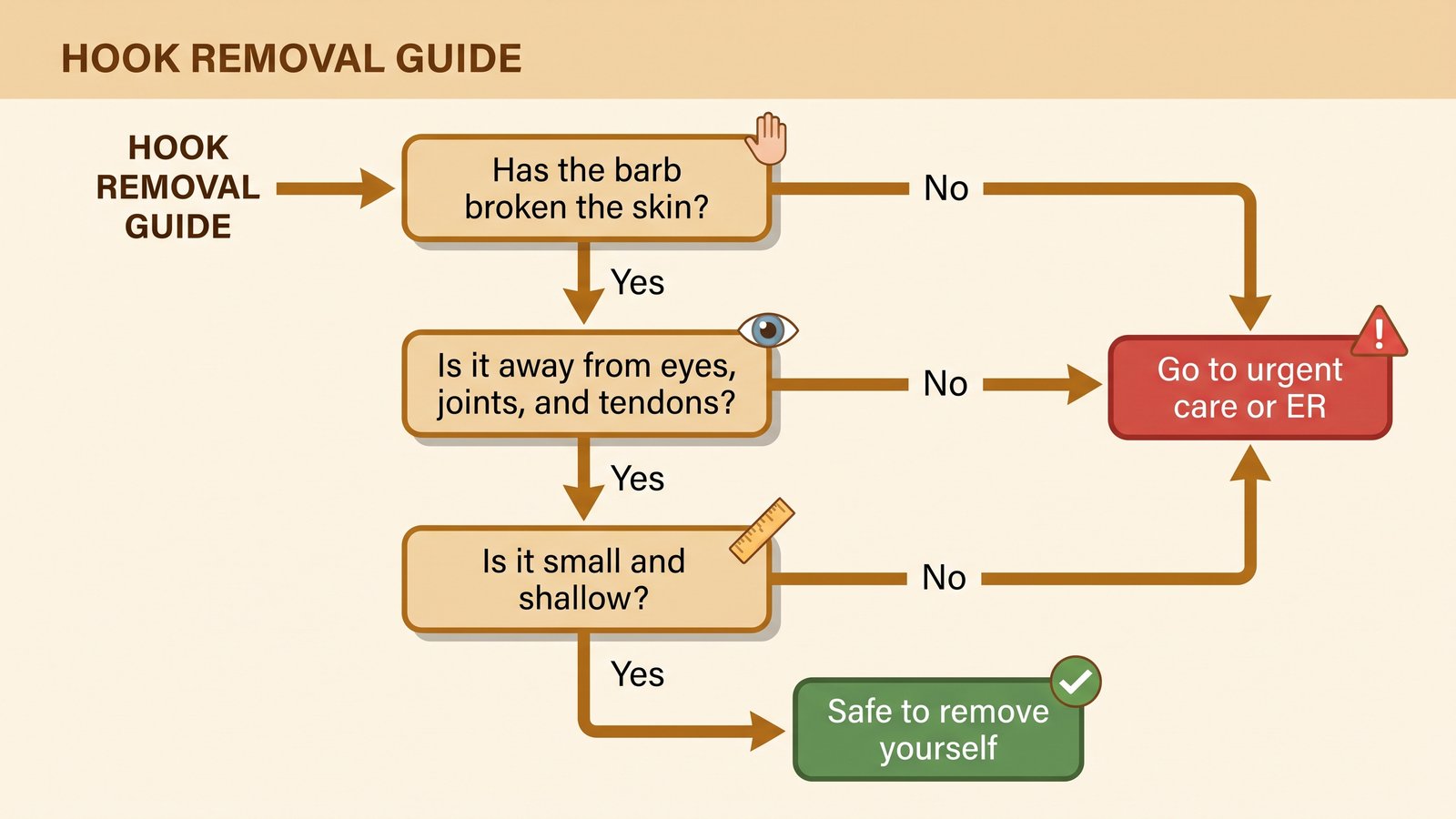
Second, where is it? Hands, arms, legs, and torso are generally fair game for self-removal. Anywhere near the eye or eyelid is never a do-it-yourself situation, full stop. Joints, tendons (the back of the hand and top of the foot are common spots), and anywhere you'd hit a major blood vessel also belong to a doctor, not a tackle box.
Third, how deep and how big. A small single hook a quarter-inch under the skin in a fleshy part of the arm is a different problem than a large treble hook with multiple points buried in your palm. If any part of this gives you real doubt, that doubt is your answer. Head to urgent care.
How to Remove a Fishhook: The String-Yank Technique
This is the method anglers and emergency doctors both reach for first, because it causes the least additional damage and often works without any pain medication at all. The American Academy of Family Physicians lists it as one of the two go-to techniques for a reason: it's fast, and it rarely creates a second wound.
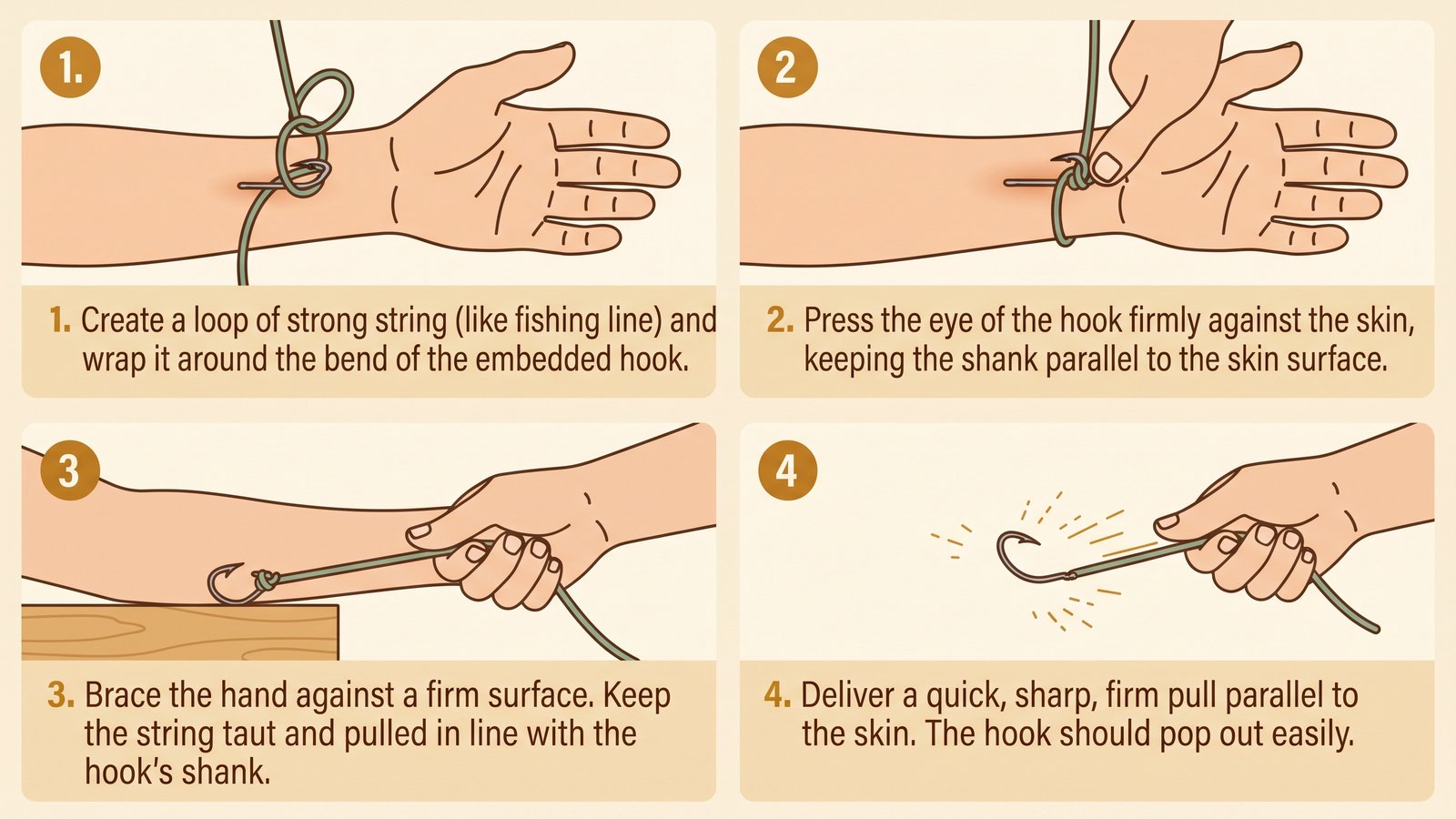
- Cut the line and any lure off the hook so you're only dealing with the hook itself.
- Wash your hands and the skin around the hook with soap and water.
- Loop a length of string, fishing line, or shoelace around the curved part of the hook, at the bend, not the eye. Hold both ends together.
- Press the eye of the hook down flat against the skin with a finger or thumb, and keep it there. This is what disengages the barb.
- Brace the injured area against a solid surface, then give the string one hard, fast pull, parallel to the skin and in line with the shank. Don't ease into it. A slow pull drags the barb through tissue; a quick one pops it past the point of resistance.
- The hook will come free quickly and can travel, so keep your face and anyone else's out of the path it'll fly.
If it doesn't come free on the first real attempt, stop and reassess rather than yanking harder. A hook that resists a proper string-yank is often bigger or deeper than it looked, and that's useful information, not a reason to try again with more force.
When the Hook Won't Budge (or You Shouldn't Try)
Sometimes the point of the hook has already pushed close to the surface on its way through, just not quite out. In that case, the "advance and cut" approach that doctors use is often more effective than fighting the barb backward: push the point the rest of the way through the skin, snip it off behind the barb with pliers or wire cutters, then back the now-barbless hook out the entry hole. It sounds more aggressive than the string-yank, but it's actually gentler on the tissue since you're never dragging a barb against the grain.
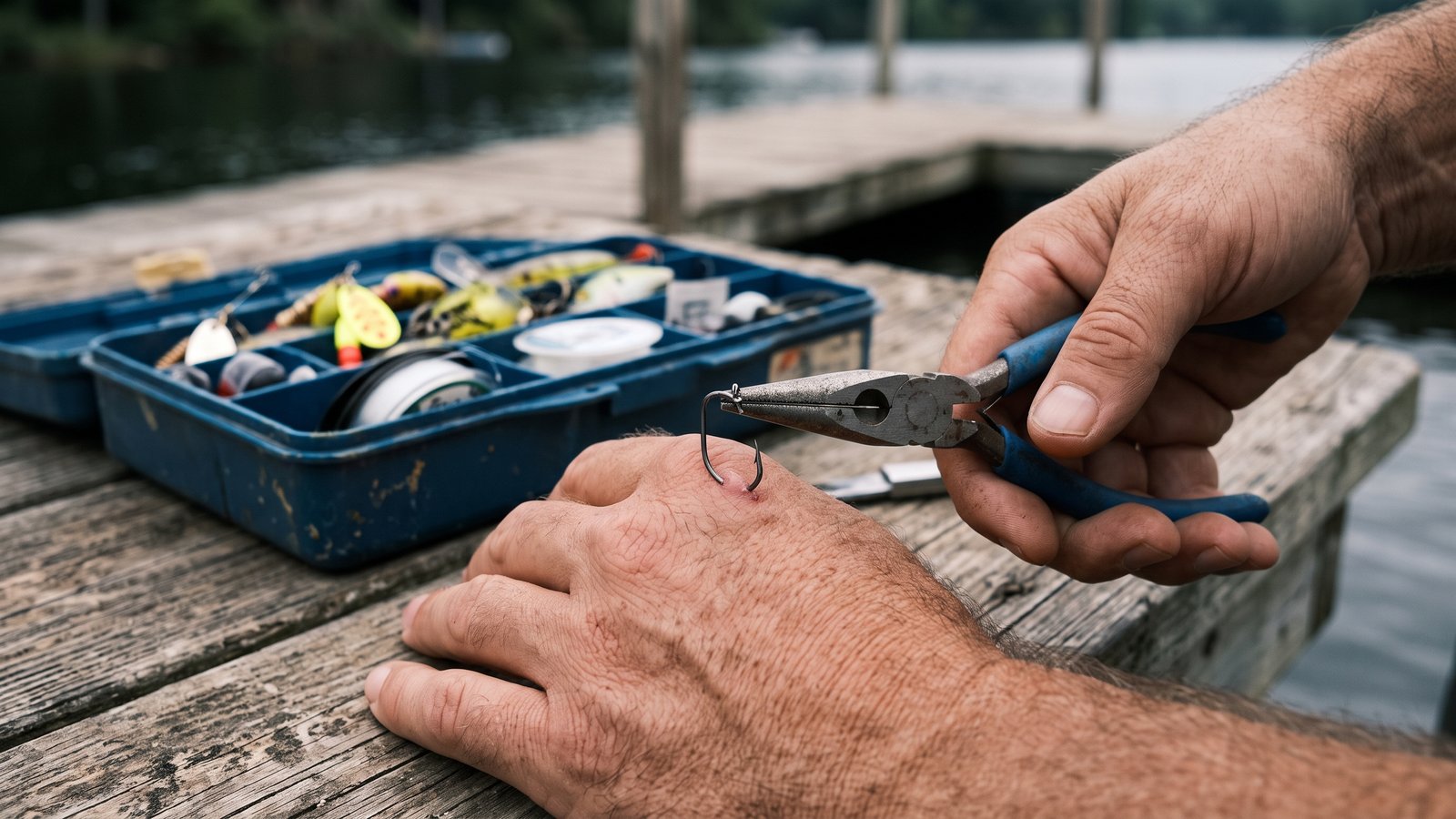
That said, this only makes sense when the point is genuinely close to breaking through somewhere convenient. If it's not, don't manufacture a second wound trying to force it there. And there's a hard stop list regardless of technique: a hook in or near an eye, one that's crossed into a joint or is sitting against a tendon, one embedded in the face deep enough to worry about nerves, or a treble hook with more than one point set in tissue. All of those go to urgent care or the ER, where they can numb the area first and remove it properly.
Do You Need a Tetanus Shot?
Probably worth checking, and it's a quick mental math problem. If your last tetanus booster was more than five years ago and the wound is dirty (which a fishhook injury usually is, given where it happened) or fairly deep, you're in the window where a booster is recommended. For a cleaner, more superficial hook injury, the standard ten-year rule applies instead.
We've written a full breakdown of when a tetanus shot is actually necessary and how to figure out your own timeline, since most people genuinely don't remember their last one. If you're unsure, calling your doctor or an urgent care line to ask takes two minutes and settles it.
Wound Care and Infection Warning Signs
Once the hook is out, wash the area again with soap and water, apply a thin layer of antibiotic ointment, and cover it with a loose, sterile dressing. Don't tape the wound shut. Puncture wounds heal better open, since sealing them traps whatever bacteria came in on the hook. The same logic applies to any puncture wound, fishhook or otherwise.
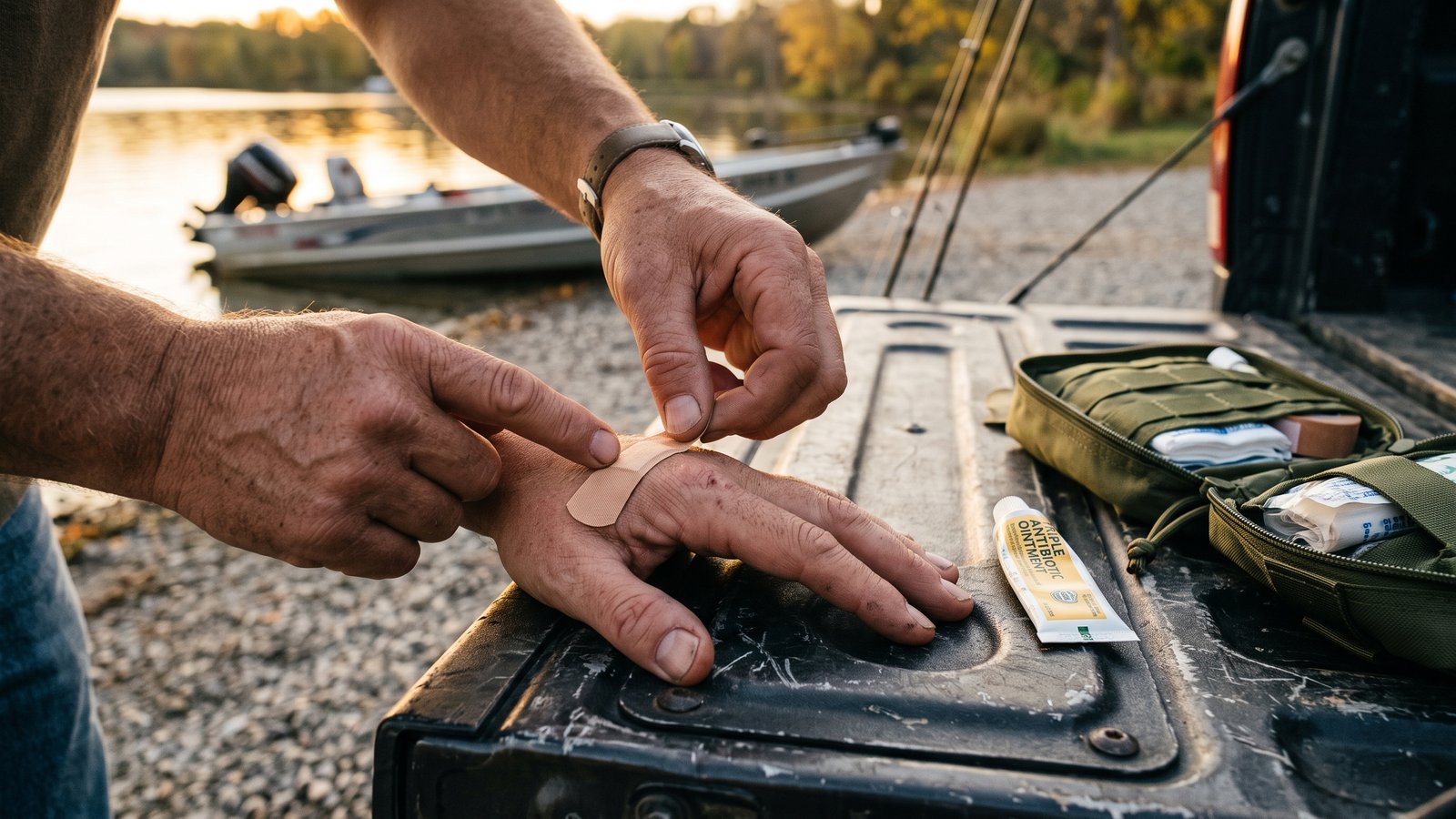
Watch it over the next few days. Some redness and mild swelling right at the site is normal for the first day. What's not normal: redness that keeps spreading outward, swelling that gets worse instead of better after 48 hours, warmth or throbbing pain, pus or cloudy drainage, or a fever. Any of those means the wound is likely infected and needs medical attention, not another day of watching and waiting. If the wound is jagged, gaping, or won't stop seeping, it may also need stitches rather than just a bandage.
Get to an ER or Urgent Care If...
Most fishhook injuries resolve at the tailgate or kitchen counter with nothing more than soap, a bandage, and maybe a tetanus check. A smaller number need real medical attention, and it's worth knowing the difference before you're standing there with a hook in your hand deciding.
- The hook is in or near an eye or eyelid. Mayo Clinic and MedlinePlus both treat this as a true emergency: don't touch it, don't remove it, cover it loosely with a cup or soft patch that doesn't press on the hook, and get to an ER immediately
- It's buried in a joint, near a tendon, or deep enough that you can't see where the barb is. Guessing at depth here is how a simple injury turns into a nerve or tendon problem
- It's a treble hook with more than one point set in the skin. Freeing one point often drives another one in deeper
- The person is a child who can't stay still, or an anxious adult who's more likely to jerk away mid-attempt than hold steady
- You've tried a proper string-yank once and it didn't work. Repeated attempts increase tissue damage without increasing your odds of success
None of this is about being overly cautious. It's about knowing which fishhook injuries are a two-minute fix and which ones need a professional doing the fixing.
Being Ready for the Next Trip
Hooks happen. Anyone who fishes long enough eventually deals with one, whether it's their own hand, a kid's ear, or a buddy's forearm on a bad cast. The difference between a five-minute inconvenience and an infected mess three days later usually comes down to what's in reach when it happens: clean hands, the right tool, and a way to dress the wound properly once it's out.
That's the whole idea behind keeping a real trauma kit within reach, not just a first aid kit built for paper cuts. See what's in the 1stHour Trauma Kit so the next hook, cut, or scrape doesn't send you searching the truck for a clean bandage.
This content is for informational purposes only and does not constitute medical advice. If a fishhook is near the eye, deeply embedded, or shows any sign of infection, seek medical attention.


