Electrical Shock First Aid: What to Do Before You Touch Anyone

Somebody in your house is going to touch a live wire, a frayed cord, or a plugged-in appliance that's fallen in water, and your first instinct is going to be to grab them. That instinct is the one thing you need to fight. A person still in contact with an electrical current is still part of the circuit, and reaching for them turns you into the second victim in the same accident. This post covers exactly what to do in that order: cut the power, check the person, and catch the injuries that don't look like much until they do.
Why You Can't Just Grab Them
Electricity doesn't stop moving once it finds a path through a body. If someone is still touching the source, whether that's a downed line, a faulty outlet, or an appliance with a short in it, the current is still flowing and their body is still part of that circuit. Touch them while that's true and the current has a new path: through you.
This is the single most common way electrical shock incidents turn into two patients instead of one. It's not a rare fluke. It's what happens almost every time someone rushes in on instinct without checking the power first. Your instinct will scream at you to help. Ignore it for the ten seconds it takes to find the breaker or the plug.
The good news is that this step is fast once you know it. It's not a complicated protocol. It's one habit: power off before hands on. Everything else in this guide depends on getting that first move right.
How to Cut the Power Source Safely
For household current, most of the time this is simple. Unplug the device if the cord is accessible and dry. If you can't reach the plug, go to the breaker panel and shut off the circuit, or flip the main breaker if you don't know which one it is. Don't waste time guessing which breaker controls which room. Kill the whole panel if you have to.
If you can't get to a breaker or outlet fast enough and the person is still in contact with a low-voltage household source, you can separate them using something dry and non-conductive: a wooden broom handle, a dry towel looped around a limb, a plastic chair pushed against them to break contact. Never use anything metal, and never use anything wet, including your own hands if they're damp. Water conducts. So does most of what's in a junk drawer, so stick to wood, dry cloth, or heavy plastic.
High voltage is a different situation entirely, and it changes the rules. Downed power lines, transformers, or anything near utility equipment should never be approached by anyone who isn't trained and equipped for it. Stay back at least 30 feet, more if you can manage it, and call 911 immediately. High-voltage current can arc through the air without direct contact, which means "safe distance" is farther than it looks. This is the one category of electrical shock where the correct first-aid action is simply staying away and getting professionals moving.
Once the Power Is Off: Checking and Responding
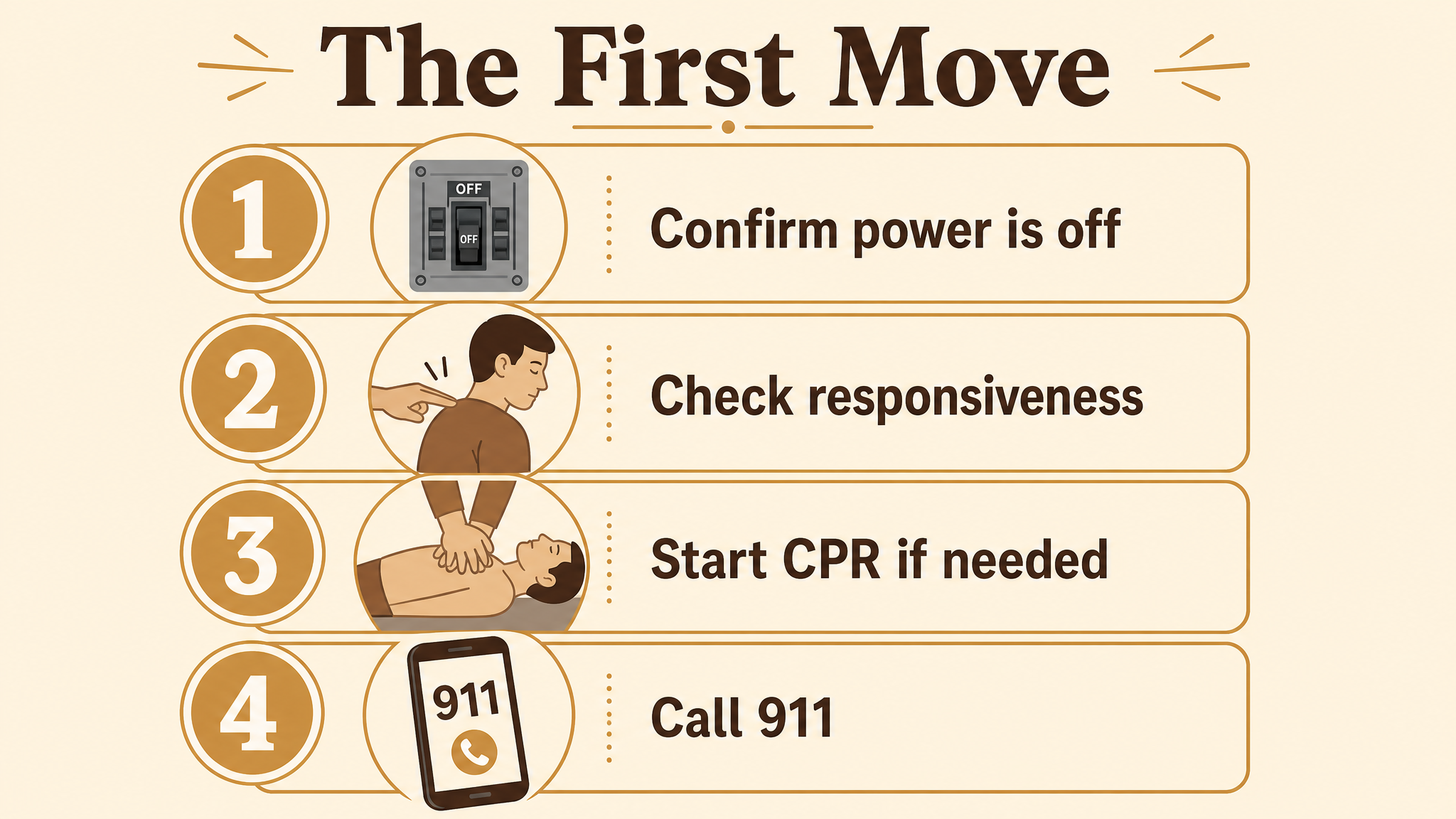
With the power confirmed off, and only then, you can approach. Here's the order that matters most, once the scene is actually safe:
- Confirm the power is off. Breaker flipped, cord unplugged, or contact broken with a non-conductive object. Don't skip this even if you're in a hurry.
- Check responsiveness. Tap their shoulder and ask if they're okay. Watch for a real response, not just a twitch.
- Start CPR if they're not breathing normally. Electrical current can throw the heart into a dangerous rhythm, and CPR in those first minutes is often what keeps blood moving until an AED or paramedics arrive.
- Call 911, even before you finish the full check if the situation looks serious. Tell the dispatcher it was an electrical injury specifically, since that changes what the responding crew brings and what they watch for once they arrive.
If you've never done hands-only CPR before, it's worth learning the two-step version now, before you're standing over someone who needs it.
If the person is conscious and talking, that's a good sign, but it's not the finish line. Keep them still, keep them warm, and don't let them get up and walk it off just because they feel okay in the moment. The next section explains why.
Electrical Shock First Aid: Symptoms That Look Fine but Aren't
This is the part most people get wrong, and it's the reason this topic matters as much as it does. A person can walk away from an electrical shock looking completely normal and still be at risk. Electrical current disrupts the heart's own electrical signaling, and that disruption can trigger a dangerous heart rhythm hours after the initial shock, not just in the moment it happened. Someone can feel steady, talk normally, insist they're fine, and still need a monitor.
Watch for confusion, muscle stiffness or weakness, numbness or tingling that doesn't fade, chest pain, or any irregular heartbeat sensation, even a mild one. Any of these after an electrical shock is a reason to get seen, not a reason to wait it out overnight. The body doesn't always send a loud signal when internal damage is happening. Sometimes it barely sends one at all.

There's also a mechanical injury risk that has nothing to do with burns. Electrical current can cause muscles to contract violently, hard enough to cause a fall, a fracture, or a dislocated joint, especially if the person was on a ladder or standing on something unstable when the shock happened. Check for those injuries too, not just the electrical ones.
Electrical Burns: What They Look Like and What to Do
Electrical burns are deceiving because the visible damage is often the smallest part of the injury. Current enters the body at one point and exits at another, and both spots can look like small, dark, almost dry wounds, nothing like the angry red burns you'd expect from a stove or a campfire. Small entry and exit marks can mask serious internal tissue damage along the entire path the current traveled between them, which can include muscle and even bone.
For the visible burn itself, cool it with cool running water, the same first move as any other burn, and cover it loosely with a clean, dry cloth. Don't use ice, don't apply butter or ointment, and don't try to clean or treat it like it's just a surface scrape. If you want the fuller rundown on burn care basics beyond electrical injuries specifically, our burn first aid guide covers the general do's and don'ts.
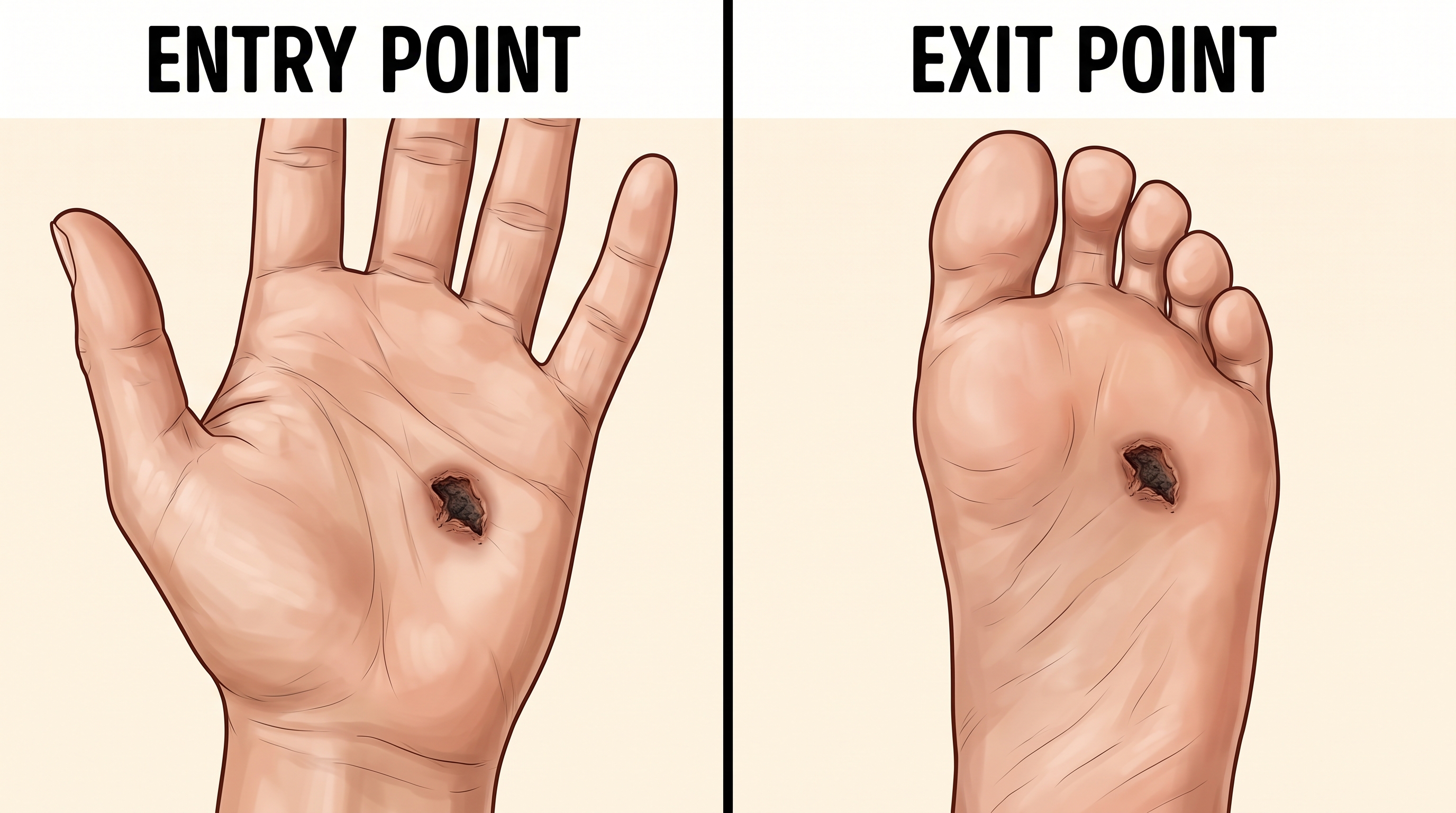
What matters most here is not treating the skin as the whole story. A small burn on the hand where current entered and a matching mark on the foot where it exited means current traveled through everything in between. That's an ER visit, not a bandage-and-move-on situation, regardless of how minor either mark looks.
Electrical Shock First Aid: When to Always Call 911
Some situations don't leave room for judgment calls. Call 911 immediately, every time, when any of these are true:
- The shock came from a high-voltage source: power lines, transformers, industrial equipment
- The person lost consciousness, even briefly
- There's any chest pain, irregular heartbeat, or shortness of breath
- The person is pregnant
- There are visible burns at more than one point on the body
- The person has a pacemaker or other implanted medical device
- You're unsure how strong the current was or how long contact lasted
Household shocks from something like a small static discharge or a brief, minor jolt from a properly grounded appliance are usually not emergencies. But if there's any real doubt, treat it like one. The downside of an unnecessary ER visit is a few hours of inconvenience. The downside of skipping one is finding out too late that the current did more damage than it looked like it did.
Electrical shock is technically an electrical injury with its own risks, but the general "don't wait it out" instinct applies across other home hazards too, including carbon monoxide exposure, another home danger that looks fine right up until it isn't.
Electrical shock is one of those emergencies where the right move looks almost too simple: cut the power, check the person, call for help, and don't trust how "fine" someone looks in the first few minutes. But simple isn't the same as automatic under pressure, and having the basics on hand for burns and other injuries in the meantime matters. If your home doesn't have a proper kit stocked yet, our home first aid kit checklist is a good place to start, and The 1stHour Trauma Kit is built for exactly this kind of first-hour response. Be ready before you need it.
This content is for informational purposes only and does not constitute medical advice. Electrical shock can cause serious or life-threatening injury, including delayed cardiac complications. Always call 911 after any significant electrical shock and seek professional medical evaluation, even if the person appears unharmed. This is not a substitute for hands-on emergency training.


