Hands-Only CPR: The Technique That Works Even Without Training
Most people freeze in a cardiac emergency. Not because they don't care — but because they're terrified of doing it wrong. This post covers exactly how hands-only CPR works, when to use it, and why the fear of "messing up" is the only real danger.
What Is Hands-Only CPR (And Why It Actually Works)
Traditional CPR combines chest compressions with rescue breaths. Hands-only CPR skips the mouth-to-mouth entirely. Just compressions. Hard and fast on the center of the chest.
It works because of how cardiac arrest actually unfolds. When someone collapses from sudden cardiac arrest, their blood still carries oxygen — for several minutes. The problem isn't a lack of oxygen in the blood. The problem is that the heart stopped pumping it. Compressions manually push blood through the body, keeping the brain and organs supplied until paramedics can restore the heart's rhythm.
Research published in the New England Journal of Medicine found that hands-only CPR was just as effective as conventional CPR for witnessed sudden cardiac arrest in adults. Bystander CPR — even imperfect CPR — can double or triple a person's chance of survival. Without it, survival rates drop by 7 to 10 percent for every minute that passes.
The barrier to doing nothing has always been the fear of technique. Hands-only CPR removes that barrier. You don't need training. You don't need equipment. You need your hands and the willingness to act.

When to Use Hands-Only CPR vs. Traditional CPR
Hands-only CPR is appropriate for adults and teenagers who collapse suddenly and are unresponsive. This covers the most common emergency scenario: a bystander witnesses cardiac arrest in a public place — a restaurant, a gym, a parking lot.
There are situations where rescue breaths still matter:
- Children under 8: Pediatric cardiac arrest is more often caused by a breathing problem than a heart problem. Rescue breaths are part of the protocol.
- Drowning victims: They need oxygen delivered quickly, so conventional CPR applies.
- People who collapsed from respiratory causes (drug overdose, choking): If the arrest is breathing-related, compressions alone won't address the underlying issue.
If you're not trained, you're looking at an adult who suddenly collapsed, and you're not sure why — start hands-only CPR. The window where your intervention matters is measured in minutes, not hours. This connects directly to what emergency medicine calls the golden hour — the critical window where early action saves lives. Don't spend that window deliberating. Start compressions.
How to Do Hands-Only CPR: 5 Steps Anyone Can Follow
Here's the full sequence. Read it once now. Then read it again.
- Check for safety and responsiveness. Make sure the scene is safe. Tap the person's shoulder firmly and shout, "Are you okay?" If they don't respond, they need help now.
- Call 911 — or have someone else call. If you're alone, call 911 before starting compressions. Put the phone on speaker. If others are around, point to a specific person and say, "You — call 911 right now." Don't say it to the crowd. Pick someone. Point at them.
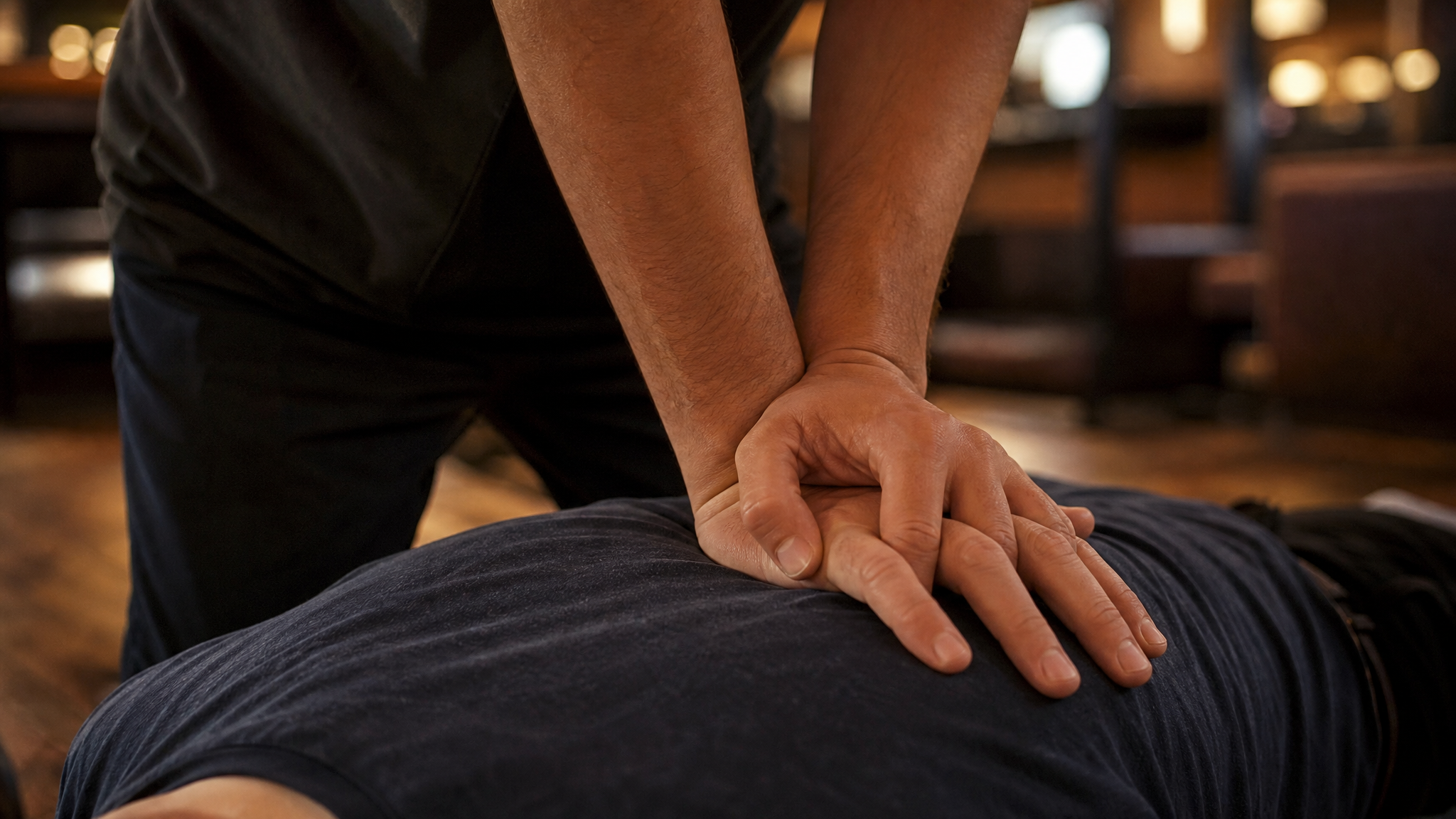
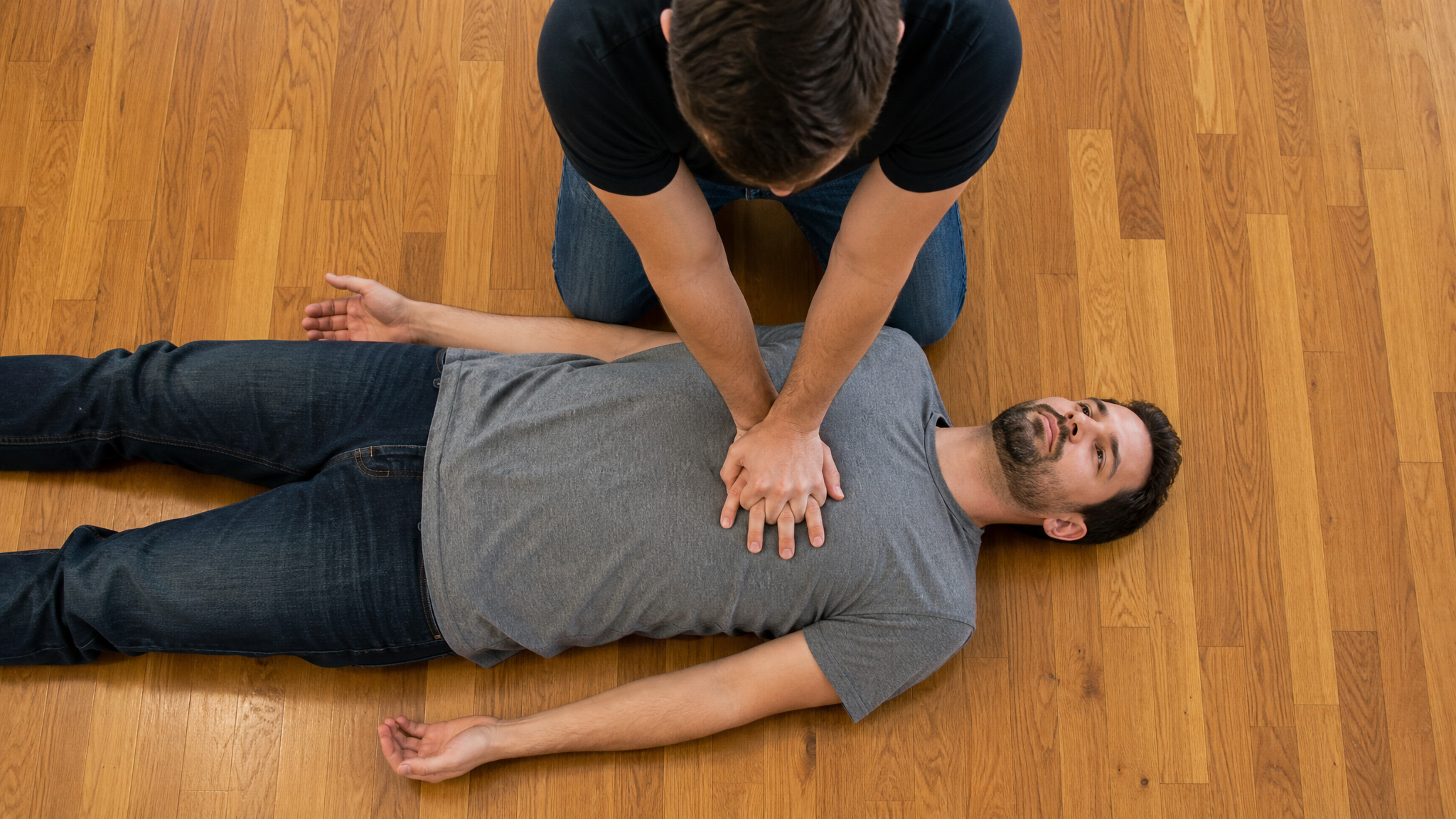
- Position your hands. Kneel beside the person. Place the heel of one hand in the center of their chest, directly on the breastbone. Put your other hand on top, interlacing your fingers. Keep your fingers lifted off the chest — only the heel of your bottom hand should make contact.
- Push hard and fast. Lock your elbows. Keep your arms straight. Use your full body weight, not just your arms. Compress the chest at least 2 inches deep with each push. Do this at a rate of 100 to 120 compressions per minute. That's roughly the beat of "Stayin' Alive" by the Bee Gees — not a coincidence. It was chosen as a mnemonic because it works.
- Keep going without stopping. Don't stop to check for a pulse. Don't pause between compressions for longer than 10 seconds. If an AED (automated external defibrillator) becomes available, use it — then resume compressions immediately after a shock is delivered. Keep going until paramedics take over.
The Right Compression Rate and Depth (This Is Where Most People Go Wrong)
Depth and rate are the two places bystander CPR fails most often — and both errors work against survival.
Too shallow: The most common mistake. People are afraid to hurt someone who is already unconscious. Here's the truth: cracked ribs are survivable. Cardiac arrest without compressions is not. You need a minimum of 2 inches of depth on each compression. For larger adults, 2.4 inches. You will feel resistance. Push through it.
Too fast or too slow: Under 100 compressions per minute doesn't circulate blood effectively. Over 120 and you're not allowing the chest to fully recoil between compressions, which limits how much blood refills the heart. Stay in the 100–120 range. Count out loud if it helps. "One, two, three, four..." Let that rhythm anchor you.
Not letting the chest rise: After each compression, take your weight fully off. Allow the chest to come back up before the next push. If you're leaning on the chest between compressions, you're preventing the heart from refilling. Full compression, full recoil. Every time.
If you're getting tired — and you will — ask someone nearby to rotate in every 2 minutes. CPR is physically demanding. Fresh hands do better compressions.
What If You're Afraid You'll Do It Wrong?
This is the most important section in this post.
The evidence is consistent: bystander CPR, even imperfect bystander CPR, improves survival outcomes. Waiting for someone more qualified costs time that cannot be recovered. Every minute without compressions is brain cells dying.
You will not be prosecuted for acting in good faith. Good Samaritan laws exist in all 50 states and protect bystanders who attempt to help in a medical emergency. You cannot be sued for trying.
You might break a rib. The person might not survive even with your intervention. Those outcomes are not your fault. What you can control is whether you tried. The data says trying matters. The law says trying is protected. Your instinct to help is the right one — trust it.
Fear of imperfection is the only thing that turns a survivable event into a fatal one.
How to Call 911 and Do CPR at the Same Time
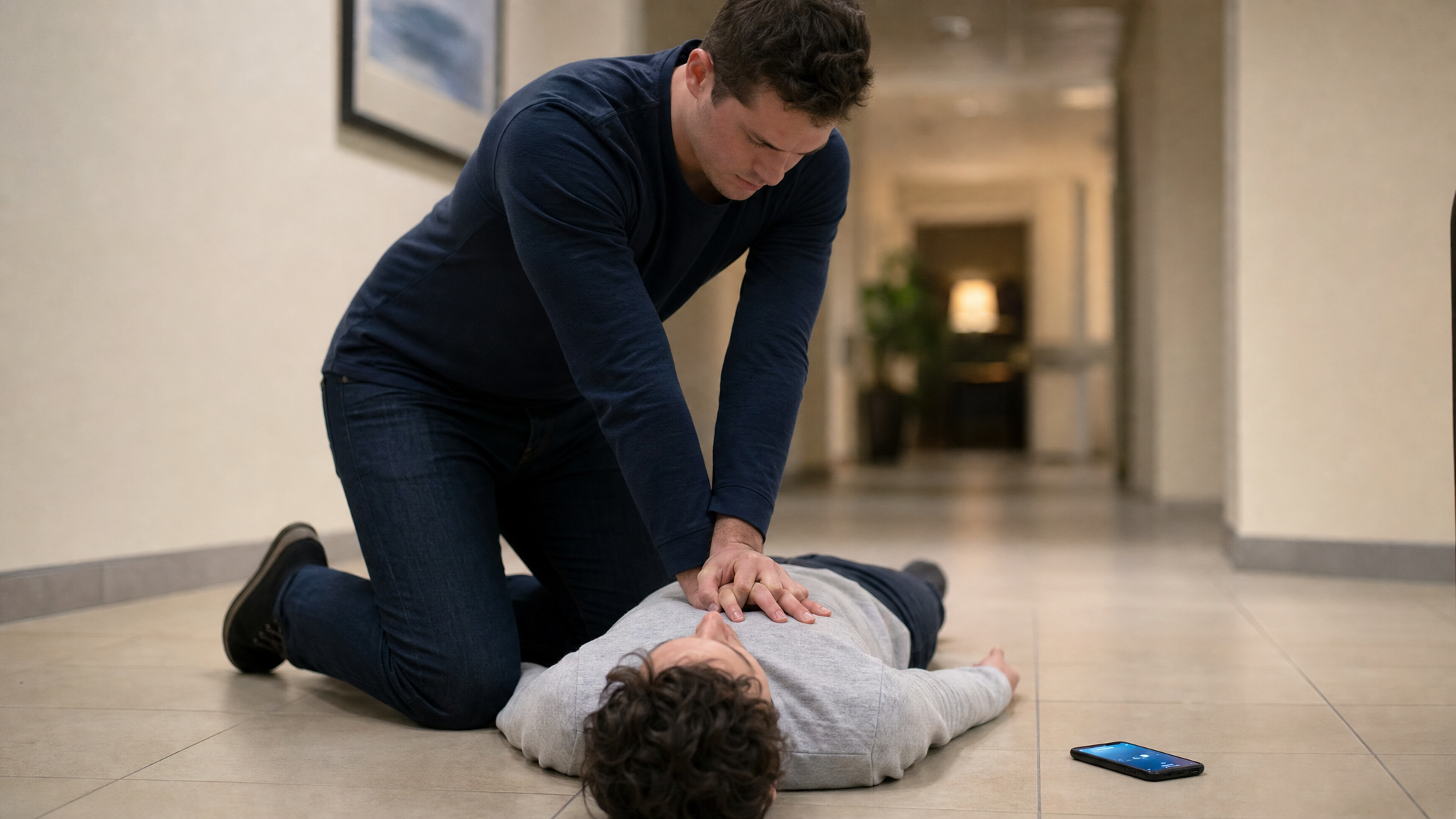
Put your phone on speaker before you start compressions. Set it on the ground next to the person. The 911 dispatcher is trained to walk you through this — they will tell you what to do, keep time with you, and stay on the line until help arrives.
Tell the dispatcher:
- Your location (be as specific as possible — address, cross streets, or landmarks)
- What happened ("A man collapsed, he's not responding, I'm starting CPR")
- Your phone number in case you get disconnected
The dispatcher can also help you locate the nearest AED. If there's one in the building — many public spaces and businesses are required to have them — the dispatcher can direct you or someone else to retrieve it. Using an AED alongside compressions dramatically increases survival rates.
Don't hang up. Keep compressing. Let the dispatcher track the time and talk you through the rest.
After CPR: What Happens Next and How to Prepare Now
When paramedics arrive, step back and let them take over. Tell them when you started compressions, how many rounds you did, and whether an AED was used. That information affects their next steps.
If the person survives, they'll likely be taken to a cardiac care unit. Recovery varies. Some people return to full function. Others have memory gaps or fatigue for weeks. What's consistent: the people who survive cardiac arrest almost always had bystander intervention in the first few minutes.
Preparation doesn't end with knowing how to do CPR. It means having the right tools accessible when seconds count. That means being able to control severe bleeding while waiting for EMS, knowing how to use a tourniquet if needed, and keeping a properly stocked first aid kit close by — at home, in the car, wherever your family spends time.
The 1st Hour First Aid Kit is built for exactly these moments — not just scrapes and splinters, but real emergencies where the first few minutes determine everything. Grab yours before you need it.
This content is for informational purposes only and does not constitute medical advice. For certified CPR training, contact the American Heart Association or American Red Cross.


