Tourniquet Use: When It Saves a Life and When It Can Cause Harm

For decades, civilians were told to never apply a tourniquet. The fear was permanent damage — nerve injury, tissue death, limb loss. That fear kept people from acting. And that hesitation killed people who could have been saved.
Here's what the military learned after more than two decades of combat medicine: tourniquets, applied correctly, rarely cause permanent harm. What causes permanent harm is uncontrolled severe bleeding that nobody stopped. The data isn't close. In conflicts where tourniquet use became standard protocol, deaths from extremity hemorrhage dropped dramatically. The myth was simply wrong.
This guide covers everything a civilian needs to know about tourniquet use: when to apply one, when not to, exactly how to do it, and what to tell EMS when they arrive.
- Use a tourniquet for uncontrolled limb bleeding — arterial spurting, amputation, or when direct pressure fails.
- Do NOT use on the neck, torso, or groin — a limb tourniquet can't work there.
- Place 2–3 inches above the wound. Twist until bleeding stops completely. Lock the windlass.
- Write the time of application on the band or the person's skin. Do not remove it.
- Tell EMS the exact time you applied it the moment they arrive.
What a Tourniquet Actually Does
A tourniquet is a circumferential compression device — it wraps around a limb and applies enough pressure to compress the artery underneath, stopping blood flow below the application point. Unlike direct pressure, which works from outside a wound, a tourniquet works by shutting off the supply line entirely.
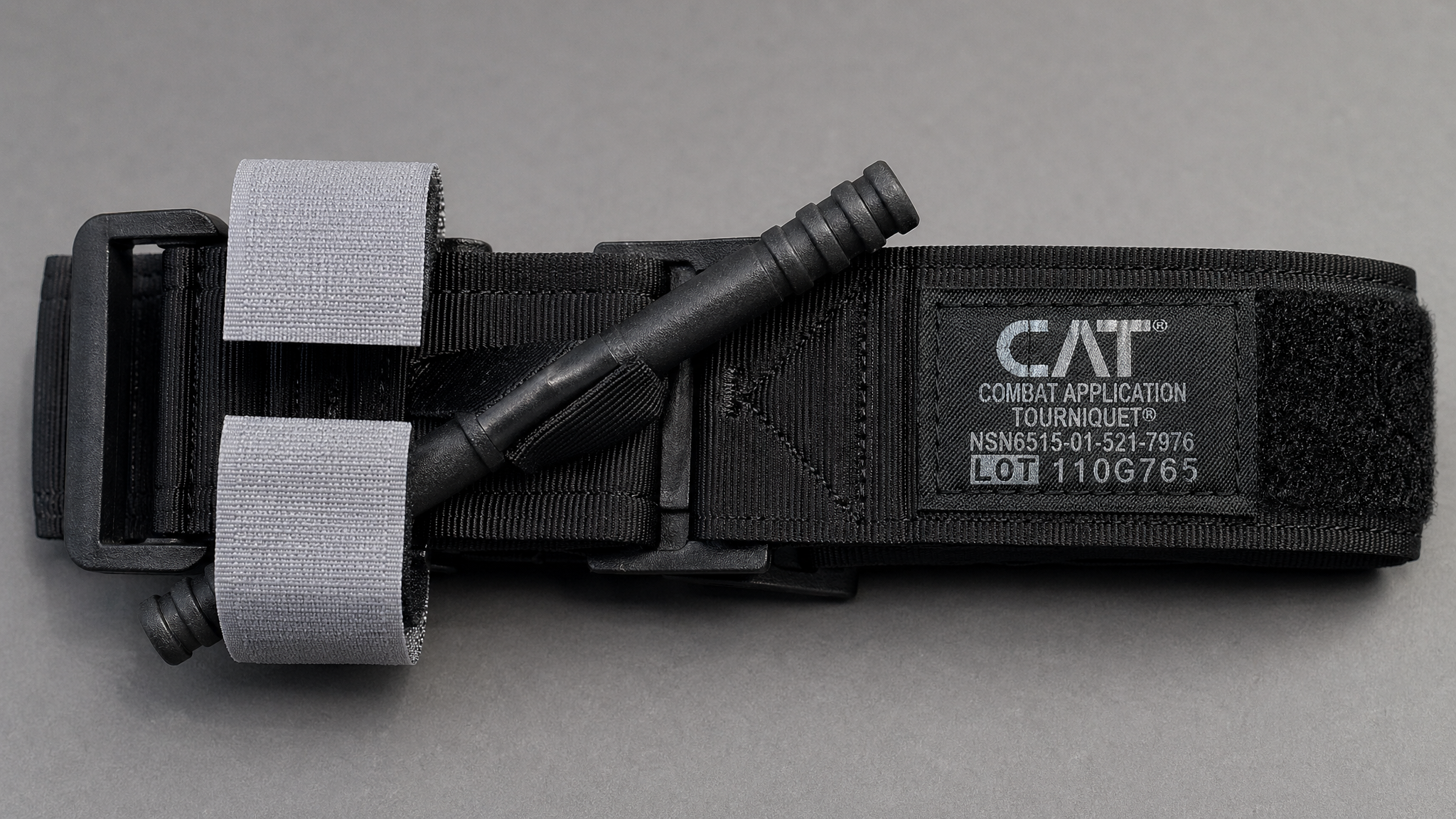
The two main components are the band (which wraps around the limb) and the windlass (a rod that twists to tighten the band). As you rotate the windlass, the band tightens progressively. When you've twisted enough to fully occlude the artery, bleeding from the wound stops. You lock the windlass in its retaining clip so it can't unwind.
That's the mechanism. It's mechanical, not chemical. It doesn't depend on clotting factors or pressure alone — it physically closes the artery. That's why it works when nothing else does.
When to Apply a Tourniquet
The short answer: any time a limb is bleeding uncontrollably and you can't stop it with direct pressure or wound packing.
The more specific answer:
- Bright-red, spurting blood from an arm or leg. Arterial bleeding won't respond to surface pressure fast enough. Go straight to the tourniquet.
- Partial or complete amputation. There's no wound to pack. Apply the tourniquet immediately.
- Direct pressure has been applied firmly for 2–3 minutes and the bleeding hasn't slowed. You're dealing with arterial involvement or a wound too deep for surface pressure. Escalate.
- Multiple casualties. You can't maintain constant pressure on three people at once. A tourniquet holds the bleed without requiring a second set of hands.
- The wound is too large or mangled to pack. Severe crush injuries, blast injuries, or degloving injuries may not have a clear cavity to pack. A tourniquet proximal to the injury stops the flow.
One important note: don't wait until you've exhausted every other option. If the bleed is clearly arterial — if the blood is bright red and spurting in rhythm with the heartbeat — apply the tourniquet first. Every second of arterial bleeding compounds the blood loss.
When NOT to Apply a Tourniquet
Tourniquets only work on limbs. They rely on circumferential compression of a cylindrical structure — an arm or a leg. Applying one anywhere else either doesn't work or causes additional harm.
Never use a tourniquet on:
- The neck. Compressing the neck occludes the airway and the carotid arteries. It will not stop a neck bleed. It will cause asphyxiation and stroke. For neck wounds, apply firm direct pressure with your hand against the wound — no devices.
- The torso. A tourniquet cannot be applied tightly enough around a chest, abdomen, or pelvis to generate arterial occlusion. For torso wounds, use direct pressure, wound packing, and chest seals for penetrating thoracic injuries. Call 911 immediately.
- Junctional areas (groin, armpit, shoulder). The tourniquet can't get above the wound the way it can on a mid-limb. Junctional hemorrhage — bleeding from where the limb meets the torso — requires specialized junctional tourniquets (like the SAM JT or JETT) or direct manual pressure with hemostatic gauze packing. A standard CAT or SOFTT-W applied near the groin is better than nothing, but is not as effective as mid-limb application.
- Over a joint. Placing a tourniquet directly over the elbow or knee means the device sits on the bony joint rather than compressible soft tissue. It won't achieve arterial occlusion. Place it on the fleshy part of the limb above or below the joint.
How to Apply a CAT Tourniquet: Step by Step
The CAT (Combat Application Tourniquet) is the most widely used civilian and military tourniquet. The SOFTT-W works similarly. The steps below are for the CAT — if you use a different device, the principle is the same but the mechanism may vary slightly.
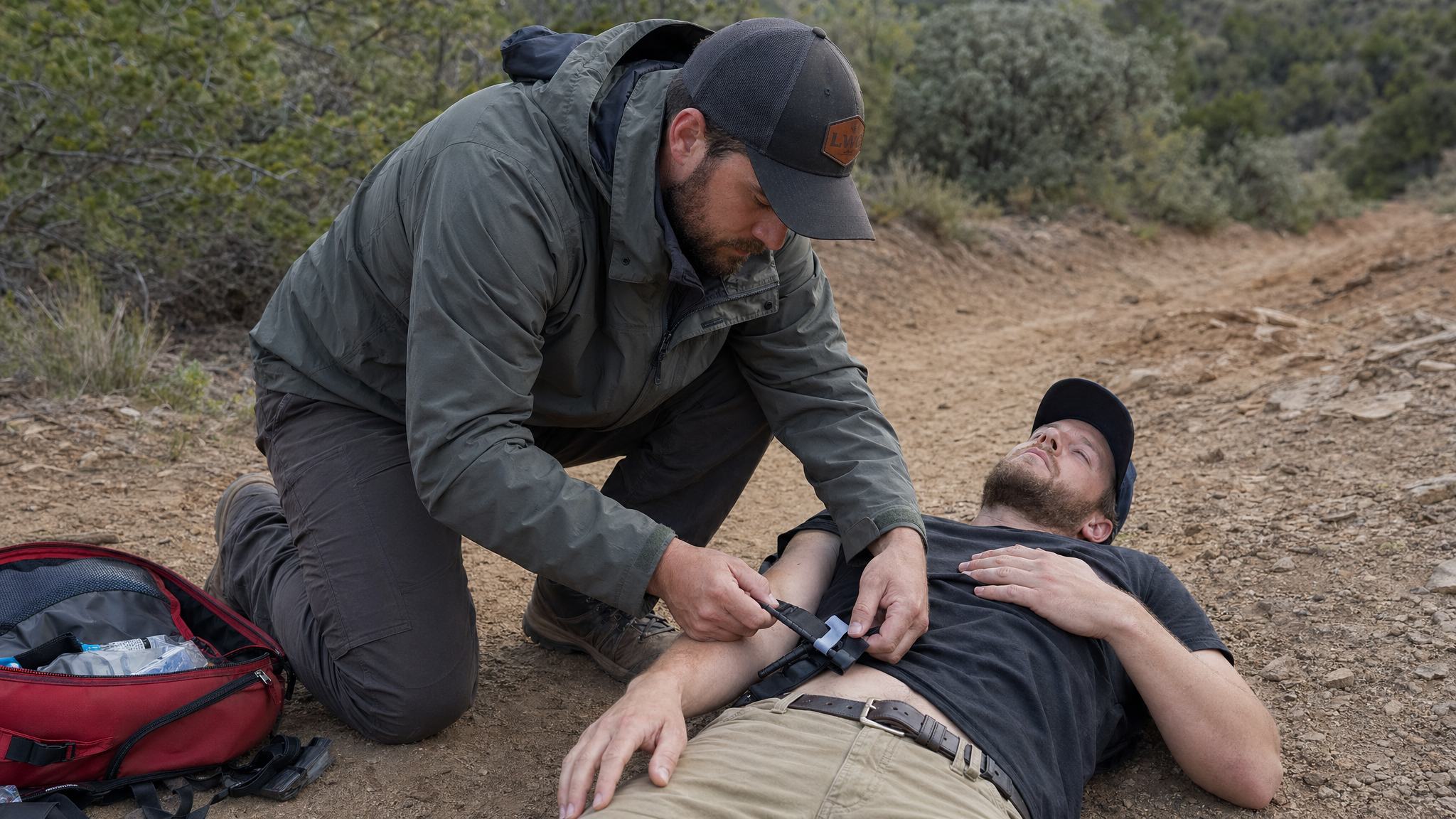
- Identify the limb and the wound. Expose the injury by cutting away clothing. You need to see what you're working with.
- Position the tourniquet 2–3 inches above the wound. "Above" means between the wound and the heart — proximal, in anatomical terms. This ensures you're cutting off the supply to the wound site. Never position it directly over a wound or over a joint.
- Thread the band through the buckle and pull tight. The band should already be snug around the limb before you twist anything. If it's loose at this stage, it won't generate enough pressure later.
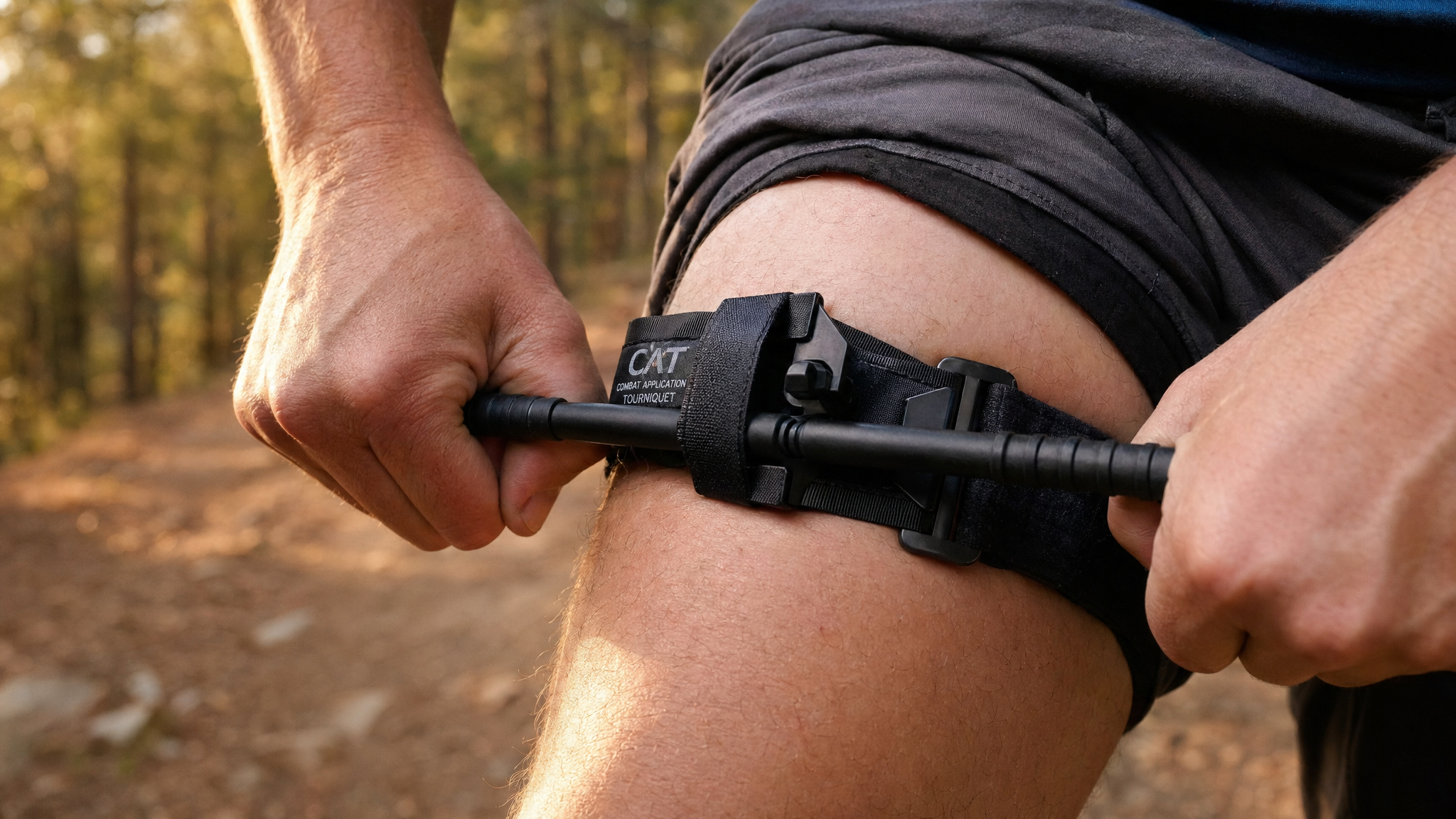
- Twist the windlass rod until bleeding stops completely. This is the critical step. Keep twisting. It will be painful for a conscious person — acknowledge that, tell them what you're doing, keep going. You should see visible changes: the limb blanches below the tourniquet, and the bleeding slows and stops. "Mostly stopped" is not enough. Fully stopped.
- Lock the windlass into the retaining clip. The clip prevents the rod from unwinding. If the windlass isn't locked, tension bleeds off and the bleed resumes. Confirm it's secured before doing anything else.
- Secure the free end of the band. Use the hook-and-loop tail to lock everything flat. A loose tail can snag or come undone in movement.
- Write the time on the tourniquet band. Use a permanent marker. Write "TQ" and the exact time in 24-hour format. If you don't have a marker, write it on the person's forehead or forearm in whatever you have. EMS and surgeons need this number.
- Do not remove the tourniquet. Once it's on and bleeding has stopped, leave it alone. Only a physician in a controlled surgical setting should release a tourniquet.
The "Permanent Damage" Myth — Debunked
This is the fear that stopped people from acting for decades. It deserves a direct answer.
The concern came from historical data on poorly applied tourniquets left on for extended periods — often in surgical settings where vessels were deliberately occluded without monitoring. That context shaped a generation of civilian first aid guidance: don't use a tourniquet; it damages nerves and tissue; it causes limb loss.
The military evidence dismantled this. During Operation Iraqi Freedom and Operation Enduring Freedom, combat medics applied tourniquets tens of thousands of times. A 2008 study published in the Journal of Trauma and Acute Care Surgery examined 232 tourniquet applications in a combat theater. Limb loss attributable to the tourniquet itself was rare. Most complications occurred with improvised devices or application errors — not with properly applied commercial tourniquets.
The research conclusion: a correctly applied tourniquet held for under two hours causes minimal permanent damage in the vast majority of cases. The tissue damage threshold begins around the two-hour mark and increases with time after that. Before two hours, the risk of permanent injury from a tourniquet is far lower than the certainty of death from uncontrolled arterial hemorrhage.
Put simply: the tourniquet doesn't kill limbs. Bleeding out kills people.
Time Matters: The Two-Hour Window
Tourniquet effectiveness doesn't degrade over time — but the risk profile changes as the clock runs. That's why the application time matters so much.
The tissue below a tourniquet is being deprived of oxygenated blood. Healthy tissue can tolerate ischemia (oxygen deprivation) for a defined period. Up to roughly two hours, that deprivation is reversible — surgeons can restore circulation and the tissue recovers. Beyond two hours, ischemic damage accumulates and the risk of permanent injury rises significantly.
This is the "golden hour" framing extended to tourniquet medicine: the faster EMS arrives and transfers care to a trauma surgeon, the better the outcome — not just for the hemorrhage, but for the limb itself.
Your job: apply the tourniquet, write the exact time, get the patient to advanced care as fast as possible. The clock starts the moment you twist that windlass.
Types of Tourniquets Civilians Can Buy
Not all tourniquets are equal. The field has converged on a small set of proven devices backed by military testing and peer-reviewed performance data.
CAT (Combat Application Tourniquet) — Gen 7
The standard issue tourniquet for U.S. military personnel since 2005. Single-handed application design makes it usable on yourself — an important feature if you're injured and alone. The Gen 7 version corrected a windlass durability issue in earlier generations. This is the most widely recommended tourniquet for civilian carry.
SOFTT-W (Special Operations Forces Tactical Tourniquet — Wide)
Military-grade, often preferred by special operations units. Slightly wider band than the CAT, which some practitioners find generates more consistent occlusion on larger limbs. Equally effective, slightly bulkier. Both the CAT and SOFTT-W are validated to military specifications.
Improvised Tourniquets — Last Resort Only
Belts, zip ties, shoelaces, torn clothing: these are almost never capable of generating the arterial occlusion pressure that a properly designed windlass device can. The TCCC (Tactical Combat Casualty Care) guidelines treat improvised tourniquets as a temporary measure until a real tourniquet is available — not as an equivalent alternative. If you're relying on an improvised device, you're accepting significant risk of failed hemorrhage control.
Carry a real tourniquet. The CAT Gen 7 runs about $30. There is no cost-effective reason to substitute.
What to Tell EMS When They Arrive
When paramedics reach the scene, three things matter immediately:
- What happened. "Car accident — passenger has a laceration to the left thigh from metal, arterial bleeding."
- What you did. "Tourniquet applied to the left upper thigh. Direct pressure applied before that for approximately three minutes without success."
- When you applied the tourniquet. Give the exact time. Say it out loud and point to where you wrote it. This number drives the surgical timeline — the trauma team needs to know how long the limb has been occluded.
Then step back. Your job is done. Let the paramedics work. Stay visible in case they have questions, but get out of their operational space.
1st Hour builds civilian hemorrhage control kits with a CAT Gen 7 tourniquet, hemostatic gauze, and everything else you need staged and ready. One kit in your vehicle. One at your workstation. Because none of this works if it's not within reach. See the full lineup at 1sthour.com.
Build the Habit Before the Emergency
Reading about tourniquet use and applying one under stress are two different things. The mechanics are simple enough — what fails under pressure is the hesitation, the second-guessing, the fear of doing it wrong. The only way to remove that hesitation is practice.
Get a tourniquet. Apply it to yourself, on your thigh, one-handed, until you can do it in under 30 seconds. You'll be surprised how quickly the movement becomes automatic. Take a Stop the Bleed course if one is available near you — the American College of Surgeons backs the program and the training is free. Clinical reference is available at MedlinePlus (NIH).
The myth that tourniquets cause permanent damage held civilians back for a generation. The data is clear now. The technique is proven. What's left is the willingness to act — and the practice to act well.


