Choking Response for Adults, Children, and Infants: Step-by-Step

Choking happens fast, and it happens in the most ordinary moments. Someone's laughing at dinner with a mouthful of steak. A toddler grabs a grape off the counter. A grandparent takes a bite of bread and suddenly can't get air. You have maybe a few minutes before the situation turns serious, and most of that window closes before paramedics could ever arrive. What you do in the first 60 seconds matters more than anything a hospital can offer later. Here's exactly what that response looks like, broken out by age, because what works on an adult can hurt an infant.
How to Tell Someone Is Actually Choking
Not every cough is a choking emergency. Someone who can still cough, speak, or make sound is moving air, which means their airway isn't fully blocked. Let them keep coughing. Coughing is the body's own airway-clearing mechanism and it's often more effective than anything you'd do by hand.
The person who needs help right now is silent. They can't cough, can't talk, can't cry. They might grab at their throat, which is the universal choking sign, or their lips and face might start turning blue or gray. If you see that combination, silence plus visible panic, don't wait to see if it resolves on its own. Act.
This distinction matters because the wrong response at the wrong moment can make things worse. Hitting someone's back while they're still coughing forcefully can startle them into inhaling the object deeper. Let a productive cough finish its job. Step in only when the airway is fully blocked.

Choking Response for Adults and Older Children
For anyone roughly age 1 and up who's fully obstructed, the sequence is the same one taught in Red Cross first aid courses:
- Stand behind the person and lean them slightly forward.
- Give 5 firm back blows between the shoulder blades using the heel of your hand.
- If that doesn't clear it, move to abdominal thrusts. Wrap your arms around their waist, make a fist just above the navel, grab it with your other hand, and thrust inward and upward in a quick motion, like you're trying to lift them off the ground.
- Give 5 abdominal thrusts, then go back to 5 back blows. Keep cycling between the two until the object comes out or the person goes unresponsive.
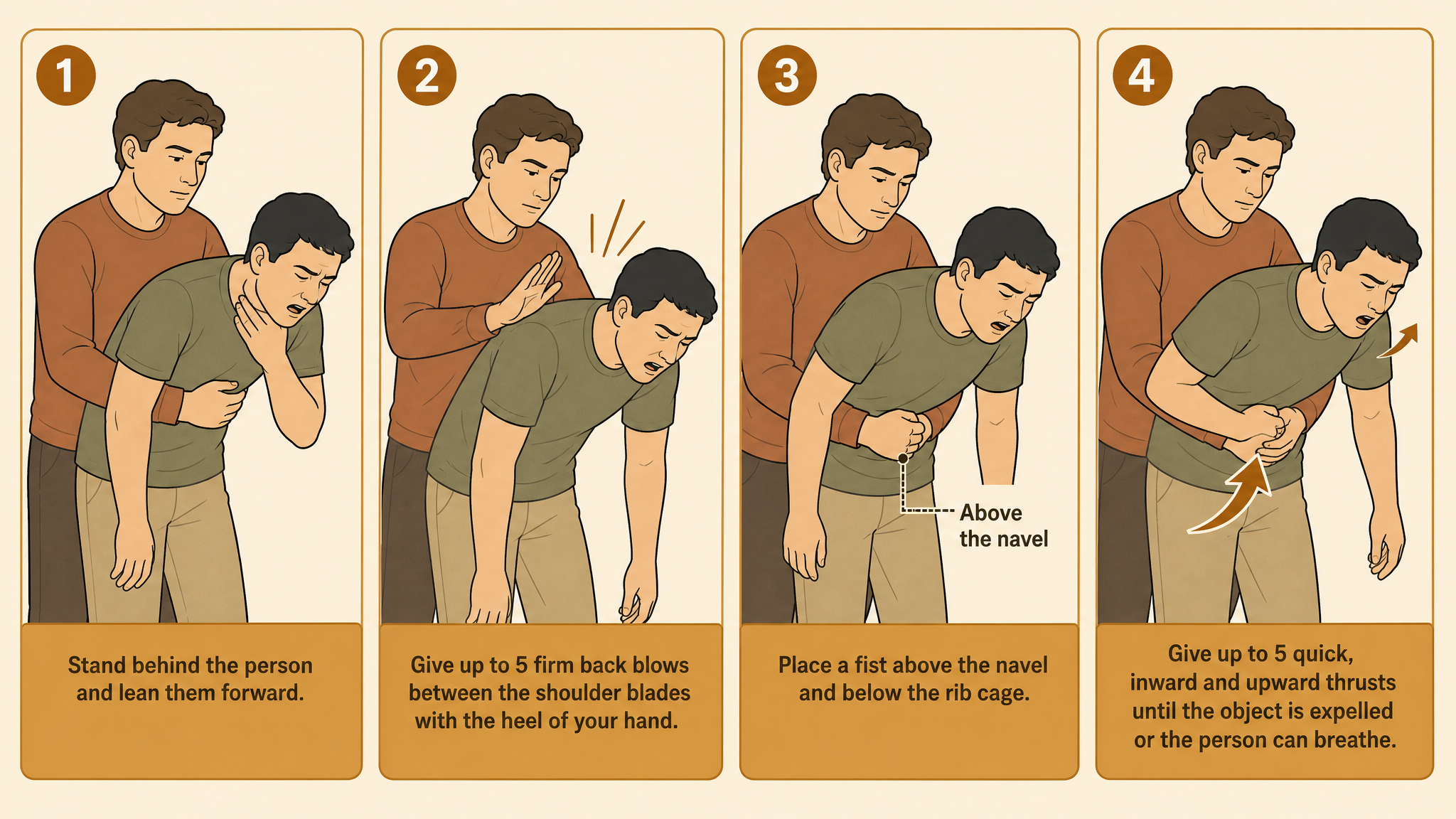
A few situations change the technique. If the person is pregnant or too large for you to wrap your arms around, use chest thrusts instead of abdominal thrusts, positioned the same way you'd place your hands for CPR compressions. If you're the one choking and alone, you can give yourself abdominal thrusts with your own hands, or bend over and press your upper abdomen against a firm surface like the back of a chair or a railing.
You'll sometimes hear this whole sequence called the Heimlich maneuver, though that name technically only covers the abdominal thrust portion. Current guidelines from the American Heart Association and Red Cross both call for the combination of back blows and abdominal thrusts, not abdominal thrusts alone, because the back blows dislodge objects that thrusts sometimes can't reach.
Choking Response for Infants Under 1
This is where people freeze, because the instinct to do abdominal thrusts on a baby is exactly wrong. An infant's abdomen and ribs can't take that kind of pressure safely. Instead:
- Lay the infant face-down along your forearm, supporting their head and jaw with your hand, and rest your forearm on your thigh so their head sits lower than their body.
- Give 5 firm back blows between the shoulder blades with the heel of your hand.
- Flip the infant face-up, still supported on your forearm with the head lower than the body, and give 5 chest thrusts using two fingers on the center of the chest, just below the nipple line. Each thrust should compress about an inch and a half.
- Alternate 5 back blows and 5 chest thrusts until the object clears or the infant stops responding.
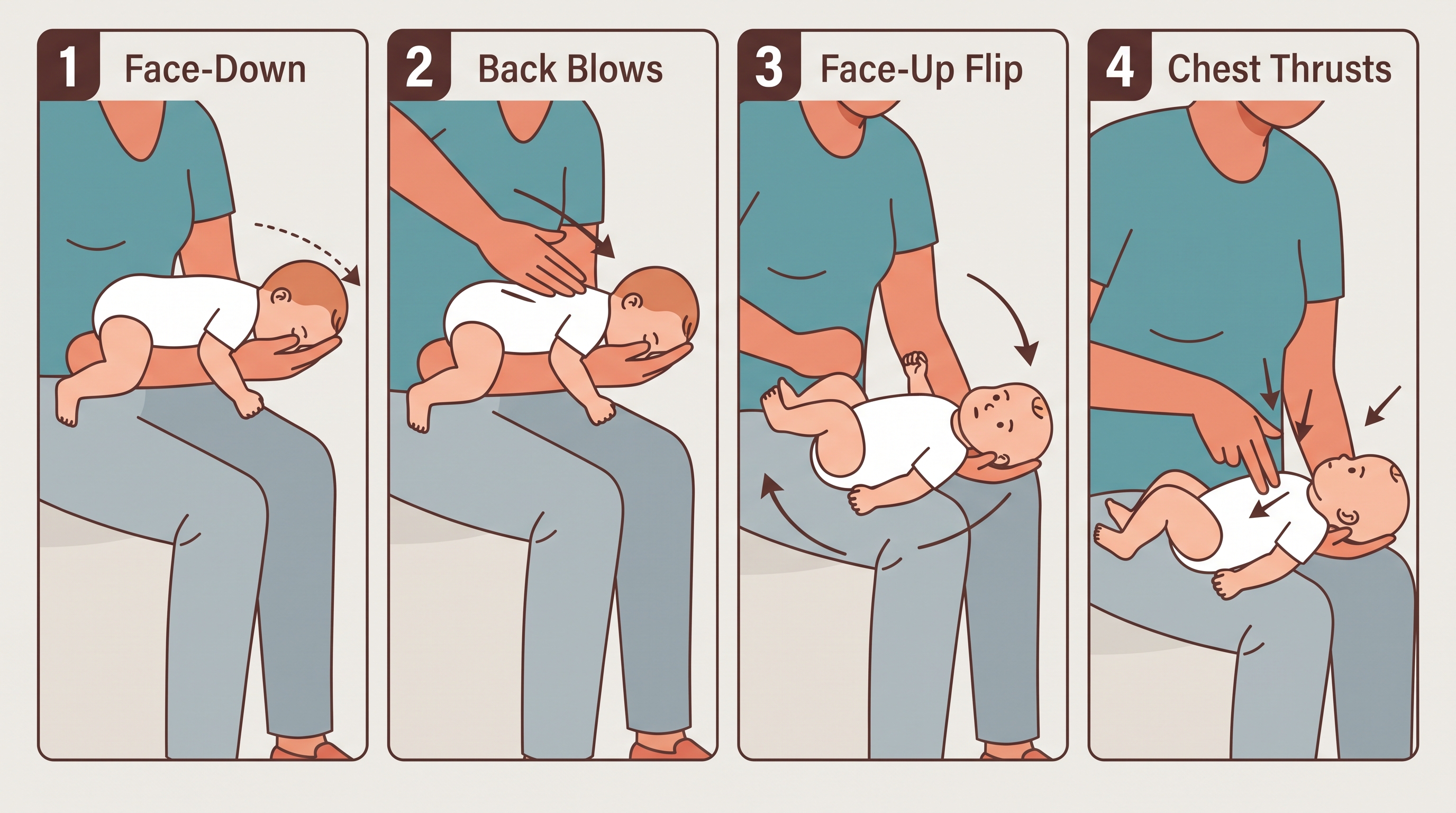
Don't attempt this if the infant is coughing forcefully or has a strong cry. That's a sign air is still moving, and a strong cough clears more debris than intervention will. This mirrors how CPR on children vs adults differs from adult technique in general: smaller bodies need smaller, more careful force, not less action.
What to Do If They Become Unresponsive
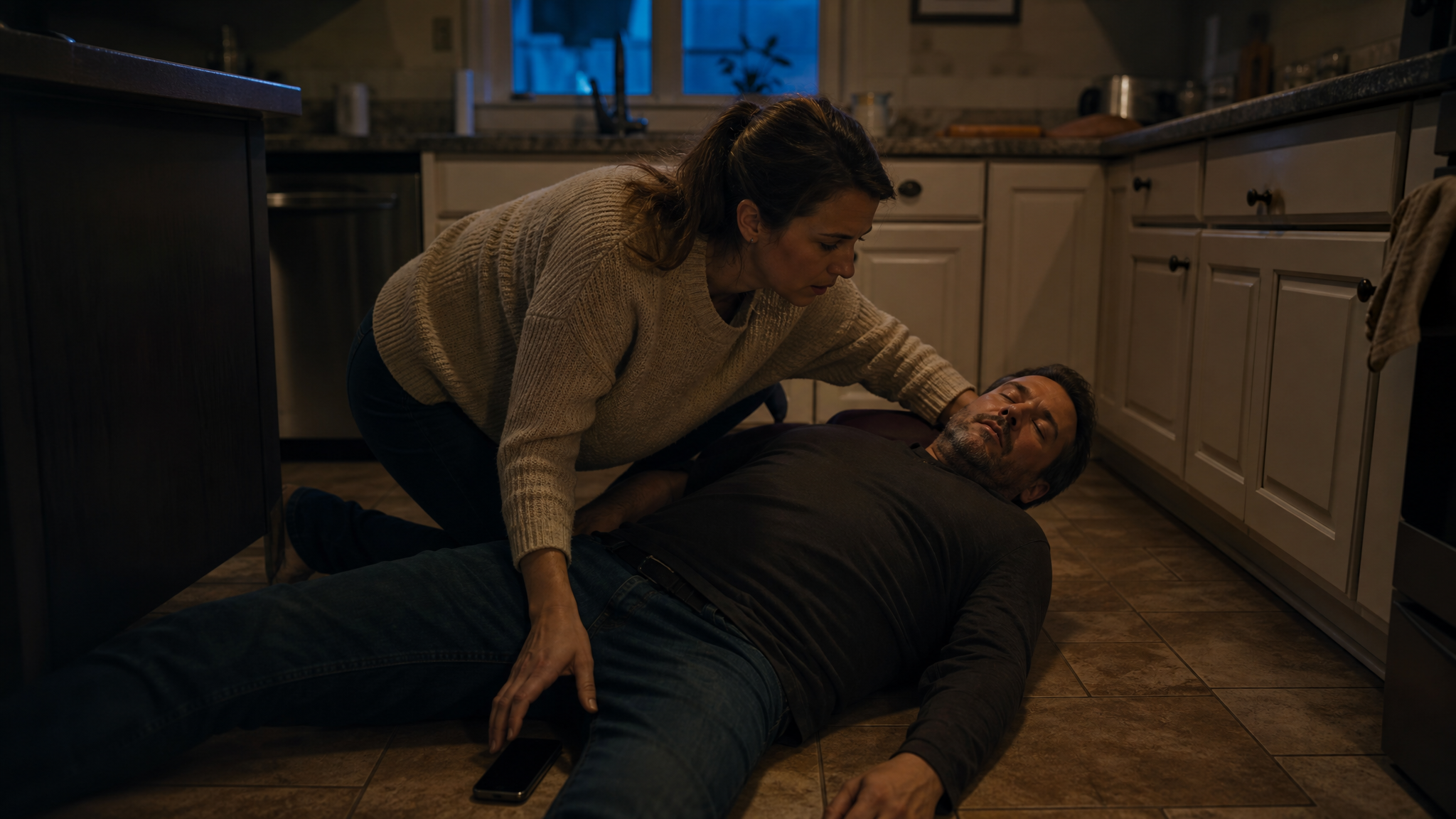
If the person you're helping stops responding, whether they're an adult, child, or infant, the plan shifts immediately:
- Lower them carefully to the ground.
- Call 911, or have someone else call while you keep working.
- Begin CPR, starting with chest compressions.
- Each time you open the airway to give a breath, glance inside the mouth for the object. If you can see it, remove it. Don't do a blind finger sweep, since that can push the object deeper.
This is exactly why knowing hands-only CPR matters even outside a choking scenario. The two skills chain together, and a choking emergency that goes unresponsive becomes a cardiac emergency in seconds. If an AED is nearby and you're not sure how to use one, the basics take less time to learn than you'd think. Choking is the fourth leading cause of unintentional injury death in the US, according to the National Safety Council, and the risk of brain injury from lack of oxygen starts around the four-minute mark. That's a shorter window than most people expect, and it's why the back-blow-and-thrust cycle needs to start immediately, not after a debate about whether it's warranted.
Choking on Your Own: Self-Rescue
If you're alone and start choking, you still have options before anyone else arrives. Give yourself abdominal thrusts using your own fist and hand, positioned the same way you would on someone else. If that's not working, bend over the back of a sturdy chair, a countertop edge, or a railing and press your upper abdomen against it firmly and repeatedly. It's less elegant than the technique with a partner, but it's saved plenty of people who were home alone.
Common Mistakes That Waste Critical Seconds
A few errors show up again and again in real emergencies:
Hesitating because you're not sure it's "bad enough" yet. If someone can't make sound, that's your answer. Waiting to confirm costs oxygen.
Using abdominal thrusts on an infant. It's the single most dangerous mix-up in this entire guide, and it happens because people default to what they've seen done on adults.
Forgetting to call 911 early. Call as soon as you start working the problem, or get someone else to call while you continue. Don't wait until the first cycle fails.
Doing a blind finger sweep. It feels like it should help. It usually pushes the object further back instead.
Knowing the steps is one thing. Having the calm and the gear to actually use them is another. If you haven't put together a proper home first aid kit yet, that's worth doing this week, not someday. The 1stHour Trauma Kit was built for exactly this kind of moment, when something goes wrong fast and you need to act without hunting through drawers for the right tool. Check out the 1stHour Trauma Kit and make sure you're ready before you need to be.
This content is for informational purposes only and does not constitute medical advice. In any choking emergency, call 911 immediately.


