AFib Symptoms People Mistake for Anxiety

You are sitting still. Nothing is wrong. Then your chest starts fluttering, your breath goes shallow, and your hands get cold. Somebody tells you it sounds like anxiety, and honestly, it does. Most people in that situation take the explanation and move on, because it fits and because the alternative is a trip to a doctor for something that already stopped.
Sometimes that explanation is right. Sometimes what is happening is atrial fibrillation, and the difference matters more than the symptoms suggest, because AFib carries a stroke risk that a panic attack does not. Here is how the two actually differ, how to check your own pulse in about a minute, and what belongs in the "call today" pile versus the "call now" pile.
Why AFib Symptoms and a Panic Attack Feel So Similar
The overlap is not in your head. Both conditions produce a racing heartbeat, shortness of breath, sweating, light-headedness, and a general sense that something is off. According to the American Heart Association, AFib symptoms include a quivering or fluttering heartbeat, fatigue, dizziness, weakness, shortness of breath, and chest pain. Read that list back and you have described a panic attack almost word for word.
There is a second reason the two get tangled. AFib is genuinely frightening while it is happening. Your heart is behaving in a way you can feel, and the body responds to that with adrenaline, which produces the emotional layer people associate with anxiety. So a real AFib episode can generate real panic on top of it, and now you have both things at once.
The result is predictable. People with AFib get told they are anxious. People with anxiety worry they have a heart problem. Both groups end up unsure, and the one with the arrhythmia is the one who loses by waiting.
The Differences That Actually Separate AFib From Anxiety
Four things tend to separate them.
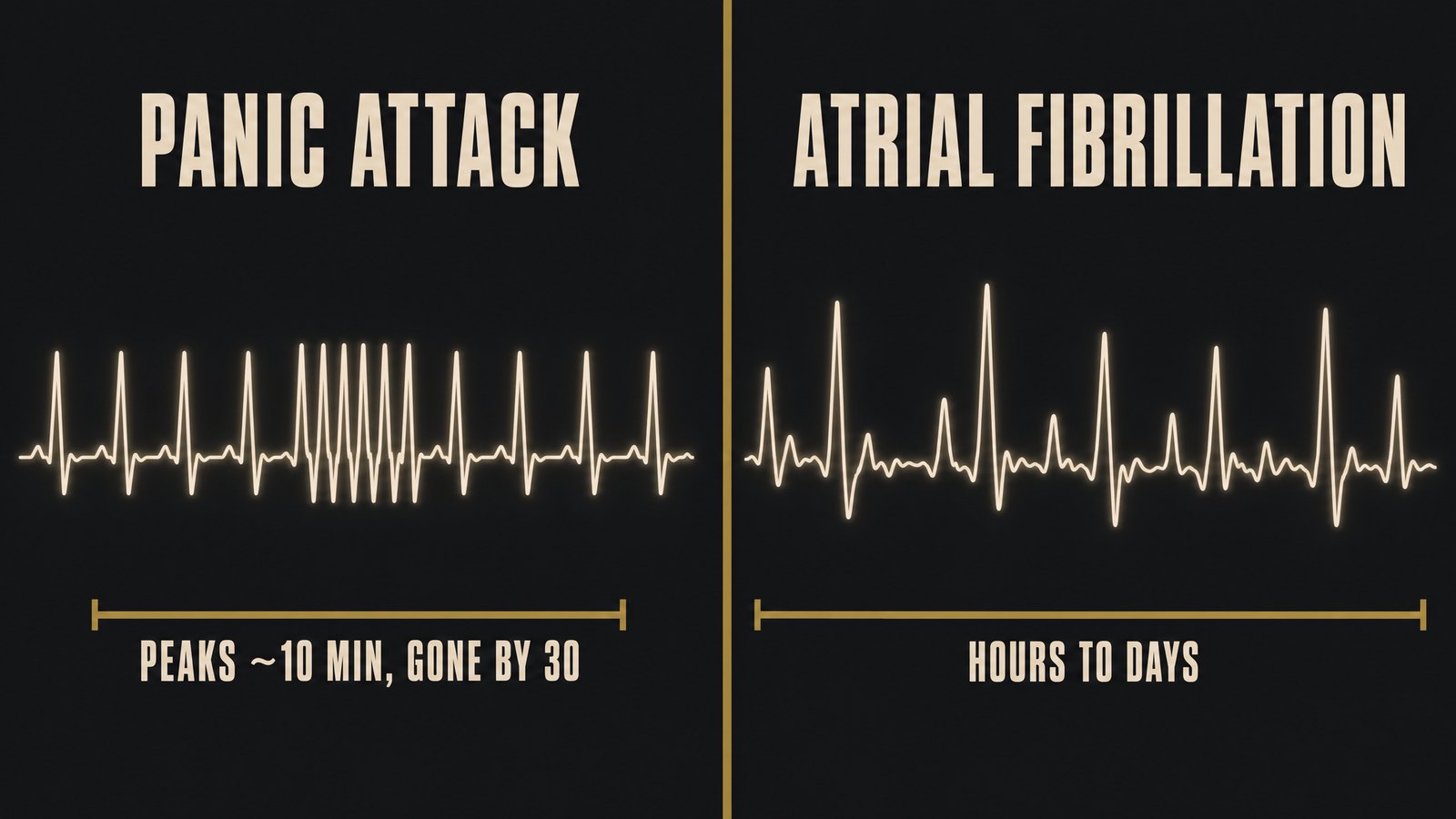
How long it lasts. A panic attack has a shape. It builds, peaks somewhere around the ten-minute mark, and then drains away, usually inside half an hour. AFib does not follow that curve. An episode can go for hours, and in some people it goes for days or simply never stops.
What the rhythm feels like. Anxiety gives you a heart that is fast but steady, like a drum being played quickly. AFib gives you something clinicians describe as irregularly irregular. There is no pattern to find. Beats crowd together, then a gap, then a run of three, then another gap. If you have ever tried to count it and given up, that is the sensation.
What set it off. Panic attacks usually have a context, even a loose one. A crowded room, a stressful call, a memory. AFib often arrives out of nowhere while you are watching television or waking up at three in the morning. Alcohol, a heavy meal, dehydration, and poor sleep are common triggers, none of which feel emotionally significant.
Which came first, the fear or the body. This is the useful one. In a panic attack, the dread tends to lead and the physical symptoms follow it. In AFib, you notice the heart first, and the worry is a reaction to it.
None of these is proof on its own. Together they point somewhere.
How to Check for an Irregular Heartbeat at Your Own Wrist
You do not need equipment for this, and it takes a minute.
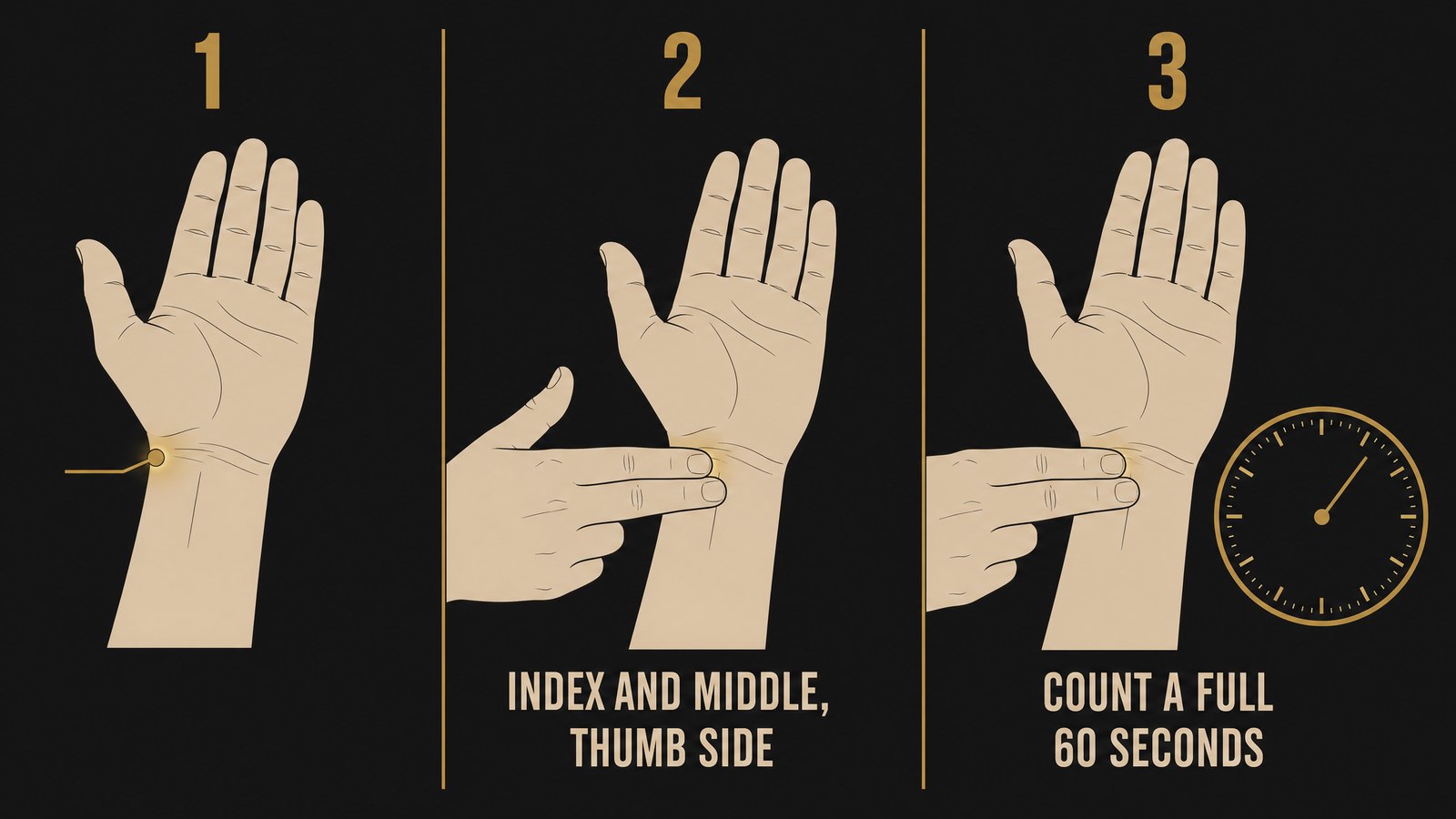
Turn one hand palm up. Place two fingers of your other hand, index and middle, on the thumb side of your wrist, just below the crease. Not your thumb, which has a pulse of its own and will confuse you. Press lightly until you feel the beat.
Now stop counting and just listen to the spacing. A normal pulse has an even rhythm, like a metronome, even if it is fast. What you are looking for is the opposite: beats that land at random intervals, some strong and some barely there, with pauses that arrive without warning.
Then count. Watch a clock for a full sixty seconds rather than counting fifteen and multiplying, because with an irregular rhythm the short version gives you a bad number. A resting adult pulse usually sits between 60 and 100. During AFib it often runs well above that, though not always, and a normal rate with a chaotic rhythm still counts as a finding.
Write down four things while it is happening: the time it started, the rate you counted, whether the rhythm was even or scattered, and what else you felt. That note is worth more at an appointment than any description you will manage from memory a week later. This is the same discipline that helps with heart palpitations that come and go, where the episode is almost never happening when you finally get seen.
What Your Smartwatch Alert Actually Means
A lot of people now find out about AFib from a wrist notification, which is a genuinely good thing, but the alert gets over-read in both directions.
What it means: the watch detected a rhythm consistent with atrial fibrillation over a sampling window. That is a real signal and worth acting on.
What it does not mean: a diagnosis. These features produce false positives, particularly during exercise, and they also miss episodes that happen while the watch is off your wrist or charging. A clean week of readings does not rule AFib out.
If you get an alert, save it. Most wearables let you export a PDF of the recording. Bring that file to the appointment, because it is data your doctor can actually read, and it gives them something to compare against an in-office ECG that may well come back normal. A single normal ECG does not close the question when the episodes come and go.
The AFib Symptoms That Are Easy to Miss Entirely
Not every case announces itself with a fluttering chest. Some people never feel the rhythm at all, and their AFib is found during an exam for something unrelated. Between those two poles sits a large group whose symptoms are real but quiet, and who explain them away.

The usual disguises are fatigue that does not resolve with sleep, getting winded on a staircase that never used to be a problem, a drop in exercise tolerance, and a vague sense of being older than you were last year. Mayo Clinic notes that patients often describe exactly this: feeling more short of breath, less active, generally worn down.
Women more often report the fatigue and breathlessness version rather than the dramatic palpitations version, which is part of why AFib in women gets recognized later. If your energy has changed and there is no obvious reason, that is worth a mention rather than a shrug.
Why Catching AFib Matters: The Stroke Connection
Here is the part that makes this worth a phone call.
When the upper chambers of the heart quiver instead of contracting, blood does not clear them properly. It pools, and pooled blood clots. If a clot leaves the heart and reaches the brain, it causes a stroke.
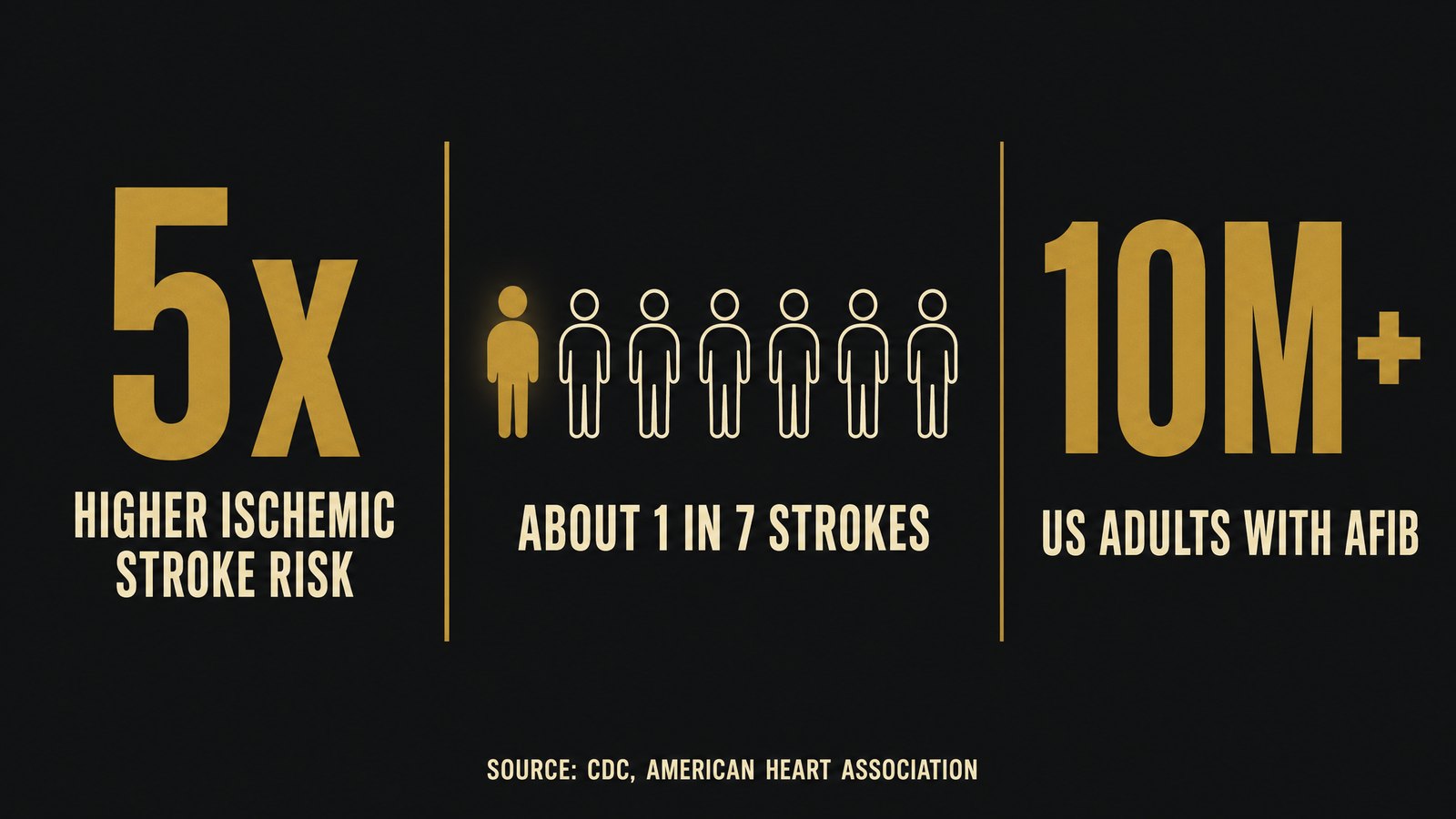
The numbers are not subtle. The CDC reports that after accounting for standard risk factors, AFib is associated with roughly a fivefold increase in ischemic stroke risk, and that AFib is behind about one in seven strokes. More than ten million adults in the United States have it.
The reason to catch it is that this risk is treatable. Once AFib is documented, your doctor can score your individual stroke risk and, for most people who need it, anticoagulation cuts that risk substantially. The danger is not really the arrhythmia. It is an arrhythmia nobody knows about.
If AFib does get confirmed, learn the FAST stroke check and teach it to whoever you live with. That is fifteen minutes of your time against the single complication you are trying to avoid.
When to Call 911 Instead of Making an Appointment
Most AFib is handled through a scheduled visit. A few presentations are not.
Call 911 if a fluttering or racing heartbeat comes with any of these:
- Chest pain, pressure, or tightness
- Fainting, or feeling like you are about to
- Severe shortness of breath, or breathlessness while sitting still
- Face drooping, arm weakness, or slurred speech, in any combination
- Confusion or a sudden severe headache
The last two are stroke signs, and they override everything else on this page. Do not drive yourself, and do not wait to see whether it settles.
Call your doctor the same day, rather than 911, if an episode lasted more than a few hours, if you have had several episodes in a short stretch, if your watch has flagged AFib, or if your pulse is irregular when you check it now. Bring your notes.
And if the symptoms turn out to be anxiety, that is not a wasted trip. Anxiety is a real condition with real treatment, and knowing which one you are dealing with is the entire point. It also helps to know that a heart attack and cardiac arrest are not the same thing, and that the warning signs of a heart attack look different again from both.
Most of what happens in a cardiac emergency happens before anyone in scrubs arrives. The 1stHour Trauma Kit was built for that window, with 82 pieces chosen for what people actually need in the first sixty minutes rather than what looks good in a box. See what is inside the 1stHour Trauma Kit.
This content is for informational purposes only and does not constitute medical advice. If you are having chest pain, fainting, or severe shortness of breath, call 911 or your local emergency number. Do not use this article to diagnose or rule out a heart rhythm problem, and do not start, stop, or change any medication based on it.


