Why Your Brain Freezes in an Emergency — and How to Train It Not To
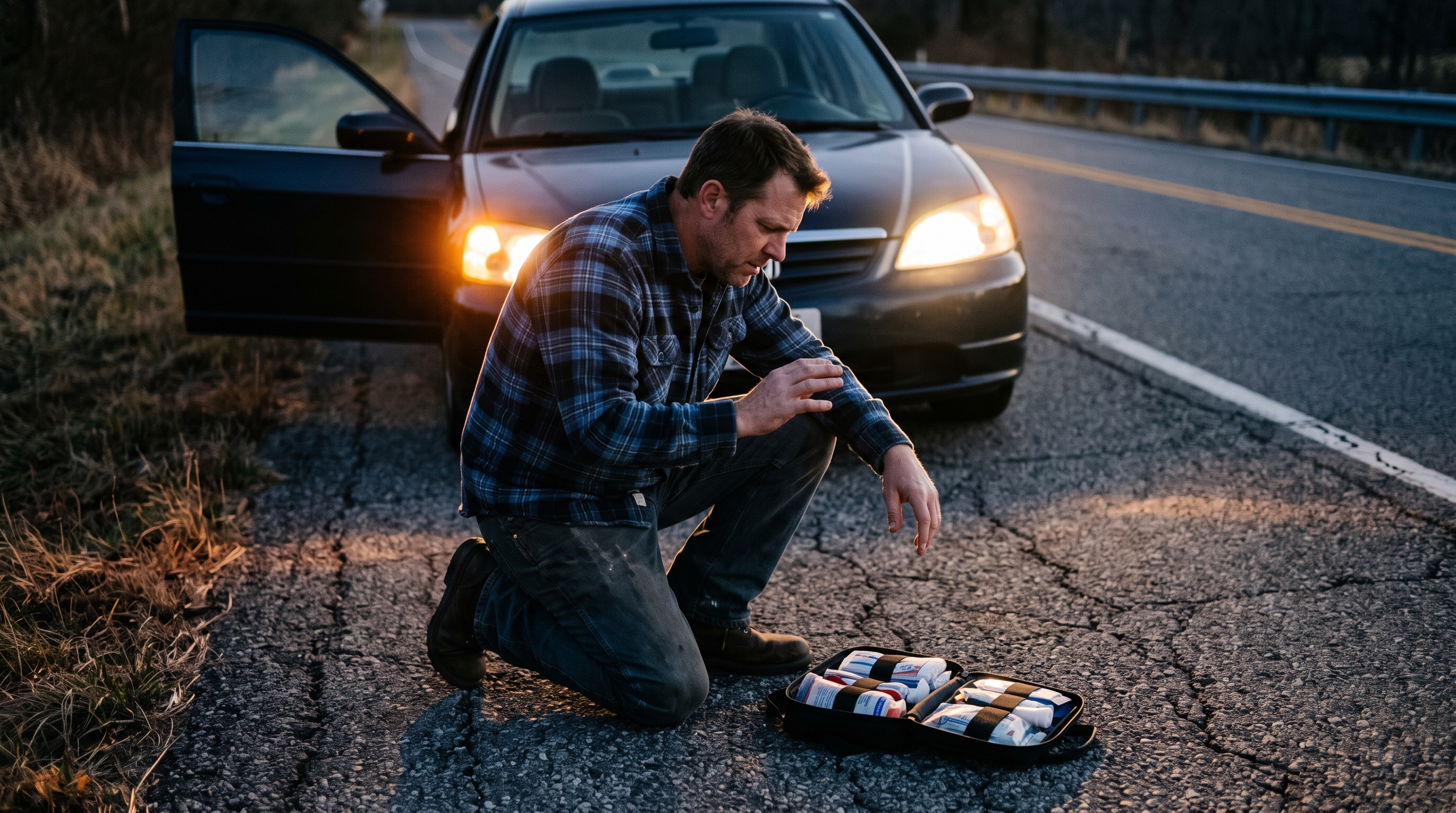
You've probably imagined it. The car swerves, someone collapses, the smoke alarm goes off at 2 a.m., and in your head, you're the one who moves first. You grab the wheel, start CPR, get the kids out the door. Then real life hands you a genuine scare, small or large, and your body does something you didn't sign up for. It locks up. Your hands won't cooperate. Your mind goes blank exactly when you need it sharp. If that's happened to you, you're not broken and you're not a coward. You're running on hardware that's older than civilization, and it doesn't care about your intentions. Learning how to stay calm in an emergency starts with understanding why your body reacts this way in the first place.
Freezing Isn't Weakness, It's Wiring
For decades, emergency response training talked about two options: fight or flight. Freeze got left out of the conversation, mostly because it's harder to romanticize. But researchers have known for a while that freezing is just as much a survival strategy as running or swinging. In the animal kingdom, playing dead confuses predators that hunt by movement. In humans, the same circuitry fires when a threat arrives too fast, too unfamiliar, or too overwhelming for a clear action plan to form.
The freeze response shows up constantly in real emergency data. Bystanders at accident scenes stand and stare. People in burning buildings walk toward exits they've used a hundred times and can't find the door. None of this is a character flaw. It's a nervous system doing exactly what it evolved to do: buy time while it figures out whether fighting or fleeing makes sense. The problem is that modern emergencies, a choking toddler, a severed artery, a flash flood warning, often don't come with time to spare.
What's Actually Happening in Your Brain
Here's the mechanism. Your senses pick up something alarming, and that information splits down two paths. One path, the "high road," runs through your thalamus to your prefrontal cortex, the part that reasons, plans, and weighs options. The other, the "low road," goes straight from the thalamus to the amygdala, your brain's threat detector, skipping the reasoning step entirely.
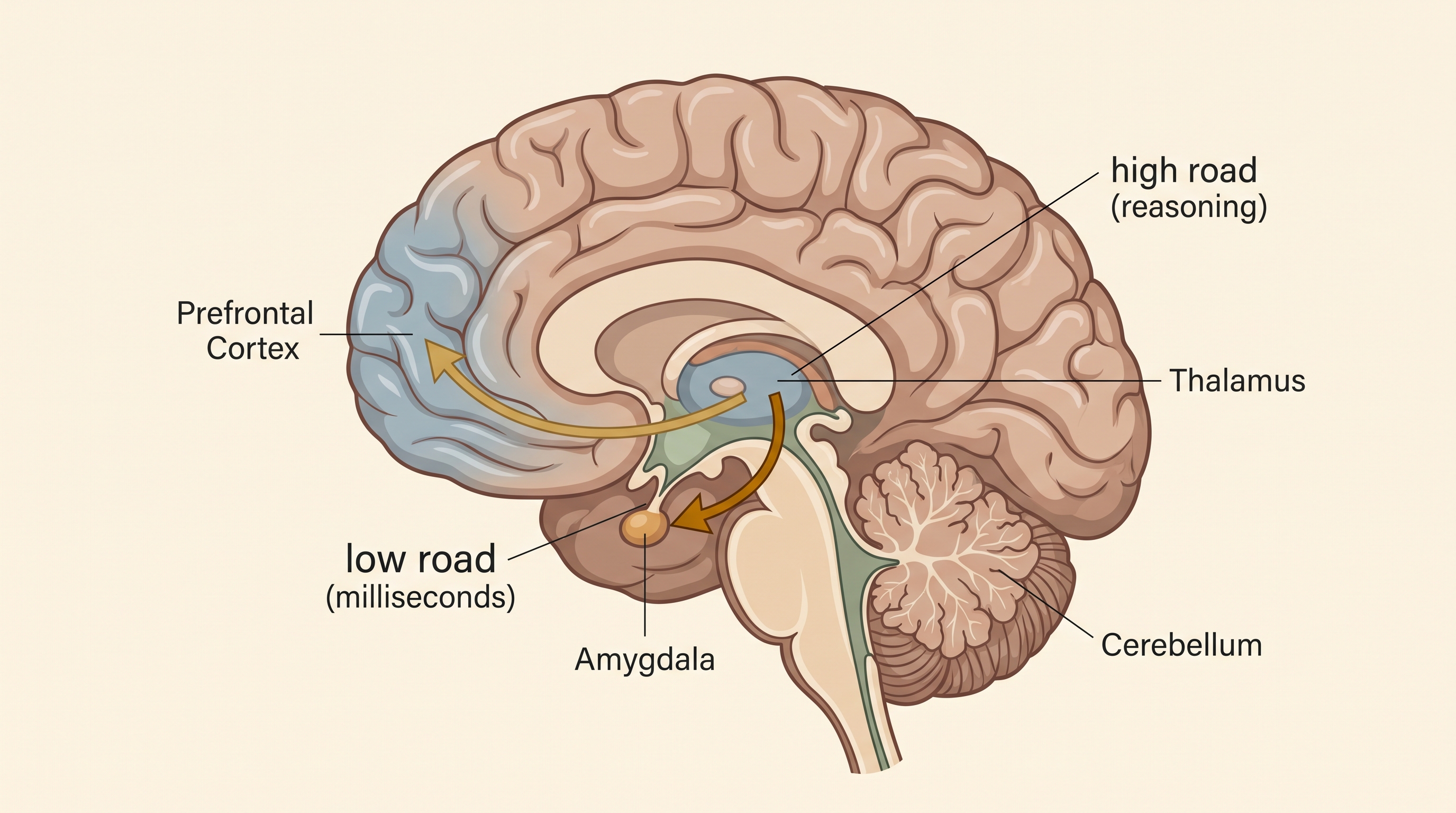
The low road is faster. Milliseconds faster. That speed is the whole point, evolutionarily speaking, when the threat is a rustle in the grass that might be a snake. But when the amygdala fires first, it can flood your system with adrenaline and cortisol before your prefrontal cortex has even registered what's happening. Researchers sometimes call this an amygdala hijack: your emotional brain takes the wheel, and your logical brain gets shoved into the back seat. That's why people report "going blank" or feeling like they watched themselves fail to act. In a real sense, they did. The part of the brain that would normally narrate a plan was temporarily offline.
The Physical Signs of a Freeze Response
Recognizing a freeze response while it's happening is half the battle, because recognition itself can start to break the cycle. Common signs include:
- Tunnel vision, where your field of view narrows and peripheral awareness drops out
- Auditory exclusion, where sounds around you seem to mute or distort
- Trembling hands or legs that feel disconnected from your intentions
- A delay between deciding to move and your body actually responding, sometimes just a second or two, but it can feel much longer
- A racing heart paired with a strange sense of slow motion
None of these mean something is wrong with you. They mean your sympathetic nervous system has taken over and hasn't yet handed control back. The goal isn't to eliminate this response. It's to shorten it.
Stress Inoculation: How First Responders Learn to Stay Calm in an Emergency
Paramedics, firefighters, and combat medics don't walk into their first real emergency and simply perform well because they're braver than everyone else. They train for it using a method called stress inoculation training, or SIT. The idea, borrowed from vaccines, is straightforward: expose someone to a manageable dose of stress repeatedly, paired with coping skills, until the nervous system stops treating that stress as catastrophic.
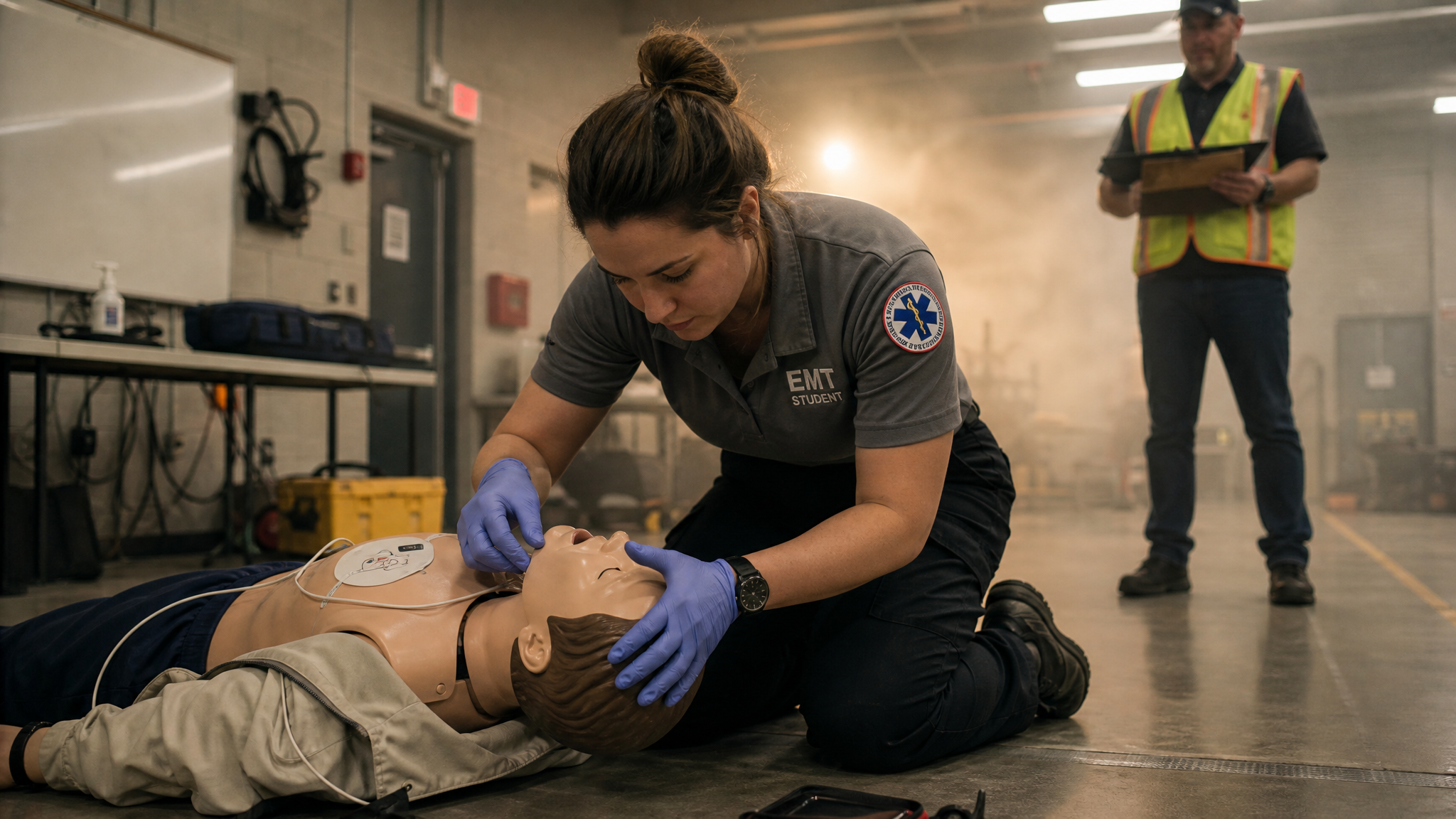
SIT typically runs through a few phases. First, education, understanding what stress does to the body so it feels less mysterious and less frightening. Second, skills acquisition, learning specific techniques like breathing regulation, coping self-talk, and mental rehearsal. Third, applying those skills under progressively more realistic pressure, often through scenario-based drills.
This is why a nurse can start an IV in a chaotic trauma bay while a bystander with no training freezes at the sight of blood. It's not raw talent. It's repetition under manageable stress until the response that used to be "freeze" gets replaced with "act."
Four Things You Can Practice to Stay Calm in an Emergency
You don't need a fire academy to build some of this into your own life. A few things actually move the needle:
Box breathing. Inhale for a count of four, hold for four, exhale for four, hold for four, and repeat. It sounds almost too simple, but slowing your breath activates your parasympathetic nervous system, the body's built-in brake pedal, and can pull you out of a stress spiral within a minute or two. Military and law enforcement trainers teach this specifically because it works fast, without equipment, in the middle of a crisis.
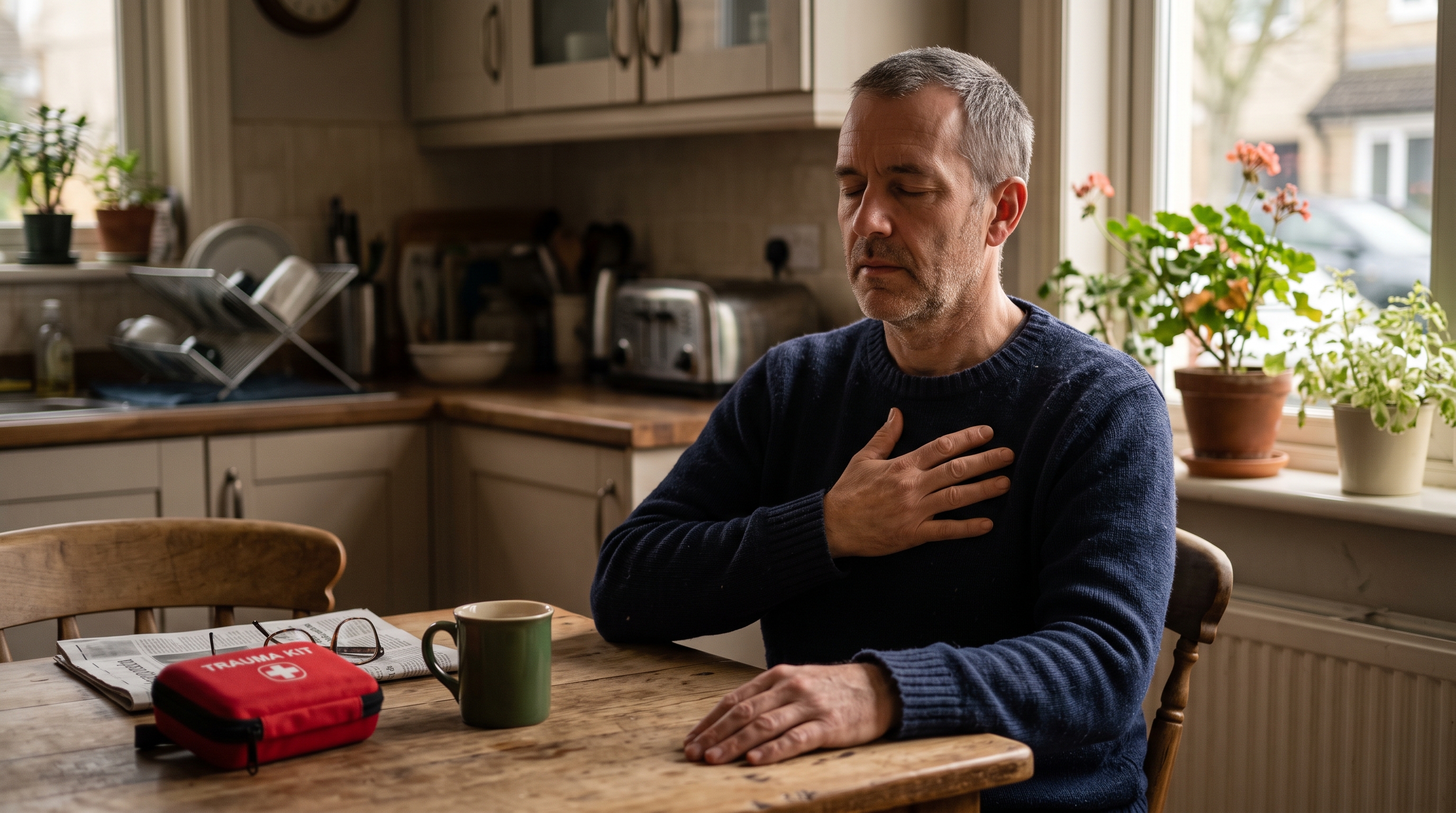
Coping self-talk. Swap "I can't handle this" for short, task-focused phrases: "breathe, move, decide." Naming what you're doing, even silently, keeps a thread of your prefrontal cortex engaged instead of letting the amygdala run the whole show.
Name the fear out loud. It sounds strange, but saying "I'm scared" or "this is bad" to yourself in the moment has been shown in neuroimaging research to lower the amygdala's threat signal and hand some control back to the thinking brain. Suppressing fear takes more effort than acknowledging it.
Physically rehearse your plan. If you've thought through what you'd do for a severe cut, a choking emergency, or your kids scattering during a fire, walk through the actual motions once in a while. Where's your first aid kit. Which door do you use. Who calls 911 while who starts compressions. The point of rehearsal isn't memorizing facts, it's building the kind of muscle memory that survives a stress response, the same reasoning behind building a real family emergency plan instead of just discussing one.
You Won't Rise to the Occasion. You'll Fall to Your Training
There's a line that gets repeated in special operations circles: you don't rise to the occasion, you fall to the level of your training. It applies just as much to a parent facing the first 60 minutes after a crash as it does to a soldier under fire. The freeze response doesn't disappear because you want it to. It shortens because you've given your nervous system a reason to trust that you know what comes next.
Part of that trust comes from mental rehearsal and breathing drills. Part of it comes from having the right tools within reach so your hands have something useful to do the moment they start working again. A tourniquet you've never seen before, buried in a junk drawer, adds friction at the exact moment you can least afford it. A kit you've opened, checked, and practiced with removes one more unknown from a moment that already has too many. That's the same logic behind knowing why the first 60 minutes of trauma care matter and being ready for what to do for a gunshot wound before help arrives.
The 1stHour Trauma Kit is built for exactly that gap between the freeze wearing off and your hands finding what they need. Eighty-two pieces, organized the way your instincts will actually reach for them, so the seconds you spend searching are seconds you get back. See what's inside the kit.
This content is for informational purposes only and does not constitute medical or psychological advice. If you're experiencing ongoing anxiety, panic, or distress related to past emergencies, consider speaking with a licensed mental health professional.


