Appendicitis Symptoms: How to Tell When a Stomachache Needs the ER

Everybody gets a stomachache that turns out to be nothing. Bad takeout, a stomach bug going around the office, too much coffee on an empty stomach. That history is exactly why appendicitis symptoms are so easy to miss for the first several hours. It doesn't announce itself with a car alarm. It starts quiet, in a spot most people would blame on something they ate, and only reveals what it actually is once it has already started moving. Here's what separates a stomachache you can sleep off from a case that needs same-day emergency care.
The Pain Pattern That Gives Appendicitis Away
The single most useful thing to know about appendicitis symptoms is where the pain starts and where it goes. According to the Mayo Clinic, pain often begins around the navel and then shifts to the lower right abdomen as the inflammation progresses. This migration usually happens over 12 to 24 hours, not minutes.
Early on, the discomfort can feel vague, more like pressure or cramping than sharp pain. That's the phase people talk themselves out of. Then, over the following hours, it tightens into a steady ache that lands specifically in the lower right quadrant, roughly halfway between the hip bone and the belly button, an area doctors call McBurney's point. Coughing, sneezing, taking a deep breath, or hitting a bump in the car on the way somewhere can all make it noticeably worse.
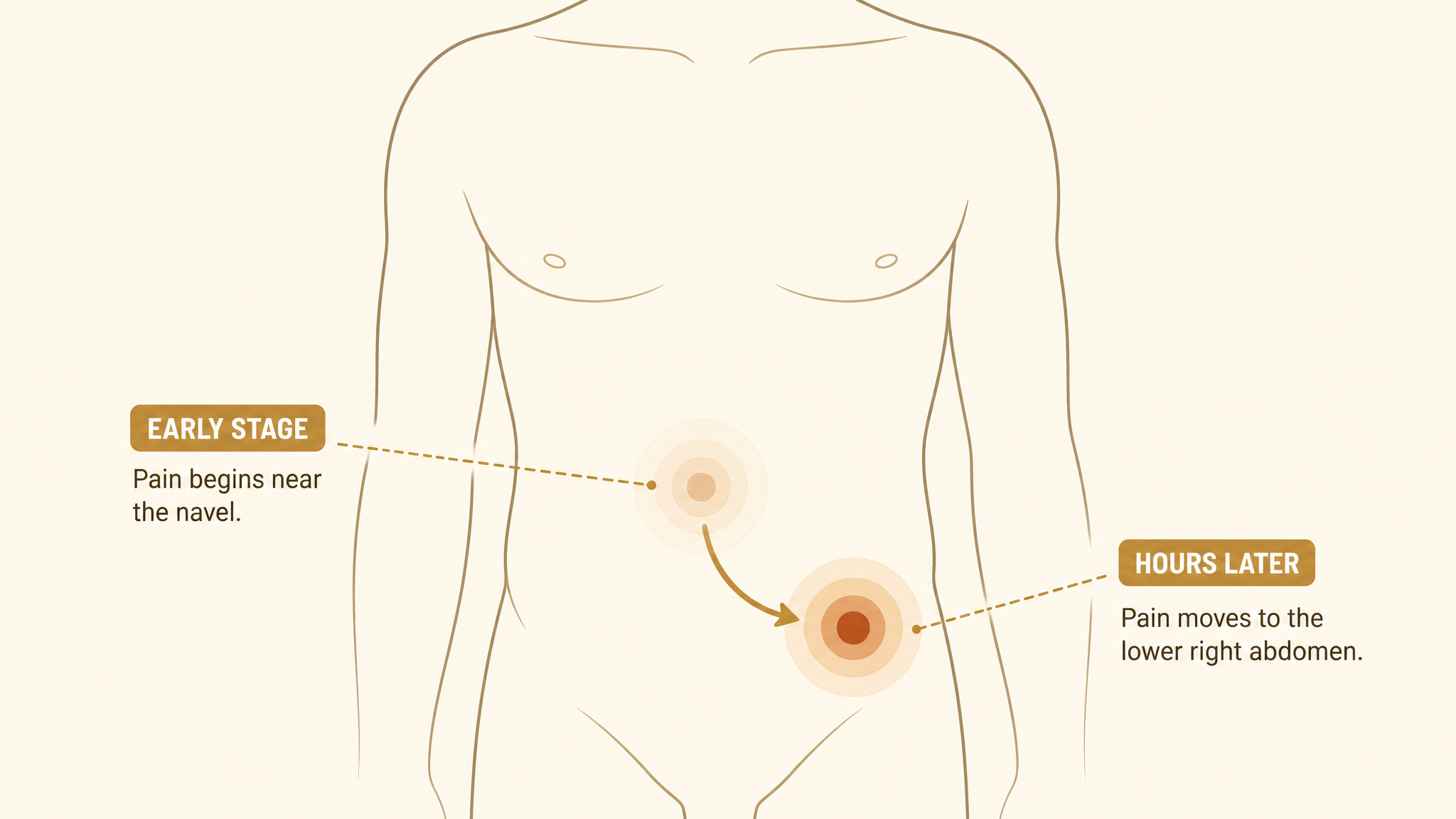
That worsening-with-movement detail matters. Ordinary gas pain or a stomach bug tends to ebb and flow. Appendicitis pain, once it settles into the lower right, tends to only go one direction: worse.
The Rebound Tenderness Check (and Other Signs Beyond the Pain)
Pain location is the headline, but appendicitis symptoms rarely travel alone. Watch for this cluster showing up together:
- Nausea, sometimes with vomiting, that follows the pain rather than causing it
- Loss of appetite, often the first sign anyone notices, especially in someone who's usually a big eater
- A low-grade fever, typically in the 99 to 101°F range rather than a spiking fever
- Abdominal swelling or a belly that feels tight
- Difficulty passing gas
- Pain that intensifies when the area is touched or when the person moves, walks, or straightens up
One test worth knowing, because you can try it at home before you ever get to the ER: gently press on the lower right abdomen with your fingers, hold for a few seconds, then release quickly. If the pain when you let go is sharper than the pain from pressing, that's rebound tenderness, and it's one of the more reliable signs pointing toward appendicitis rather than routine indigestion.
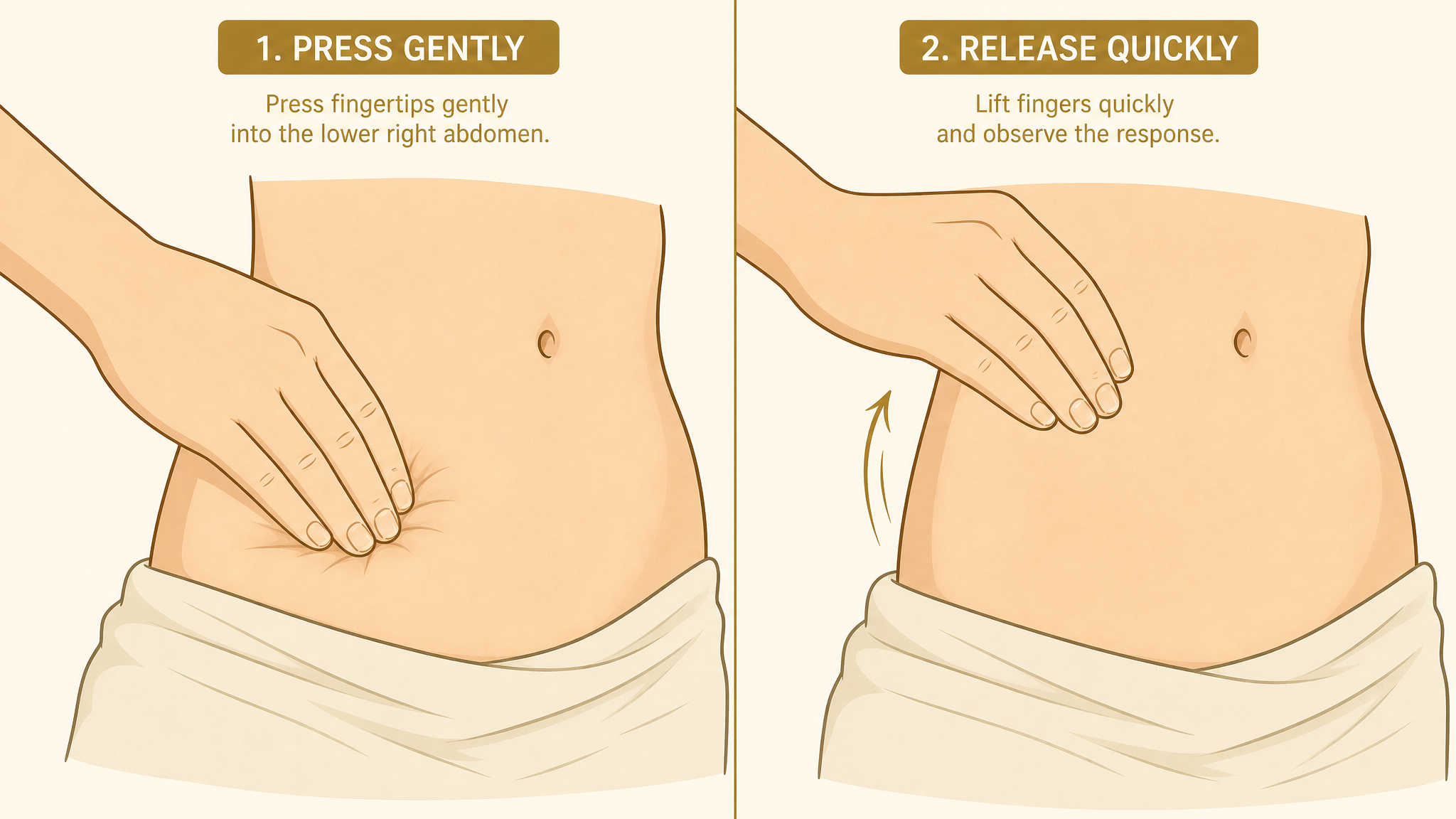
Rebound tenderness is not something you should press hard to confirm, and it's not a substitute for medical evaluation. Think of it as one more data point that shifts you from "let's wait and see" to "let's go now."
Worth knowing too: Mayo Clinic notes that roughly 40% of people with appendicitis don't present with this textbook pattern at all. Pain can stay near the belly button, sit higher up, or show up on the left side in rare cases where anatomy varies. The absence of the classic pattern doesn't rule appendicitis out. It just means the decision comes down to the whole picture, not one symptom checked off a list.
Appendicitis Symptoms in Kids Look Different
Kids get appendicitis too, most commonly between ages 10 and 19, though it can happen at any age including toddlers. The trouble is that young kids can't describe pain migration the way an adult can. A 6-year-old isn't going to say, "It started near my belly button twelve hours ago and now it's lower and to the right."
What you're more likely to see, according to Cleveland Clinic, is a child who stops eating, curls up or refuses to walk normally, cries or resists when the belly is touched, runs a low fever, and vomits. Younger children in particular sometimes get misdiagnosed early because their symptoms look like a garden-variety stomach bug, right down to the vomiting and low appetite.

A few details that separate it from a typical kid stomach bug: a child with appendicitis usually gets worse over hours instead of better, walks hunched over or limps favoring the right side, and resists having their belly touched or pressed. A stomach bug tends to come with more diarrhea and less focal belly pain. If your child's stomach symptoms aren't following the usual 24-to-48-hour bug pattern, or the pain seems to be settling into one specific spot, that's worth a same-day call to their pediatrician or a trip to urgent care or the ER, depending on how fast things are moving.
Appendicitis Symptoms in Pregnant Women Are Easy to Miss
Pregnancy changes the picture in two ways that make appendicitis harder to catch. First, the growing uterus can push the appendix upward and to the side as pregnancy progresses, so the pain that would normally sit in the classic lower right spot can instead show up higher on the right side, sometimes near the ribs in the third trimester. Second, common early-pregnancy complaints like nausea, bloating, and general abdominal discomfort can mask or mimic the early symptoms.
Rebound tenderness, the pressure-release test described above, is also less reliable in pregnancy. Studies looking at pregnant patients with confirmed appendicitis found rebound tenderness present in roughly seven out of ten cases, meaning a normal exam doesn't fully rule it out. Fever also tends to show up later and less consistently than it does in non-pregnant patients.
The practical takeaway: if you're pregnant and dealing with right-sided abdominal pain that's worsening rather than settling, paired with nausea, loss of appetite, or a low fever, don't assume it's routine pregnancy discomfort. Appendicitis during pregnancy is treated as urgent precisely because the usual signs are muted, and providers would rather rule it out early than catch it after it's progressed.
What to Do (and Not Do) on the Way to the ER
If the pain pattern and symptoms above are lining up, the next hour matters more than it feels like it should.
Do this: Get to an emergency room. Appendicitis is diagnosed with imaging and blood work that urgent care generally can't provide, so this isn't a scenario where urgent care is the right first stop. Note when the pain started and how it's moved, since that timeline is one of the first things an ER doctor will ask about. Bring a list of any recent illnesses, medications, and, for women, whether pregnancy is a possibility.
Don't do this: Don't eat or drink anything once you suspect appendicitis. If surgery ends up being needed, an empty stomach matters for anesthesia safety. Don't take pain relievers, laxatives, or anything for the stomach before you're seen. Pain medication can mask symptoms a doctor needs to evaluate, and laxatives can be dangerous if the appendix has already started to rupture. Don't apply a heating pad to the area. Heat can accelerate the inflammation and, in a worst-case scenario, increase rupture risk.

Untreated appendicitis doesn't sit still. Rupture risk climbs sharply once inflammation has gone unaddressed for roughly two to three days, and a ruptured appendix turns a same-day outpatient surgery into a much longer hospital stay with a real risk of a spreading abdominal infection. That's the same logic behind sepsis warning signs: an ordinary-looking problem that gets dramatically worse the longer it's left alone, and where the person experiencing it is often the last one to admit how bad it's gotten.
When It's Probably Not Appendicitis
Not every stomachache deserves a middle-of-the-night ER trip, and it's worth saying so plainly. Gas pain, constipation, a mild stomach bug, and menstrual cramps are all far more common than appendicitis and typically don't follow the migrating, one-direction-worse pattern described above. They also rarely come paired with a fever and steadily climbing localized tenderness in the lower right abdomen.
The distinguishing questions are simple: Is the pain moving to one specific spot and staying there? Is it getting worse instead of coming and going? Is there a fever, nausea, or loss of appetite riding along with it? One "yes" isn't a verdict. Several together, especially the migrating pain plus rebound tenderness, is the combination that should send you in rather than send you to bed with a heating pad.
This same instinct, trusting a pattern of small signs over a single symptom, comes up in other emergencies too. We've written about the same kind of decision-making for fainting versus something worse and for concussion warning signs in kids after a bump on the head. The pattern matters more than any one detail in isolation.
Being able to read the signs is half the job. The other half is being equipped for whatever the first hour throws at you, whether that's a fever spike on the drive to the ER or an unrelated cut that needs attention while everyone's attention is elsewhere. The 1stHour Trauma Kit packs 82 pieces of real medical gear into one case, built for the moments that don't wait for a doctor's appointment to open up.
This content is for informational purposes only and does not constitute medical advice. If you suspect appendicitis in yourself or someone else, seek emergency medical care immediately.


