Abdominal Aortic Aneurysm Symptoms and Warning Signs

There is a version of this condition that kills people who felt fine the day before. That sounds like scare copy, but it is the plain reality of an abdominal aortic aneurysm, and it is the reason this post exists. The aneurysm itself is usually quiet. The rupture is not. What separates a survivable story from a fatal one is almost always whether somebody knew to look before anything hurt. So we are going to cover what the warning signs actually feel like, what a rupture looks like in the first minutes, and the one cheap test that settles the question for most people who are at risk.
What an abdominal aortic aneurysm actually is
Your aorta is the main pipe out of your heart. It runs down through your chest, passes behind your stomach, and splits near your belt line to feed your legs. It is about an inch wide in a healthy adult.
An aneurysm is a weak spot in that pipe wall that stretches outward, like the bulge in an old garden hose. When it happens in the section below your diaphragm, it is called an abdominal aortic aneurysm, or AAA for short.
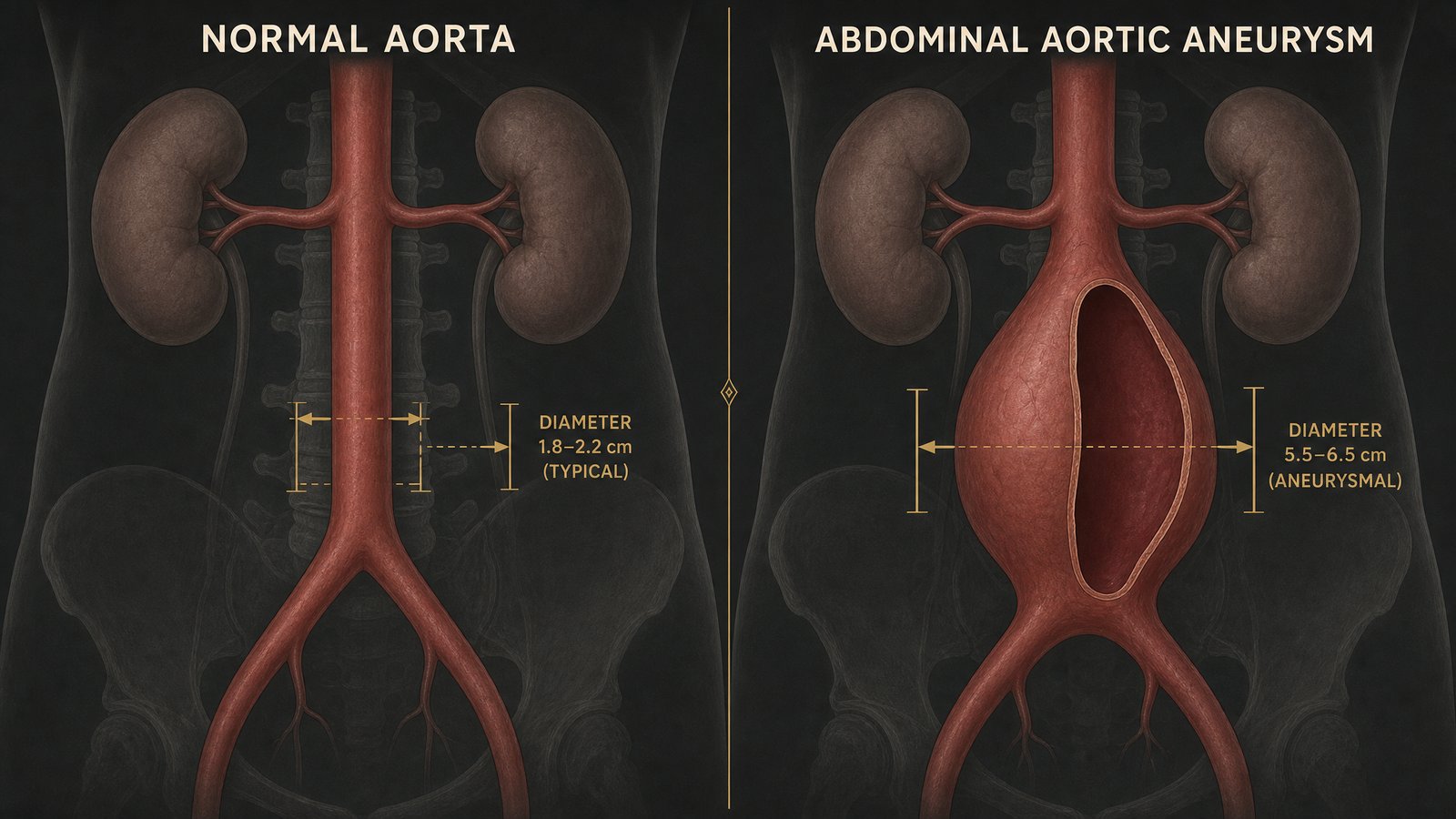
Size is what matters. A small bulge at 3 centimeters behaves nothing like one at 5.5 centimeters. The wall thins as it stretches, and thinner walls tear. That is the whole risk equation, and it is why doctors talk about diameter constantly and about symptoms almost not at all.
Most of these grow slowly. Some grow for a decade and never cause a problem. A few grow fast. You cannot feel the difference from the inside, which brings us to the part that catches people.
Why abdominal aortic aneurysm symptoms are usually silent
Here is the thing that surprises almost everybody: the majority of abdominal aortic aneurysms are found by accident.
Someone gets a CT scan for kidney stones. Someone gets an ultrasound for gallbladder pain. The radiologist notes the aorta looks wide, and a condition that had been sitting there for years finally gets a name. According to the CDC, aortic aneurysms often produce no symptoms whatsoever until something goes badly wrong.

The bulge does not press on a nerve. It does not restrict anything. There is no early ache that tells you to get checked. Feeling completely normal is the standard experience of having one.
That is why we lead with screening later in this post instead of a symptom checklist. A symptom checklist is the wrong tool for a condition that mostly does not produce symptoms. Waiting to feel something is the mistake.
Abdominal aortic aneurysm symptoms that mean it is growing
That said, some aneurysms do announce themselves, usually the larger ones. If you have any of these, get seen. Not next month.
A pulsing sensation near your navel. Some people describe feeling their own heartbeat in their stomach when they lie flat. Thin people can sometimes feel a rhythmic lump above the belt line. This one is worth taking seriously even though a normal aorta is faintly palpable in slim adults.
Deep, constant belly pain. Not the cramping of a stomach bug. A dull, gnawing ache that sits in one place and does not change with food or bowel movements. It can last hours or days.
Back, flank, or side pain that does not behave like a muscle strain. This is the one most often missed. It gets treated as a pulled muscle or a disc problem for weeks. The tell is that it did not start with an activity and does not ease with rest or position changes.
A cold, blue, or painful foot or toe. An aneurysm can throw a small clot downstream that lodges in a leg or foot artery. If one foot suddenly feels cold, looks dusky, or hurts out of nowhere, that is a circulation emergency in its own right. The pattern overlaps with blood clot in leg symptoms, and both need same-day care.
New or worsening pain in someone already known to have an aneurysm is treated as an emergency by default. Pain often means the wall is stretching or starting to leak.
Ruptured aortic aneurysm symptoms and the first hour
A rupture is a different event entirely. It is not a worse version of the ache. It arrives, and it is unmistakable to the person having it.
What it looks like:
- Sudden, severe, tearing or ripping pain in the abdomen, lower back, or flank
- Pain that reaches maximum intensity within seconds, not minutes
- Pale, clammy, gray-looking skin
- Racing pulse, then a blood pressure that falls off a cliff
- Lightheadedness, fainting, or collapse
- Nausea and vomiting
- Loss of consciousness
Vascular surgeons teach a classic triad for this: low blood pressure, back or flank pain, and a pulsating mass in the abdomen. The catch is that only about a quarter to half of people who rupture show all three. That gap is why roughly 30% of ruptures get misdiagnosed on first contact, often as kidney stones or back pain.
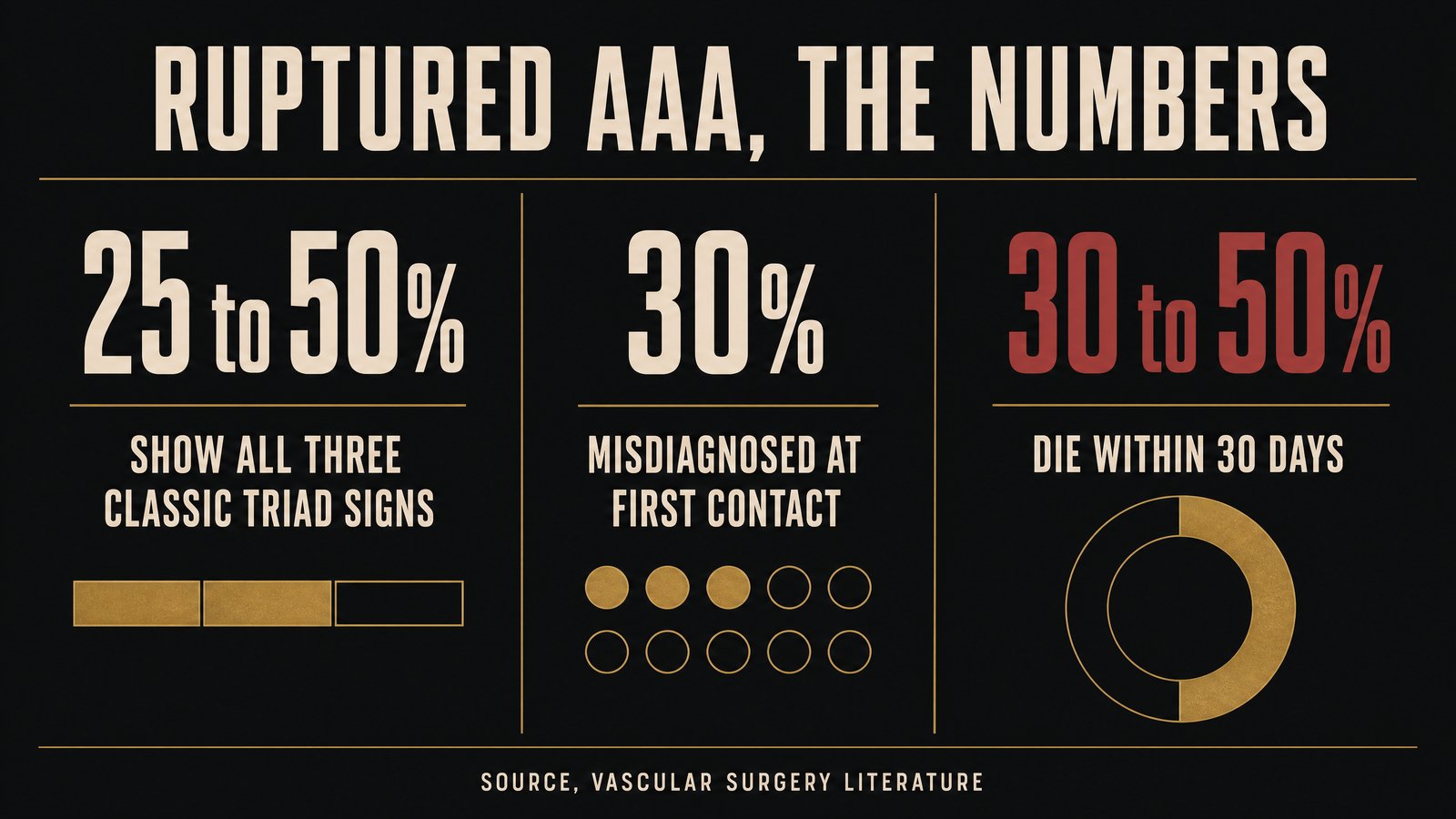
The numbers are hard. Between 30% and 50% of people who rupture die within 30 days, and about a third never make it to an emergency room at all. Repair works when the patient reaches an operating room in time, which makes this a pure time problem, the same logic behind the golden hour in trauma.
If you are with someone showing this pattern, call 911 and say the words "possible aortic aneurysm rupture" if you know they have one. That phrase changes which hospital the ambulance drives to.
Who is at risk, and who needs screening
Risk here is unusually well defined, which is good news, because it means most people can find out where they stand in about ten minutes.
The big risk factors are smoking, being male, being over 65, high blood pressure, atherosclerosis, and having a parent or sibling who had an aortic aneurysm. Smoking is the heavyweight. The CDC puts a history of smoking behind roughly 75% of all abdominal aortic aneurysms, and the risk stays elevated for years after quitting.
The U.S. Preventive Services Task Force recommends a one-time ultrasound screening for men aged 65 to 75 who have ever smoked. For men in that age range who never smoked, the guidance is that doctors should offer it selectively rather than automatically, which in practice means you may need to ask. For women, the evidence is not strong enough for a blanket recommendation, though women with a family history or a smoking history should still raise it with their doctor.
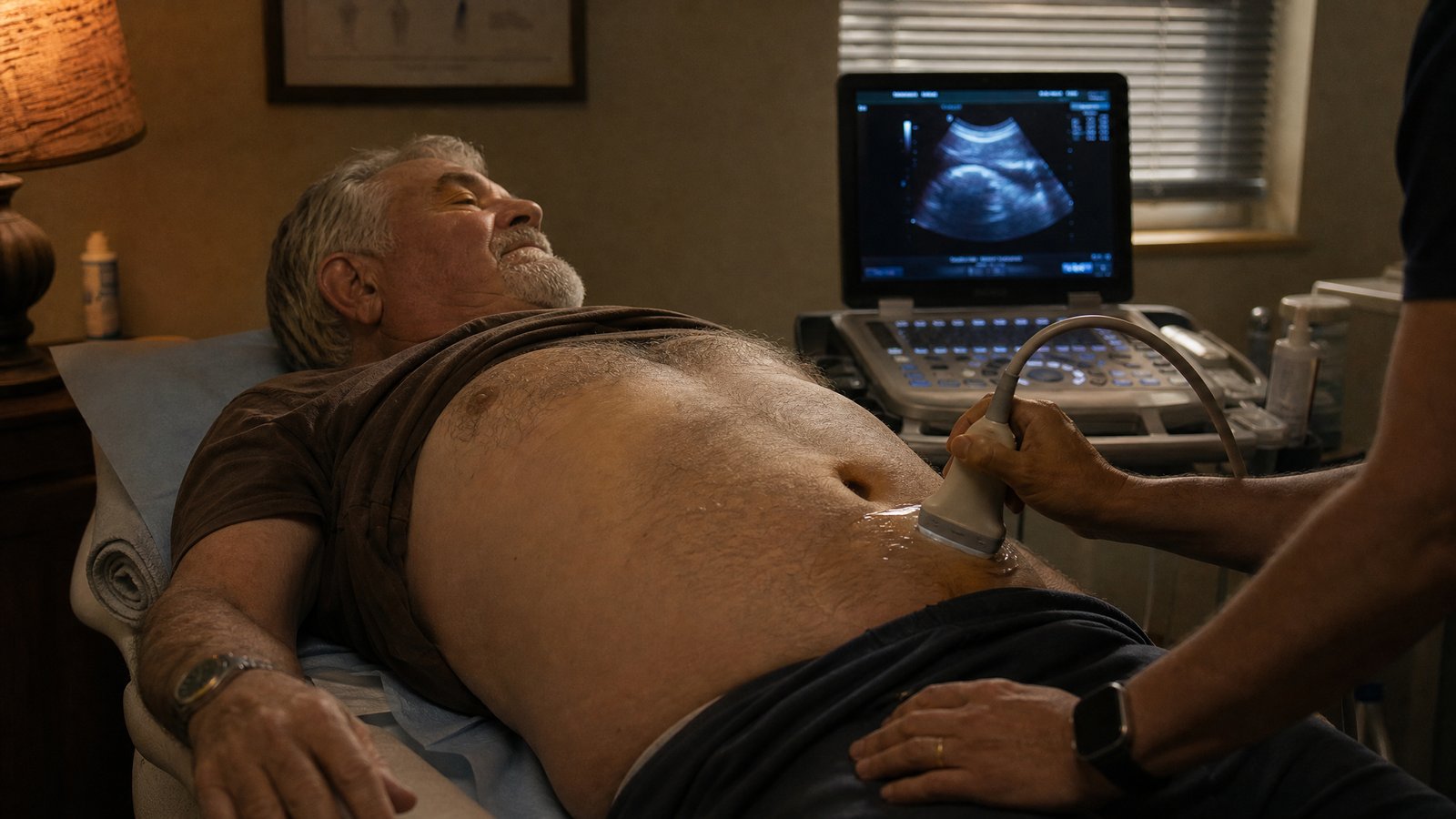
The test is an abdominal ultrasound. No needles, no radiation, no prep beyond an empty stomach. It takes about ten minutes and Medicare covers a one-time screening for eligible patients.
If you are a 68-year-old man who smoked in his twenties and has never had this scan, that is the single most useful thing in this article. Book it.
What happens if they find one
Most people who get a positive screening result do not get surgery. They get a calendar.
| Aneurysm diameter | Typical management |
|---|---|
| Under 4.0 cm | Repeat ultrasound every two to three years |
| 4.0 to 5.4 cm | Scans once or twice a year, aggressive risk-factor control |
| 5.5 cm and above | Repair usually discussed, sooner if growing fast or painful |
Thresholds run somewhat smaller in women, and any aneurysm that grows quickly or starts to hurt moves up the queue regardless of size. Mayo Clinic has a good plain-language rundown of how the decision gets made.
Meanwhile the work is unglamorous and effective. Stop smoking, because it is the strongest driver of growth. Control blood pressure. Treat cholesterol. Keep the appointments. Plenty of people carry a small aneurysm for the rest of their lives and die of something else entirely at 90.
When repair is needed, there are two routes. Endovascular repair threads a stent graft up through the groin arteries, with a shorter recovery and lifelong follow-up scans. Open repair replaces the segment directly and is more durable but harder to come back from. Which one fits depends on the aneurysm's shape and your overall health, and that is a conversation for a vascular surgeon, not a blog post.
What you can do in the moment
We will be straight with you. There is no field treatment for a ruptured aorta. This is not a bleeding wound you can pack or a stopped heart you can compress. The bleeding is internal and the fix is a surgeon.
What still matters in those minutes:
Call 911 first, before anything else. Lay the person flat and keep them still and warm, since movement and cold both worsen shock. Do not give food, water, or aspirin. Gather their medication list and any imaging reports if they are within arm's reach, because "known 4.8 cm AAA on surveillance" is the most useful sentence you can hand a paramedic. Stay with them and keep talking to them.
If they lose consciousness and stop breathing normally, start CPR and keep going until help arrives. Survival is poor in that scenario, but it is not zero, and doing nothing guarantees the outcome.
The honest takeaway is that this is one of the few emergencies where nearly all of the winnable ground is upstream of the event. Understanding what bleeding out actually means makes the case plainly: once the aorta opens, minutes decide it. A scan years earlier decides more.
We build kits for the emergencies you can act on, the bleeding you can stop, the wounds you can pack, the first hour you can actually influence. An aortic rupture is not one of those, and we are not going to pretend otherwise. But the same instinct that makes you keep a trauma kit in the truck is the one that should get you to book the ultrasound. If you want the part you can control in your hands, take a look at The 1stHour Trauma Kit.
This content is for informational purposes only and does not constitute medical advice. If you think you or someone near you is having an aortic emergency, call 911 or your local emergency number. Do not use this article to diagnose or rule out an aneurysm, and do not start, stop, or change any medication based on it.


